


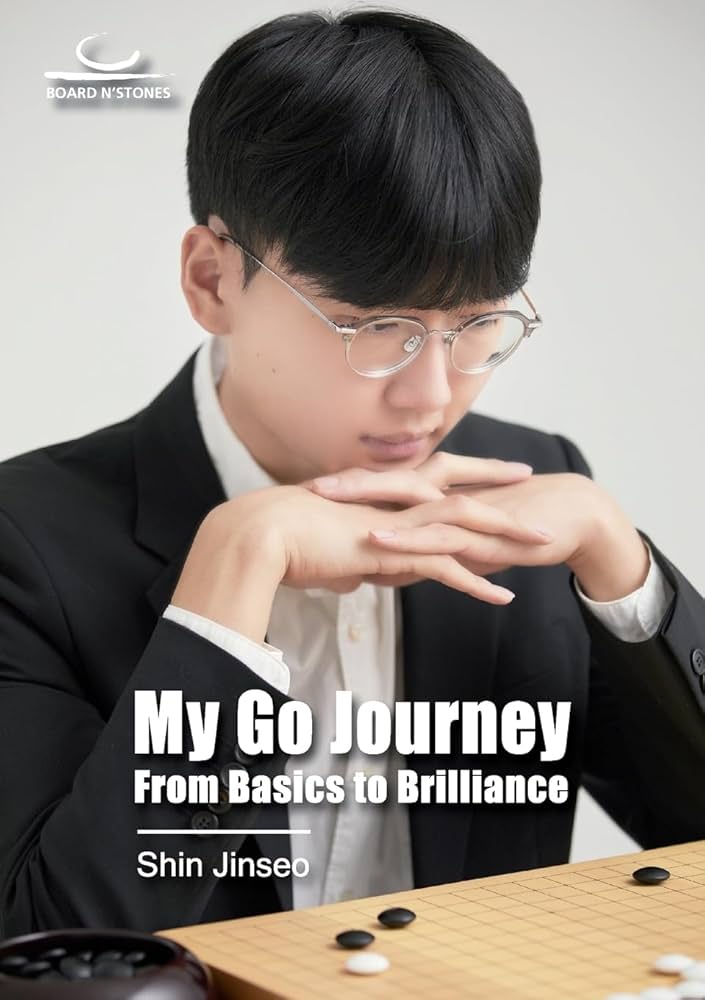
Learning from Pro autobiographies #4: My Go Journey: From Basics to Brilliance by Shin Jinseo

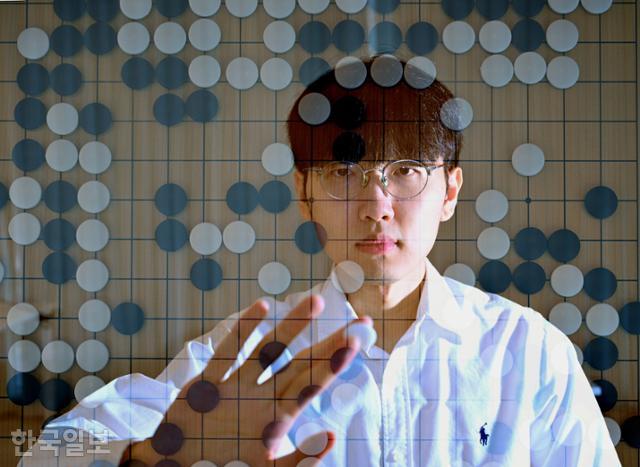
“Today’s myosu (brilliant move) is not the same as a blue spot (AI top recommendation). A blue spot is considered a proper or correct move that should be played. A move that goes beyond that, a true myosu, must surpass even the Al’s calculations […] True Al study is about imagining and calculating moves that go beyond those recommendations, constantly evolving your own ideas. It’s about aiming for an answer beyond the answer.”
Introduction
Artificial Intelligence has reshaped the very ground of Go, setting a new, superhuman standard. For the modern player, this presents a profound question: how does one pursue mastery when an infallible digital oracle exists? The answer lies in a uniquely human obsession. Shin Jinseo’s journey—from the child who cried after winning because he had lost too many stones, to the teenager who could not sleep after an online demotion, driven to play through the night to win 14 consecutive games and reclaim his rank—reveals an uncompromising will that predates AI. This relentless drive, not raw talent alone, is the engine behind the world’s top-ranked player. His autobiography charts a path of disciplined coexistence with the machine, showing him to be a new kind of master: one who uses the AI not as a crutch, but as a crucible for his own human ingenuity.
From an unorthodox childhood forged by a demanding father and the chaotic world of online Go to his historic reign as the “Final Boss” of international competition, Shin’s story is a testament to the enduring power of human will, patience, and creativity in the age of the algorithm. This article explores the making of a genius who learned to dance with the digital god of Go, not as its servant, but as its most dedicated apprentice.
The Unorthodox Forge
Every great artist has an origin story, a tale of the forces that shaped them. For Shin Jinseo, the world’s strongest Go player, that story is not one of serene study in a hallowed academy. It is a tale of two unlikely and unforgiving teachers: a relentlessly demanding father and the chaotic, anonymous battlefields of the internet.
While other child prodigies were sent to Seoul’s prestigious dojangs, Shin’s primary academy was the one run by his father in Busan. Here, the curriculum was not about gradual improvement; it was a trial by fire. His father was a “problem master,” assigning life-and-death puzzles far beyond a child’s grasp. The goal wasn’t necessarily to solve them, but to engage in a teeth-gritting, all-out struggle. A lazy attitude was met with sharp rebukes. The strictness was so intense that his own grandmother, upon witnessing it, declared she would never return. The lesson his father tirelessly tried to impart was a paradoxical mantra for a competitor: “Don’t be obsessed with winning and losing.” For a young boy with a burning desire to win, this was a language he could not yet understand.
Concurrently, another teacher was shaping him: the digital realm. While his father provided the discipline, the internet provided the arena. Shin Jinseo was, by his own admission, “raised by the internet.” He lived on Go servers like Tygem, devouring thousands of 10- and 30-second games. This was where he developed his “ultra-fast Go,” a style driven by a deep “dopamine craving” for victory. It was chaotic, instinctive, and brutally effective in its domain. He was dancing on the edge of a cliff, a dazzling and reckless style where one misstep meant a plunge into the abyss. This forged a player of immense raw power, but one whose foundation was unstable.
The collision between this unrefined talent and the structured world of elite professionals was inevitable and painful. His raw, online-honed aggression met its match in two seemingly unbreakable walls. The first was his countryman, Park Junghwan, the embodiment of “flawless Go.” Where Shin was impulsive, Park was calm and persistent, mercilessly punishing every overstep. Shin lost to him ten consecutive times, a very public testament to his limitations. The second wall was China’s Ke Jie, a player whose intuitive speed mirrored Shin’s own, but was tempered by greater discipline.
The true “agony of the click” was not a hardware malfunction, but a failure of mental software. The impatience bred in countless online games bled into his most critical professional moments. The starkest example was the 2016 LG Cup semifinal. After oversleeping and rushing to the board, he lost his composure in a winning position. With over an hour on the clock, he made a catastrophic blunder born entirely of emotional impatience. It was in this searing failure that his father’s mantra finally began to make sense. He understood that to be a champion, he needed the detached clarity of a spectator who “sees eight moves further”, a perspective his frantic online style had never allowed.
His evolution from prodigy to champion was a conscious act of self-forging. The turning point was his victory over Park Junghwan in the 2020 LG Cup final. It was a win he admits involved luck, but its psychological impact was profound. By breaking that ten-game losing streak, he shattered a mental barrier. The confidence from that victory cascaded, allowing him to finally overcome Ke Jie and begin his own era of dominance.
This refined strength was then tested in the world’s most brutal competitive crucible: the Chinese Go league. He entered a “jungle-like” ecosystem where dozens of players possessed world-champion-level skill. To compete here was to understand that his will had to be matched by unwavering endurance. His success in this arena—the toughest in the world—was the final proof that the transformation was complete. The boy forged in the unique fire of a Busan academy and online servers had become a global champion, his unorthodox education not a hindrance, but the very source of his unparalleled will.
The Final Boss
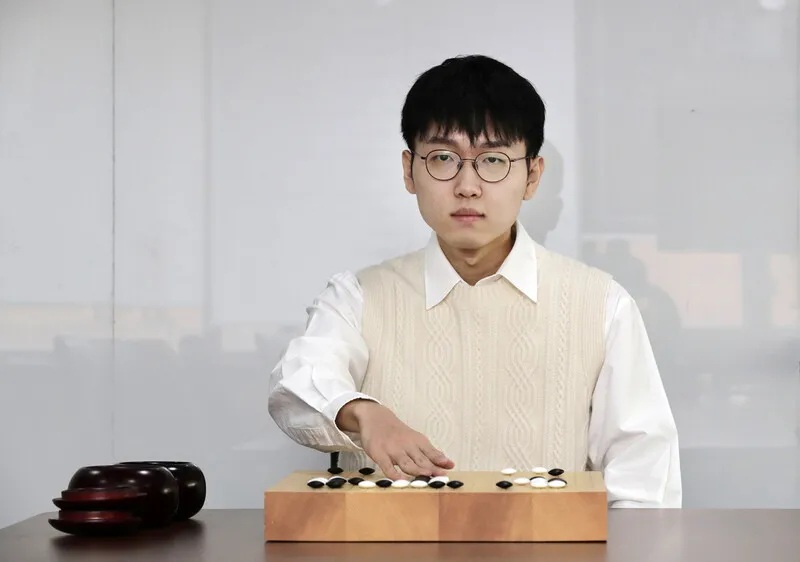
While Go was his main online arena, Shin Jinseo was no stranger to the world of computer games, even to the point of worrying about his involvement in StarCraft. This frame of reference led him to a powerful insight — “The difference between games and reality is clear. In games, the final boss is ultimately destined to hand over the crown to the hero. In real life, however, it is the final boss who takes the crown.” He would sometimes muse about the solitary figure on the final stage, wondering, “what that boss was thinking…” as the protagonist drew nearer. Shin was destined to stop wondering and learn the answer firsthand.
The “Final Boss” is a title of immense pressure, not glory. In 2005, at the 6th Nongshim Cup, Korea’s Lee Changho defined the role. With his team nearly eliminated, he staged his “Miracle of Shanghai,” winning five consecutive games to single-handedly seize the championship. He was the immovable object, the player who took the crown, not the one destined to surrender it.
Nearly two decades later, Shin Jinseo faced an identical trial at the 25th Nongshim Cup. The scenario was a mirror: four Korean players had fallen, leaving him alone against five of the world’s best from Japan and China. The mandate was absolute: win every game or lose the title. Shin did not just replicate Lee’s miracle; he surpassed it. In doing so, he broke two records: completing the tournament with an undefeated 6–0 run (a first for a final runner in the Nongshim-Cup), and in doing so extended his overall consecutive Nongshim-Cup win streak (across editions) to 16–0 — surpassing Lee Chang-ho’s previous record of 14 consecutive wins (2000–2005).
This record-breaking feat invites comparison to the legend, but Shin dismisses it with clear-eyed humility. “To truly reach a level where such comparisons are valid,” he states, “I would need to continue for at least another ten years.” For Shin, Lee’s legacy is not just in titles, but in a fundamental revolution of the game itself. Lee Changho shifted the paradigm of modern Go from middle-game combat to a relentless, endgame-focused calculus, making the constant re-evaluation of each move’s value a core professional skill.
Shin once sought the master’s wisdom, hoping for a secret to managing the exhausting grind of competition. He asked how he approached minor games differently from major finals. Lee’s answer was a lesson in essence: “I prepare for all games the same way.” In that simple statement, Shin understood the chasm between high-level skill and legendary discipline – a level of respect for the game that admitted no tiers of importance.
The paradigm has shifted once again, and the new frontier is not human, but algorithmic. The “God of Go” Shin now chases is no longer just the ghost of Lee Changho, but the perfect, unreachable realm of artificial intelligence. His goal, as he puts it, is not to become that god, but to “get close enough to give them a high five.” This is the relentless pursuit that defines him. Even at the pinnacle of human achievement, he sees his own Go as “lacking.” He is simultaneously the king on the hill and the most dedicated student in the classroom, shouldering the weight of a nation’s expectations while staring at a horizon of perfection that forever recedes. His story is a powerful reminder that true greatness is not a destination where one rests, but a continuous, demanding path of becoming. And for Shin Jinseo, the next step on that path is always the next game.
Studying in the Hall of the AI God
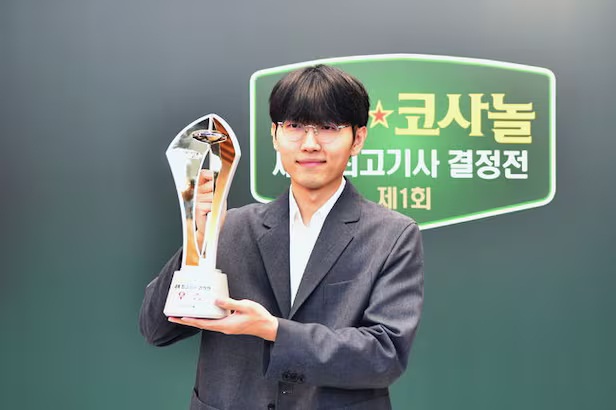
There is the Go that humans have played for centuries, and there is the Go that AI presents. The Go of this new era lies somewhere at the intersection of the two. Shin is the defining player of the AI age, a man so perfectly aligned with its logic that he earned the nickname Shin-gong-jineung—a pun on the term for artificial intelligence, meaning “Shin-made Intelligence.”
To the outside world, this suggests a player who has simply become a vessel for the algorithm. But Shin’s relationship with his silent overlord is far more nuanced. “AI is a friend, a teacher, and a rival to surpass,” he reflects. It is the god whose domain he acknowledges—the gap between the best human and the best AI is a chasm of two to three stones—but a god he refuses to worship blindly. His study is not one of passive submission. “If you only follow the recommended moves, the blue spots that AI points out, your study will become limited,” he warns. For him, true mastery in this new era is not about mimicry, but about dialogue. It is “about imagining and calculating moves that go beyond those recommendations, constantly evolving your own ideas. It’s about aiming for an answer beyond the answer.”
This philosophical approach has fundamentally altered the fabric of the game. The classic records of legends like Lee Sedol and Park Junghwan, once the holy texts for aspiring players, now serve a different purpose. “What was once considered a top-level game often no longer meets today’s standards,” Shin admits, acknowledging that even his own games will likely be mere historical footnotes for the next generation—artifacts from the early, awkward years of human-AI coexistence.
In this refined landscape, old concepts are being redefined. The brilliant move—the myosu—was once a flash of human genius that could decide a title. Today, Shin argues, myosu is not dead. But its definition has been elevated to an almost impossible standard. “A blue spot is considered a proper or correct move that should be played. A move that goes beyond that—a true myosu—must surpass even the AI’s calculations.” The bar for brilliance has been raised to a celestial height.
This has led to a perception that individuality is dying, that all top players are converging into a uniform, AI-optimized style. Shin sees it differently. Playing styles have not vanished; they have become subtler, more sophisticated. The game has been distilled. The reckless, all-out attacking style of the past is now a historical relic, but the unique imprint of a player’s mind—their temperament, their threshold for risk—still remains, etched into the choices they make between multiple AI-approved paths.
Ultimately, for all its power, AI has not stripped Go of its human soul. It remains a contest of nerves, will, and imperfect judgment. “AI’s predicted win rates are just that: probabilities, not certainties,” Shin notes, speaking from experience. He has both suffered and engineered stunning reversals from a mere 5% chance of victory. The machine can map the terrain, but it cannot walk the path for you.
And so, Shin Jinseo spends his days in the hall of the AI god, not as an acolyte reciting scripture, but as its most promising apprentice. He uses it to collapse hours of analysis into minutes, yet he rarely plays full games against it, knowing its rhythm is alien to human conflict. His goal is not to become the god itself, but to learn its language, challenge its assumptions, and perhaps one day, in a moment of pure, human ingenuity, find a move that makes the machine pause—a true myosu for the modern age.
Game: Legendary bulky five at the 19th Hangzhou Asian Games, Men’s Team
In the individual event of this tournament, Shin, expecting to meet Ke Jie in the final, let anticipation outrun discipline and went into his semifinal mentally misaligned. Against Xu Haohong, impatience crept in: a rushed midgame move, unfocused endgame choices, and finally a half-point defeat. The medal was bronze, but the regret came from realizing he had approached the tournament with overconfidence rather than presence. He disregarded one of the Ten Golden Rules — “Do not be greedy for victory”.
Shin already confessed to us the lonesomeness of standing at the very top, but also how loneliness creeps in after an important loss. Although the disappointment from the individual event would continue to linger with him, it also motivated him to strive and achieve a rare heartwarming experience. “In Go, it is rare to experience success through teamwork”, but he and his teammates on the Korean national team proudly went on to win the gold medal in the team event. Nevertheless, this triumph required Shin to confront the player who had occupied his thoughts from the start: his arch-rival, Ke Jie.
This game is the Preliminary Round 4, played on September 30, 2023. Shin Jinseo 9p (representing Korea) is Black, while Ke Jie 9p (representing China) is White.
Black was ahead, but Ke Jie launched a do-or-die invasion, turning the life-and-death fate of his White dragon into the game deciding factor. In answer to the atari at 126, Black’s connection at 127 became known as the “legendary bulky five” — an mysterious yet brilliant choice.
Shin recalls that, at the time, even AI didn’t foresee that move. The moment Black connected at 127, the AI graph swung entirely in Black’s favor.
So, Shin increased the sacrifice of stones to form the bulky-five shape. White was able to capture those five stones, but Black would trade forcing moves and still have time to throw-in at the vital point of the bulky-five shape, thus killing the entire White dragon.
As soon as his dragon was captured, Ke Jie resigned.
Conclusion
Shin Jinseo’s journey, from the digital battlefields of online servers to the summit of global Go, offers a masterclass in modern excellence. It is a narrative that dismantles the myth of effortless genius, revealing instead a portrait of relentless self-refinement. He was shaped by fire—the stern discipline of his father and the impulsive energy of internet play—and then spent years tempering that raw material into the unyielding steel of a champion. His victories are not just triumphs of skill, but of a will that learned to conquer impatience, to endure repeated consecutive losses, and to shoulder the immense pressure of being a nation’s last hope.
Shin Jinseo’s story powerfully demonstrates that true greatness lies not in reaching a final destination, but in the continuous, demanding, and profoundly human path of becoming. For him, the purpose is found in the pursuit itself, and the most important game is always the next one.

Оставить комментарий