


Infinity on the Tip of Your Finger. Introduction: The Brain’s Last Stand

“Everything changes, even stone.”
—Claude Monet
The Leader of the Humans
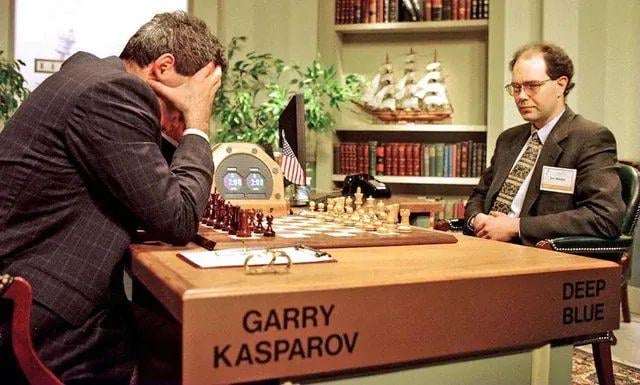
When Garry Kasparov lost to Deep Blue, a chess machine invented by IBM, not only was the greatest chess grandmaster of his time thrown into despair, but the whole of Western world was in shock and dismay. It was two years before The Matrix, but 13 years after The Terminator. While Kasparov was no John Connor, not by any stretch of the imagination, he was still, as David Shenk put it, “the leader of the humans,” and enough movies had been out to remind people what losing to a machine in the game of intelligence means for the human race.[1] It’s all gloom and doom from now on—the beginning of theend. Steven Levy from Newsweek would later report, in an almost choking tone, no less of an apocalyptic prospect than this:
We are sharing our world with another species, one that gets smarter and more independent every year. Though some people scoff at the idea that machines could become autonomous, remember it wasn’t long ago that almost no one thought a computer would ever beat a human chess champion. Could we ever face anything akin to the horrendous sci-fi nightmares that we see in “Terminator 3”?[2]
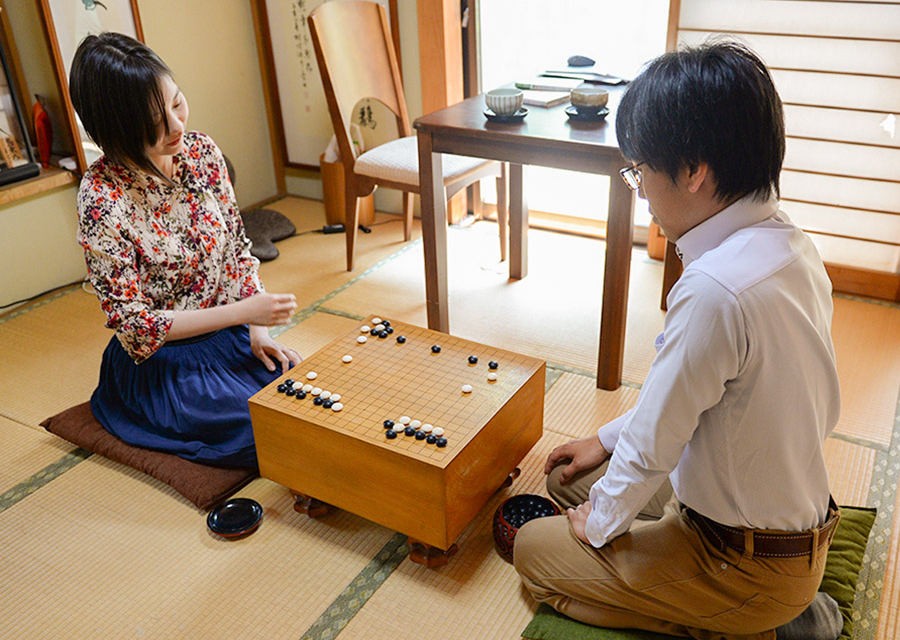
Meanwhile, in the Eastern world, the Go players were all chill, sipping their cup of tea and yawning as they were watching their “leader” get crushed on the other side of the world. No one paid attention to him, any more than they did to their wives complaining about recycling. For one thing, they were occupied with playing the world’s most sophisticated board game ever in human history.
—Yes, I know. For those of you who love chess, this is a controversial statement to say the least. I am more than aware that in the Western world, especially in the United States, chess stands as the universal symbol of intellect and genius. For decades, the chessboard had served as a proxy battlefield for the Cold War, elevating grandmasters to the status of geopolitical warriors and cementing the game’s dramatic cultural weight. Countless movies and tv shows like The Queen’s Gambit portray characters at the chessboard, competing to prove who is the smartest in the room. My personal favorite? Sherlock Holmes and Professor Moriarty in Sherlock Holmes: Game of Shadows. Towards the end of the movie, just at the brink of a world war, they play a game of chess on the balcony of a castle beside Reichenbach Falls. Inside the ballroom are world’s most powerful monarchs, gathered to decide the fate of the European continent. Little do they know their own fate rests on the tip of the fingers of these two geniuses, for they are not just playing to win the game of chess, but the game of life and death for everyone. Chess, then, is the microcosm of the fight between the two, the battleground that expands far beyond the confines of 64 squares.
And in that sense, I respect the game. It’s marvelous to see how an 8×8 board with 32 pieces generates so many possibilities, that it is virtually inexhaustible. Many astounding intellects throughout history were themselves astounded by its complexity. Marcel Duchamp, one of the most influential artists in modern art, proclaimed, “while all artists are not chess players, all chess players are artists.” Taking a step further, Peter Weiss declared, “nature supplies the game of chess with its implements; science with its system; art with its aesthetic arrangement of its problems; and God endows it with its blessed power of making people happy.” Though its euphoriant potency might be a little controversial, the game is indeed enormous, with all the possible move variations estimated to be more than the number of atoms in the observable universe.
Yet, if I am being truly honest, I am not all that impressed. And no offense to the Westerners, but I don’t want to sugar-coat the general sentiment of the East at the time, because “not impressed” is what the Go players thought as they watched Deep Blue win game after game. In fact, to a Go player, machines beating humans in the game of chess was a natural course of history, something that was expected to happen. Chess, in the eyes of the Go players, was a warm-up (again, no offense to chess aficionados), and to dub Kasparov’s fight against a chess machine “The Brain’s Last Stand” as Newsweek’s cover did? Is that the last stand or the last stand-up?
For one thing, the machine simply crunched through millions of possible moves per second using brute force and a few clever shortcuts, and Kasparov lost to this rather rudimentary technology.[3] I will dive into more details later, but no machine can win against a Go master with brute force approach, not ever. They can’t even beat me, an intermediate player, if that’s the approach they are going to take. But already in the 1970s, even before the birth of the Internet, the machines were catching up with chess grandmasters. I wasn’t even born then, and I remember technology was just at the brink of exponential advancement when I was around 9, 10 years old. I mean, the smartphones came around when I was entering my 20s, so you get what I mean.
Fast forward four decades, and even on the morning when Lee Sedol, one of the greatest masters of Go in history, was playing his first game against AlphaGo in 2016, no one, not a single Go player, thought Lee would lose. No machine was able to beat a pro-level Go player until then, let alone the best of the best. This is the most sophisticated board game ever created by human intellect, and it takes more than simple calculation. It requires something far beyond logical reasoning, like intuition and creativity—the exclusive privileges of being human.
Or so we thought.
So I invite you guys to contemplate just how unimpressive it would have been for the Go players to see Kasparov whining about the match being rigged and all.[4] “But,” you ask, “why were the Go players unimpressed? What’s so special about Go?”
Infinity—and Beyond
In any game of perfect information, where all moves that have occurred on the board are fully disclosed for the players, there are essentially two ways to estimate the number of moves. The first is to calculate literally every move that can occur within the game. Thus, in chess, if we simply calculate the number of moves with White and Black playing consecutively, then the number is estimated around 10120. This, however, includes all the illegal moves, and if you only count the “legal” moves—that is, moves that do not go against the rules of the game—the number is drastically reduced to somewhere around 4.8×1044. That’s still a large number, considering that the estimated number of atoms in the observable universe is around 1080.
What about Go? Unlike chess, which is a game played by removing the given pieces, Go is a game of filling in the board, the objective of which is to win more territories—intersections—than the opponent. It starts with an empty space of 19×19 matrix, which means there are 361 intersections on which the stones can be placed.[5]
Figure 2: Go board
In Go, just like chess, two players, Black and White, play consecutively. However, unlike in chess, Black goes first in Go, and the rules are much simpler. In chess, the value of each piece is already set from the start, with king being the absolute priority all the way through. The values of other pieces may be relative to some degree, depending on how a game develops, but no matter what game you play, a knight can never make a move like a queen, nor a bishop can move in straight lines, and this inherent difference of values between pieces largely influences the way a game can—and should—be played. Not to mention you only get 16 pieces to begin with, and the more moves you make, the less pieces are going to be on the board, which, personally, is a bit depressing. Then there’s rules like castling, pawn promotion, stalemate, threefold position, and so on (and what’s up with en passant?).
In Go, however, as far as the pieces are concerned, there is no inherent hierarchy of value built into them before they are played. They are all the same. One stone is one stone no matter what, and it all depends on you to give it worth. While stones on the board will inevitably gain or lose relative value depending on the flow of the game, that algorithm of value is entirely created by your choices. Whether it be a king of a move or a pawn of a move depends solely on you. There is no king to protect, no bishop to sidestep. There are only stones that unequivocally reflect your value judgment, from one moment to another. You are your own king, queen, bishop, and pawn fighting your own battle, from the beginning to the end. Thus, it is like music—each note either resonates in harmony or dissonates in conflict with previous notes and the notes that follow.
In addition, while pieces are consistently moving around in chess, the stones that have been placed stay placed on the same spot in Go. The only time the stones are removed during the game is when they are considered “captured,” which is being surrounded by the opponent’s stones. So if we simply calculate the number of all the ways to place stones on a Go board without repetition, then the number is 361!, which is roughly 10768.[6] Of course, when you only count the legal moves, the number has to reduce drastically, and the total sensible moves in Go is roughly around 2.082×10170. Remember how chess, including all the illegal moves, was still much smaller than this number? Well, the number of legit moves in Go is around that, which is about 2.082×1090 times more than the estimated number of atoms in the entire observable universe. That is practically infinity, and it’s not an exaggeration. Even if the entire human race, all 8 billion of us, were to play 100 games of Go every single day for the next 100 years, the total number of games played would be around 2.92×10¹⁶, and it usually takes about an hour to play one “decent” game.[7] No supercomputer, no matter how fast or how many, could ever exhaust all the possibilities in Go.
It is, in that sense, limitless and boundless. It is the matrix in its purest form, allowing for the greatest amount of freedom with the least number of rules. As far as boardgames are concerned, it is truly the pinnacle of human creativity, simplicity in perfect union with complexity. It is, as Go players would say, universe on a wooden plate, infinity on the tip of your finger.
THAT, my friends, is why the Go players were like “Garry who?” That, my friends, is also why the Go players were all chillaxing even as we watched Lee play against AlphaGo, the first deep learning machine ever to challenge a professional Go player.
Then came game 1.
And it was the beginning of the end.
The brain’s last stand, indeed.
[1] David Shenk, The Immortal Game: A History of Chess (New York, NY: Anchor, 2006), 220.
[2] Steve Levy, “Machine vs. Man: Checkmate,” Newsweek, March 14, 2010, accessed January 11, 2023, https://www.newsweek.com/machine-vs-man-checkmate-139325.
[3] Brute force, simply put, is calculating the total moves one by one, until all possibilities on the board are exhausted. While this is the surest way to explore every existing move in the game, it is practically impossible to do so even with supercomputers that calculate millions of moves per second. All the sensible moves—that is, moves that pro-players could and would make—in chess amount to approximately half the number of atoms in the entire observable universe, roughly speaking.
For clarity, while Deep Blue leverages a significant amount of brute force, it isn’t solely reliant on this approach. It also uses heuristic evaluation and pruning, which is essentially a set of rules-of-thumb that allows Deep Blue to assess highest value moves in any given moment. However, Deep Blue’s heuristic evaluations of moves are still based on a substantial degree of brute force searching, which is why it is still considered as a brute force system, in contrast to machines like AlphaGo, the first machine to officially beat a pro-level Go player.
[4] Shenk, The Immortal Game, 200.
“That loss was a humiliation for Kasparov, who later charged that the rules (which he had agreed to) were unfair, and that Deep Blue’s chess-expert operators cheated by giving their machine some human help during the match.”
[5] Unlike chess, you don’t place stones in the blank spaces between the lines. You place them on the intersections between the lines, including the very outer lines.
[6] In case you don’t know what that exclamation mark behind 361 is (called factorial), it means you multiply all the numbers beginning from 1, all the way up to 361. So, 361! means 1×2×3×4×5× … ×361. Of course, this doesn’t quite accurately represent the actual possibilities of the moves, because in an actual game, stones are bound to be captured and not all intersections are filled with stones.
[7] By decent I mean you aren’t playing a blitz game, which, frankly, is a competition of mere reflexes.


Оставить комментарий