
🎥 Alex Qi 1p Interview: Became Pro in 6 Years Thanks to…

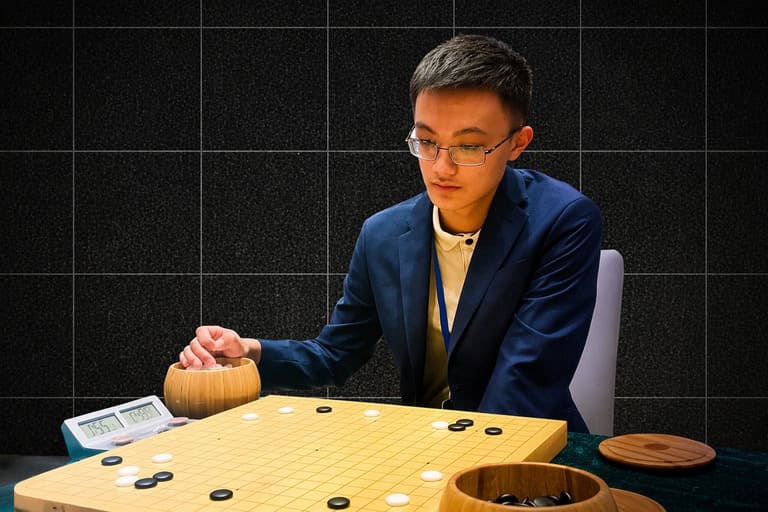

How does a young player become a professional in just six years?
In this interview, Alex Qi 1p talks about the path that took him from a child reluctantly attending his first Go class to becoming a professional player while still in high school. It is a conversation about talent, yes—but even more about structure, discipline, teachers, and the kind of steady work that turns potential into real strength.
What makes this interview especially interesting is that it is not framed as a miracle story. Alex does not describe a secret shortcut or a magical training method. Instead, he talks about fundamentals: strong teachers, lots of life-and-death practice, regular play, reviewing games, and learning how to study seriously. He also shares a practical detail that many ambitious players overlook—how to solve problems properly, and why doing them on paper can be better than solving them interactively online.
The interview also broadens into a bigger discussion about American Go. Alex reflects on the current tournament scene in the United States, the role of the U.S. Go Congress, the next generation of strong young players, and the gap that still separates North American professionals from the top players in China and Korea. His comments are realistic, but not pessimistic. They show both how much progress has been made and how much infrastructure is still missing.
For young players, parents, teachers, and anyone curious about what serious Go training looks like outside Asia, this is a very worthwhile interview. It is grounded, practical, and full of small insights that reveal how strong players are really built.
What You’ll Learn
- How Alex Qi 1p started playing Go and became a pro in six years
- Which teachers and study habits shaped his growth
- Why life-and-death training mattered so much to his progress
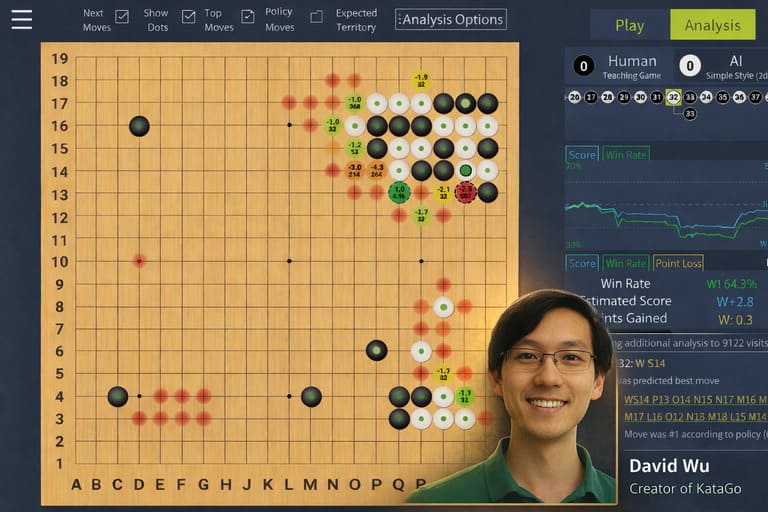
- How he uses AI and online problem resources
- What he thinks about the state of Go in the United States
- Which young American players are worth watching
- Why North American pros still face a big gap against Asia’s top players
- His personal superstition before important tournaments
Vadim: Thank you for being here. For people who may not know you yet, could you introduce yourself?
Alex: My name is Alexander Qi. I am a 1-dan professional player with the North American Go Federation. I earned my professional qualification in 2022.
Vadim: The Go Congress is coming up, and I saw on the website that all three generations of the Qi family are going to be there. That sounds both impressive and a little intimidating. So let me start with this: when you were a kid, did you really have a choice about whether you were going to play Go?
Alex: It’s funny, because I first learned Go from my dad while we were in China. But after we came back, I had a break of a few months. Then one day my dad told me there was a Go class in New Jersey taught by a professional player, and he said I should go. At first, I really didn’t want to. My parents basically forced me to attend that first session. But after that class, I genuinely fell in love with the game. I became excited to go every time, and that was how it all started.
Vadim: How old were you then?
Alex: I was eight years old.
Vadim: And how long did it take you to become a professional?
Alex: Six years.
Vadim: That sounds almost too simple when you put it like that. At what point did you decide that becoming a pro was actually your goal?
Alex: During online classes in seventh and eighth grade, I would often have my iPad next to my computer and scroll through professional Go games instead of paying attention. At that time there were not many tournaments, so I did not really know how strong I was. But then I played in the Gotham Go tournament and realized I was around 6 or 7 dan strength, much stronger than I had thought. That was when I decided I wanted to play in the professional qualification tournament that August.
Vadim: And you became pro right away, in 2022?
Alex: Yes.
Vadim: So how did your training actually work during those years?
Alex: I improved a lot during middle school. American middle school is not especially demanding, so I had time. In high school, though, I became involved in many other activities, especially music. I play the clarinet, and that took a lot of time. But I still usually spent about an hour every day either doing life-and-death problems or playing a game. If there was a tournament nearby, I would try to go. During breaks, I would sit down with a board and either play against AI or play online.
Vadim: How would you describe the current Go scene in the United States?
Alex: Right now, I think it is quite active. We probably have more than fifty tournaments per year. The U.S. Go Congress usually brings together around 550 to 600 players. We also have active professionals, and I think the overall culture is in a good place to keep growing Go in America.
Vadim: Who are some younger American players people should watch?
Alex: There are several. Some very young players are already close to pro-qualification level. A few ten-year-olds are expected to play in the professional qualification tournament, and there are also kids around twelve or thirteen who are already around 6 dan. Those are definitely players to keep an eye on.
Vadim: What makes the U.S. Go Congress special?
Alex: The U.S. Go Congress is a big annual gathering where hundreds of Go players come together in one place. There are events like the U.S. Masters, where the strongest North American players compete, as well as the U.S. Open, where players of many levels participate. There are also side events like Pair Go and Crazy Go. More than anything, it is a meeting point for people who are passionate about the game.
Vadim: How did you become so strong so quickly?
Alex: First of all, I had very strong teachers, and I owe them a lot. One of my earliest teachers gave me strong fundamentals. She gave me life-and-death books, and I worked through them again and again. That built the basis of my reading.
Later I became a student of Ryan Li, and that was when my style started changing. Before that, I was extremely aggressive, like many kids are. With Ryan, I learned more balance and strategy. After that, I also worked with another teacher, a very strong Chinese amateur 7 dan, who introduced me more deeply to modern opening theory and AI-informed play.
Vadim: So what did your study look like beyond lessons?
Alex: A lot of problem solving. That was the backbone of my reading improvement. These days, for harder problems, I often use 101 Weiqi. It has a huge database, so you can always find difficult material.
Vadim: Do you solve problems directly on the website?
Alex: Only if I have to, like when I am in the car or I cannot print them. Otherwise, I prefer printing them out. The reason is that online tools often play the opponent’s moves for you automatically. That means you are not fully reading out everything yourself, and that can be bad for your reading. So yes, I print a lot of problems and solve them by hand.
Vadim: Would you say your improvement was mostly talent or mostly hard work?
Alex: Mostly hard work. I became strong because of the hours I put into playing and doing problems.
Vadim: A lot of people work hard and still do not improve that fast. Do you have one practical tip?
Alex: For life-and-death problems, do them seriously. Printing them out and working through them on paper helps a lot. It forces you to read more honestly.
Vadim: Who is your favorite professional player?
Alex: Lee Sedol. He was incredibly creative, very combative, and yet also very consistent. Many players with fighting styles lose games simply because the positions become so complicated, but he managed to keep winning through that chaos. He saw ideas that other players simply did not imagine. That always inspired me.
Vadim: How far away are North American professionals from truly competing evenly with the best players in China and Korea?
Alex: I think that is still a long way off. Many people believe AI has closed the gap, but I actually think it has made the gap larger. AI rewards massive amounts of time spent training, reviewing, and grinding through variations. In Asia, the structure and culture support that kind of work much more. In America, players usually still have to go through school, college, jobs, and everything else. We simply do not have the same environment or the same amount of available time.
Vadim: So if there is no full Asian-style system in the U.S., how should a young player start?
Alex: Find a teacher. There are many good teachers in America. A strong teacher can set you on the right path, give you problems, play teaching games, and connect you with other students of a similar level. Once you have that structure, the rest comes down to putting in the time.
Vadim: And finally, one lighter question. Before an important game, do you have any ritual or superstition?
Alex: Not really the day before. But I do have a superstition about what I wear. I once won the New York State Championship undefeated while wearing a blue suit. Since then, I often wear that same blue suit to tournaments. It has become my tournament outfit.
Vadim: Thank you very much for the interview.
Alex: Thank you.





Комментарии