


Go Books: Road to Dan Guide (3k – 1d)
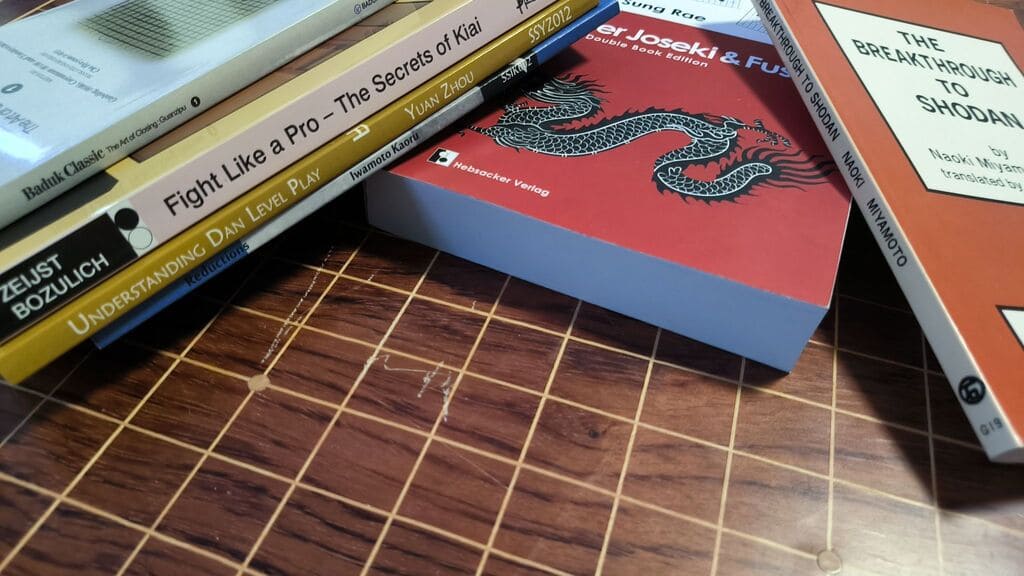
Enhance your path to dan with other recommendations
If you’re already at 3k–1d and aiming for a stable dan rank, these articles will help deepen your understanding at different stages of growth. We’ve prepared book guides for all levels — from absolute basics to advanced concepts.
- Go Books: Your Guide to Choosing the Right Read
- Go Books: Absolute Beginner Guide (30k)
- Go Books: Going Wide (20 kyu – 11 kyu)
- Go Books: Going Deep (10k-4k)
The short way to handle this article would be to simply tell the inclined reader to go back and digest all previous book recommendations in this book series, which would already lead you to Dan level. But where would be the fun in that? So let’s sit back, grab a cup of tea, and ponder what we have not done on our Go learning journey yet and where we can go from here.
We’ve covered the basics, absorbed countless proverbs to sharpen our instincts, built reliable openings, learned to identify big and urgent moves, honed life-and-death reading, and examined every phase of the game, from opening to midgame to the final delicate points of the endgame. We’ve come a long way, haven’t we? Give yourself a pat on the back, you’ve earned it. And now you’re ready for a slightly bitter truth: reaching Dan level feels like stepping into a new universe, uncovering truths on the Go board you never even suspected and rethinking everything you thought you knew. It may take effort and sometimes pain, but you can absolutely do it. With a bit of guidance, this final stretch is far less daunting than it first appears.
Before we head into my book recommendations and musings, a quick shoutout to the Go Magic videos “The Art of Attachments” and “Probing Moves” by Alexander Dinerchtein. These videos were originally meant to be books, and it shows. To this day, they are still my all time favourite English Go content in any media, because of how marvellously they show how much of the world of Go is still hidden from you at SDK level and give you a treasure trove of inspiration and insights to push beyond your current level. I will be forever thankful to Go Magic for opening those topics up to me and I wouldn’t have been able to hit Dan level last year without their insights.
Alright, onto the books!
The Breakthrough to Shodan
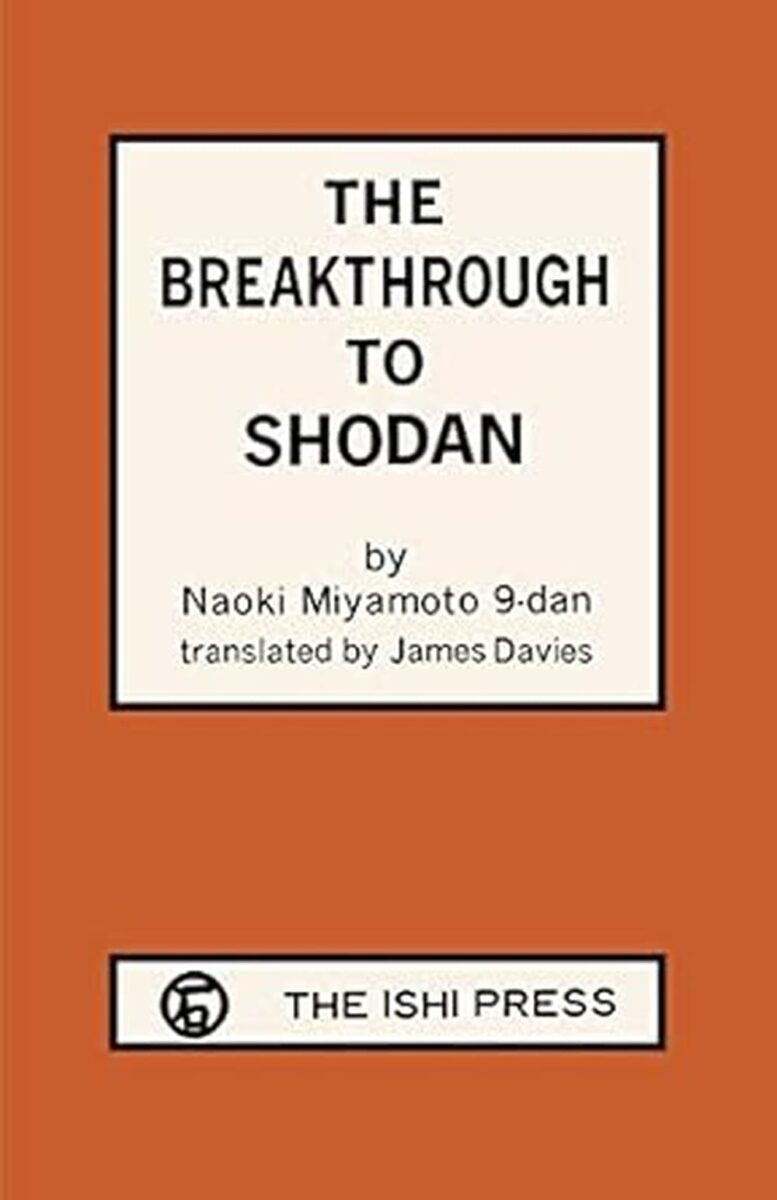
by Naoki Miyamoto
“I want to get to Shodan quickly – That must be the first thought of everyone who learns to play Go, but the barrier turns out unexpectedly thick. I sometimes hear people who are stalled at the 4-5 Kyu level say “I don’t have any talent”. Nonsense, no special talent is needed to reach Shodan.”
Why The Breakthrough to Shodan?
The title gives its purpose away, but despite its plain chapter names (“Chapter 1” through “Chapter 10”), this book is essential for any Go library. It’s a culmination of everything you’ve learned so far, with a sharp focus on understanding corner shapes and developing the intuition needed to judge continuations on the board. It helps dismantle old habits, refine your fundamentals, and reshape your understanding of the game.
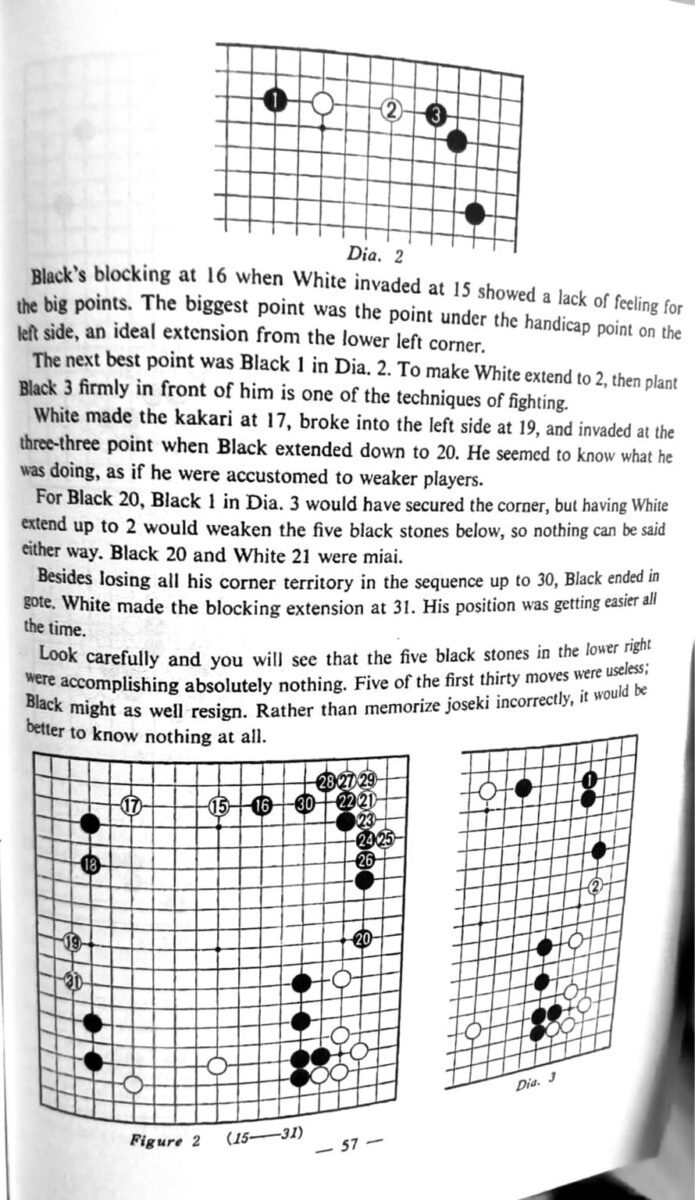
The Book
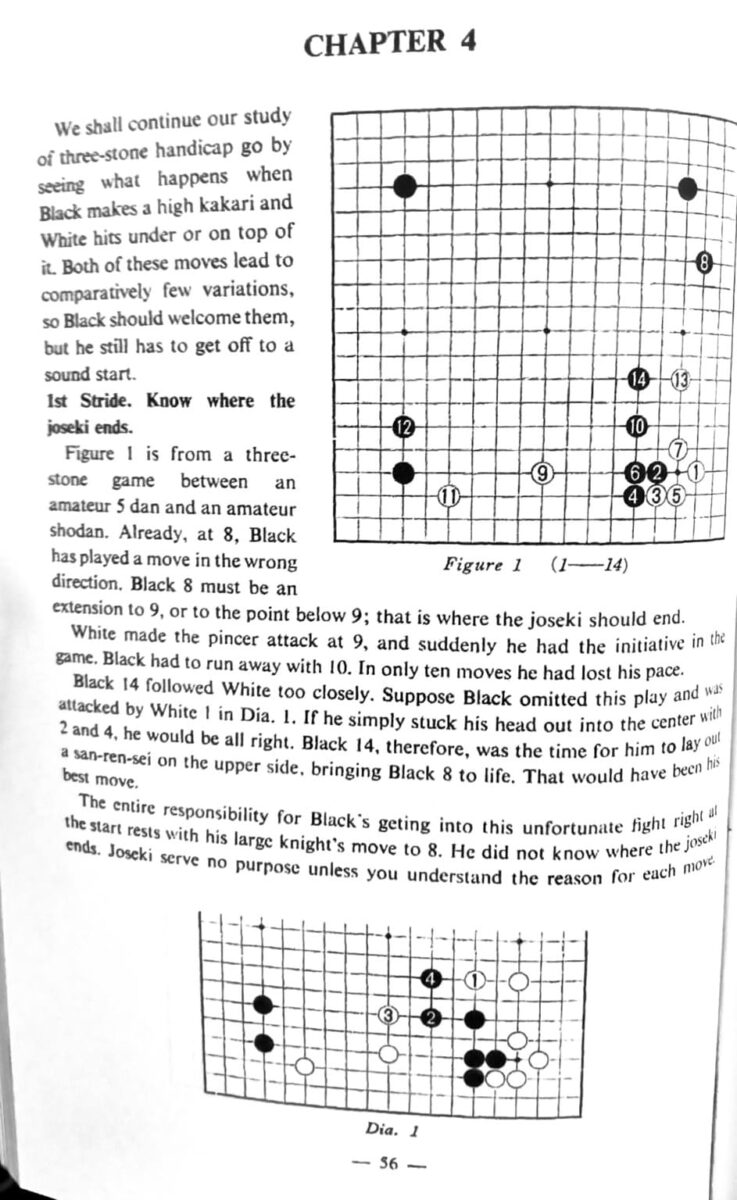
“The Breakthrough to Shodan” is split into 10 chapters, each of which starting its contemplations from different opening moves in a handicap game. Handicap games against a stronger player in many ways exacerbate bad habits a player might have picked up, such as being too timid or being prone to overplays. Miyamoto uses these games to great effect to reinforce fundamentals, while also teaching you new ways to think a step further, than what you were used to up to now. The very first example highlights a weaker player using large-knight corner defenses. You might wonder why this matters, since few players use such defenses today.
This example forces you to confront a truth that is going to be a valuable teacher: your instincts cannot be trusted yet. You may not play a large knight defense yourself, but you very likely play moves with the same problems, just hidden in modern joseki or flexible shapes that feel right to you until a stronger player uses them against you. He mentions how the overreliance on specific shapes and Joseki makes a player predictable and that knowledge can be used to plan counterplays. After playing 2 seemingly innocent large knight moves in 2 corners, a player might already find themselves in a trap that will spell doom 20 moves later. That first diagram alone can probably already keep you busy for 10 minutes, uncovering which tools the stronger player used to spring this trap. Miyamoto doesn’t spend a great deal of time explaining every move to you, as you are expected to put these stones on the board and think for yourself, while Miyamoto explains the concept and nudges you towards self-realization.
The next chapter deals with the fear of being double approached that many players have, followed by building a sense of direction with one space jump in chapter 2 and how different opening shapes can throw off your entire game based on the example of a 4-3 approach. There are 7 more chapters and all of them are carefully crafted to teach something about your game, allowing you to start an introspective search of your own games and giving you inspiration for what to look out for in the future.
After Joseki & Fuseki
by Kim Sung Rae
“In Go, when you don’t know the correct sequence, it is difficult to decide where to play.”
Why After Joseki & Fuseki?
When I pushed toward Dan level, it felt like relearning Go from scratch. Shapes I trusted suddenly collapsed, tactics that once worked now failed, and every mistake felt fatal. The problem wasn’t that my old shapes were wrong, it was that I didn’t know how to think strategically with the possibilities each group offered. At lower levels, you simply don’t need this depth. At Dan level, it becomes essential. This book reveals a whole new layer of possibilities and shows how even familiar shapes can blossom into rich continuations. There is also a sequel to this book focussing on AI Joseki. I have contacted the owner of www.go-spiele.de/en/, who are currently looking into acquiring some publishing/selling rights, as it is currently not available in Europe.
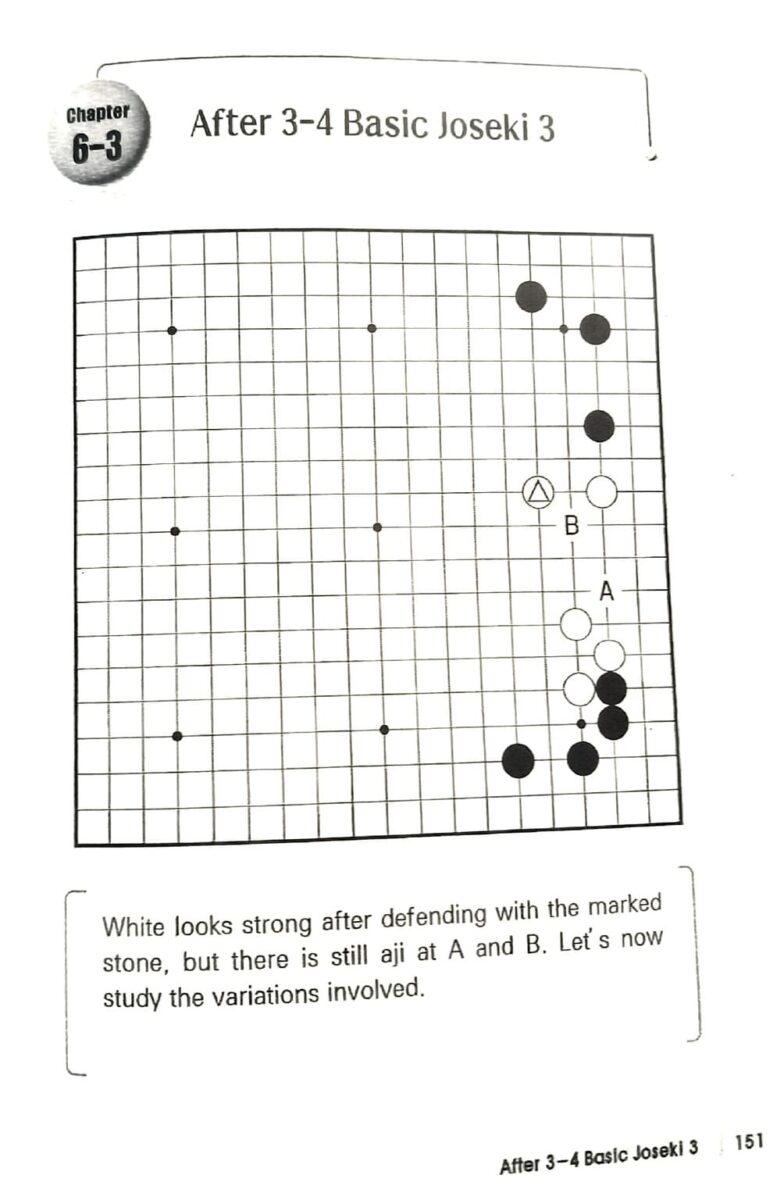
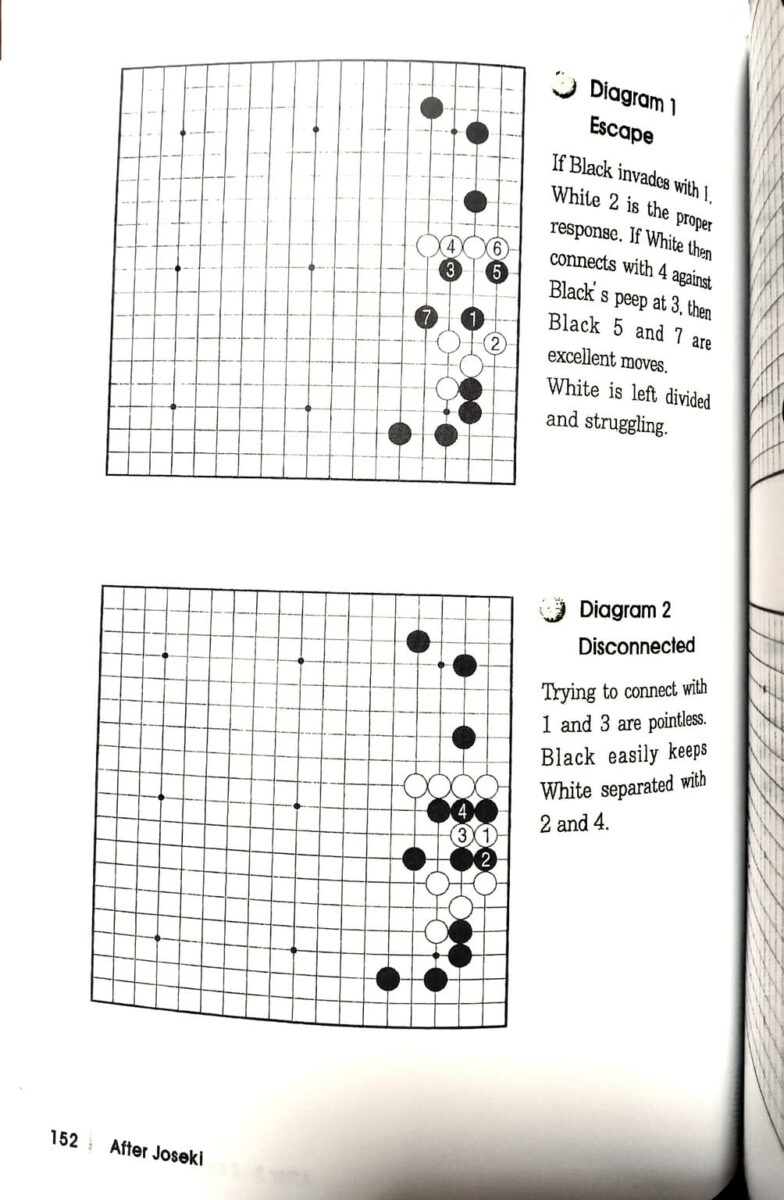
The Books
This volume consists of two separate books with a different focus. After Fuseki explains how to approach the most common corner enclosures, which is its own special topic that definitely deserves a lot more attention than it has received so far, but the real star of the show is After Joseki, which dives into all the weird and wonderful options that open up to you, well… after joseki. This concept is a very nebulous one indeed for the longest time, and most go learners only know very few simple examples of these, as they are commonly taught, such as how to press down a two space extension, but this book opens up an entirely new layer and a lot more strategic depth for your play after all kinds of common pincers and frequent midgame shapes.
After Fuseki starts with probably the most well known and most eye opening example of this concept that many single digit kyu players will already recognize as it stems from the first Joseki everyone learned that you can probably even easily visualize from me telling you the moves: B-4-4, W-low approach, B-knights move defense, W-slide into the corner, B-defend 3-3 and W-2 space extension to the side. Black pressing down on the two space extension or white threatening the group in the corner with a pincer are the variations that you might already be vaguely familiar with, but in the spirit of this article: What happens beyond the variations you already know? How about a pincer on the two space extension? Or an attachment into the two space extension to start a crosscut? Or a throw-in and kick? Or if you are feeling particularly cheeky, a very fight intensive trick play after the throw in?
All of these open up entirely new possibilities to keep in mind, shapes that might be more advantageous to you after looking at the rest of the board and options you might have never considered. The chapter ends with 2 real game diagrams of professional players using more creative ways to play this Joseki, giving you a real appreciation of seeing in action when the normal way to continue apparently was not satisfying enough, which is truly inspiring to see after learning these intricacies. The following chapters focus on a wide variety of pincers, as pincers increase the Aji tremendously, before also going over some common midgame shapes, like a 2 stone wall and a 3 space extension, all capped off with up to 6 real game examples. It is just a tremendously inspiring book to work through.
After Joseki is equally inspiring, but a bit less immediately applicable, as corner enclosures are a lot rarer these days with more players valuing speed and most corner enclosures that do get played, like a 4-3 keima defense, not having an endless amount of Aji to work with. However, the examples and explanations given here are still fantastic and absolutely worth learning about, as they will give you new ideas of how to approach particularly thick positions, which you can also use as inspiration for other positions on the board. My personal highlight of this book is the chapter on a double defended 4-4 stone (horse jump + diagonal), often considered to be an impenetrable fortress of a perfect corner enclosure. While 3-3 invasions can already be rather trickful, your opponent better think twice about ignoring any outside stone if you have read this book.
Fight Like a Pro: The Secrets of Kiai
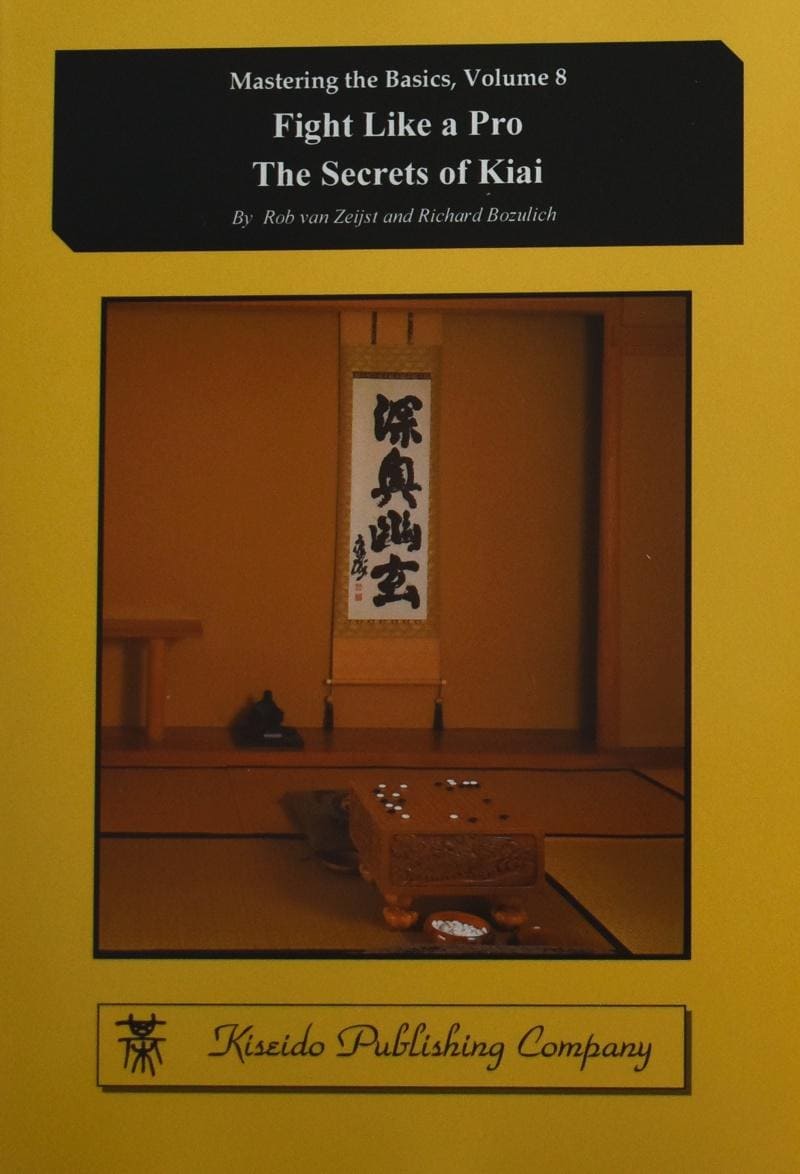
Rob van Zeijst and Richard Bozulich
Understanding Dan Level Play, Deep Thought & All His Other Books
by Yuan Zhou
“Fear is the bane of the human race. Although necessary for our survival in a hostile world, it inhibits risk-taking and prevents us from succeeding even in pursuits whose consequences for failing will not lead to our demise.”
Why Pro Game Review Books?
This is more of a general category than one concrete book, because there is a plethora of review books on professional games and all of them have incredibly valuable insights on individually brilliant moves and strategies by masters of the game. As opposed to many other book categories, these books are all worth reading, no matter how many other books on this topic you have read before.
The Books
Not all books are made equal and I chose these three as great examples that made their dense concepts approachable to the average reader.
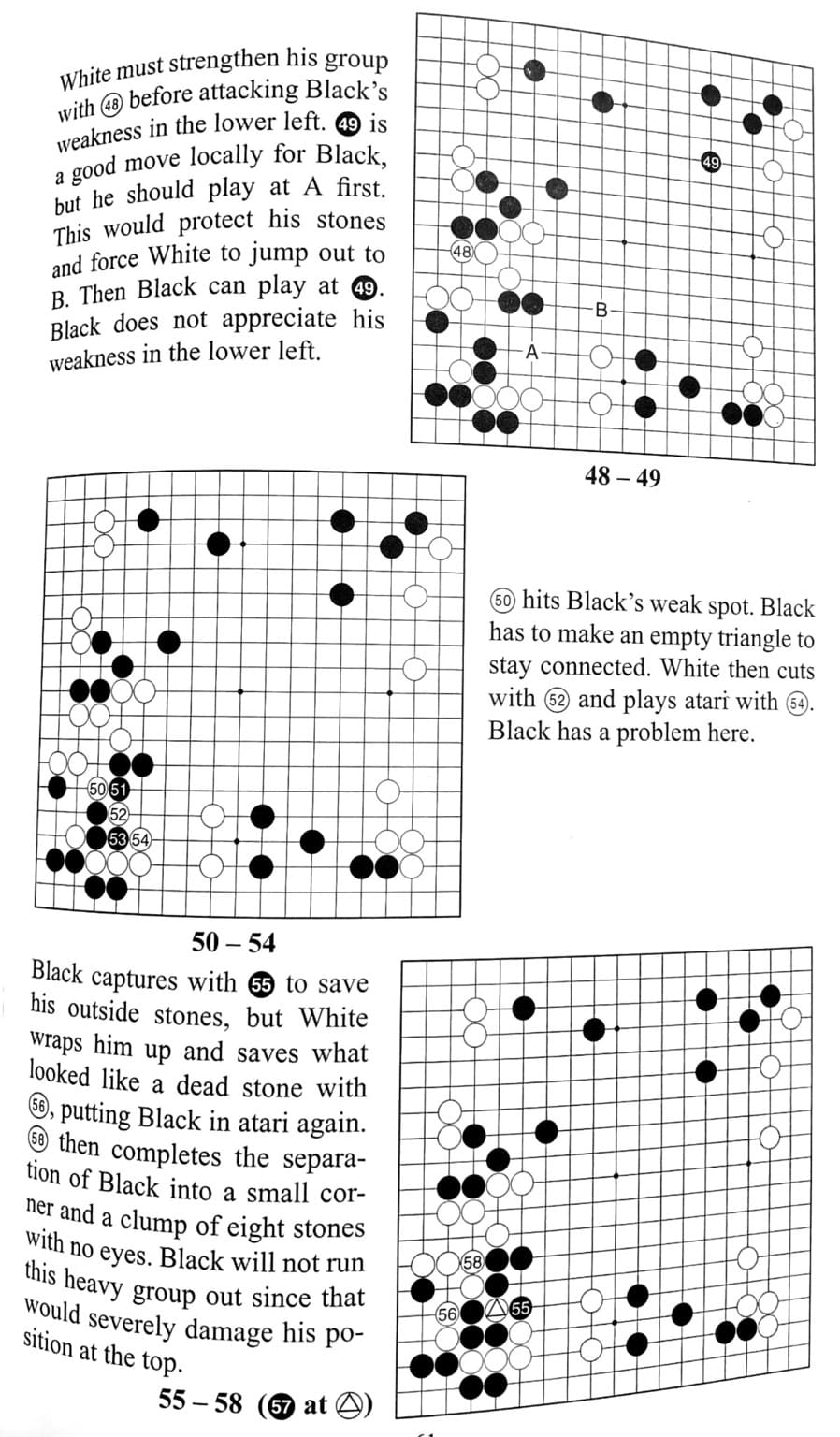
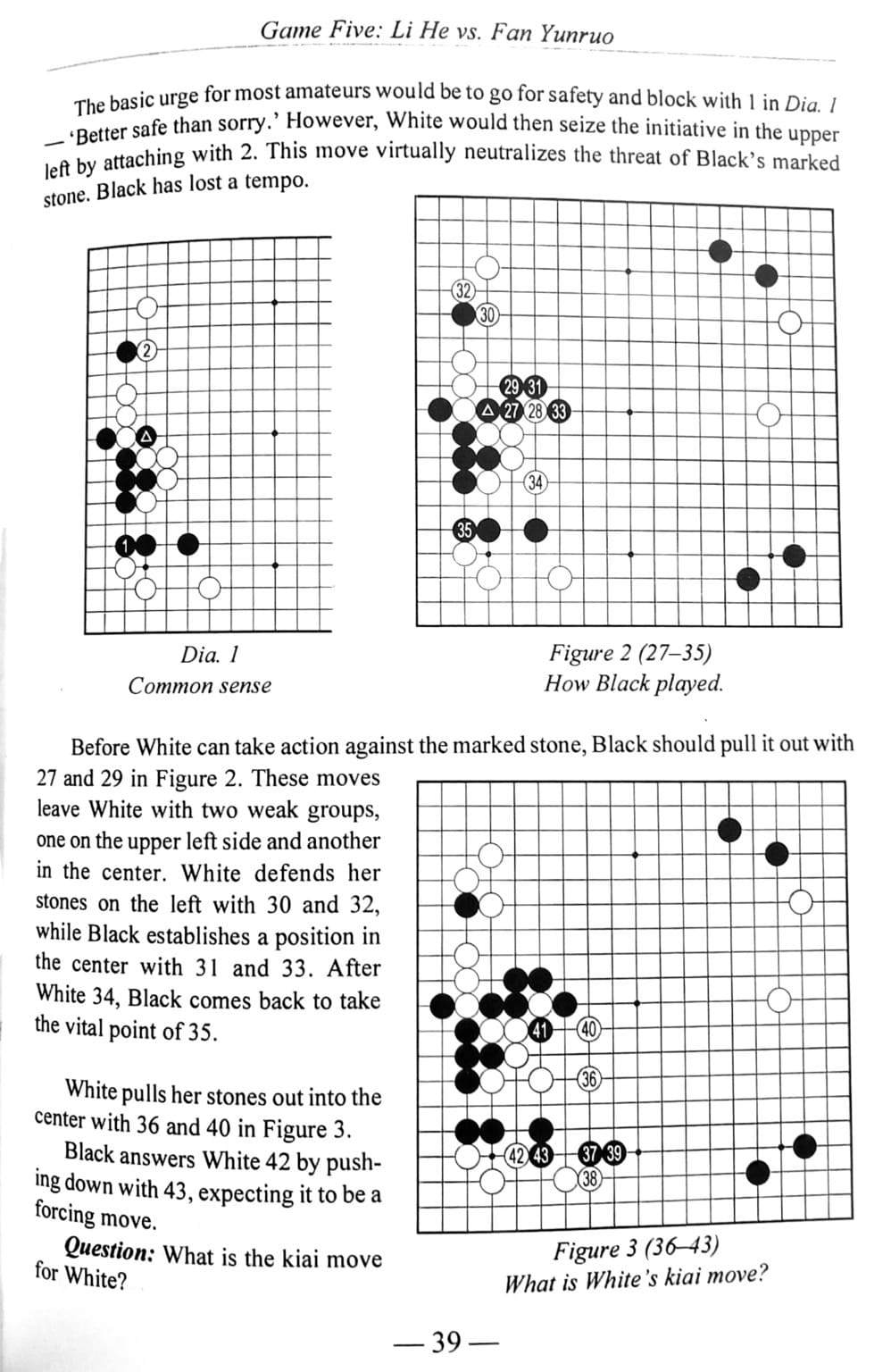
“Fight like a Pro” is a teaching book on “Fighting spirit”, using professional games as the foundation to talk about how to keep pressure on to not lose your footing in a game of Go. This is an absolute gem of a book, as it contextualizes the 16 matches contained within in regard to self contained move variations to keep the flow of the game in your favor, which is a topic I have rarely seen explored this well.
The book starts with a diagram of a pretty well known crosscut Joseki, that leads to a game situation in which neither player wanted to kill the other player, as it would have overconcentrated and overvalued a small area of the board, while both players carefully needed to tread between the lines of keeping enough pressure on to not have his own group die without compensation through a random misstep. Analyzing how this Joseki and its different variations work could already take you a good while, but understanding how this single Joseki affected the entire game and every move until the end of the game is an absolutely brilliant excursion into a concept that learners up until this point often just “winged it”, instead of truly grasping the essence of fighting and how to use it in more ways than just to kill or survive.
Future chapters focus on other fighting concepts that can shape an entire go match, be that luring an opponent in for an invasion and using that pressure to direct the game and gain points while attacking or building early game strength and using that strength as a foundation for constant and relentless attacks shaping the game in your favour. I consider this book an essential addition to any go book collection.
Yuan Zhou on the other hand focusses on single move/few move diagrams, which allows every reader to understand the concepts presented in these books. The challenge with many similar books is that complex fighting variations, throw-ins, or subtle cuts are never explained and hidden in more complex move diagrams, making the learnings not as immediately accessible.
A stronger player likely won’t need a thorough exploration of a relatively standard 4-3 approach Joseki, but Zhou’s books also focus on more subtle exchanges of why certain Joseki were chosen, so that even seemingly simple Joseki diagrams have something to learn from, even if these books are by their very nature not as dense as books that that contain longer and more complex variations, but who says that learning at the highest level only needs to be painful? “Deep Thought” only analyses 2 games, while “Understanding Dan Level Play” has a bit of a more brisk pace, looking at 7 games. I highly recommend giving both books a try to see which level of detail suits your own learning preferences.
Invasions & Reductions
by Iwamoto Kaoru
“When invading stones are captured, the opponent usually also gets outside strength. In other cases, the invader may end up with a weak running group.”
Why Invasions & Reductions
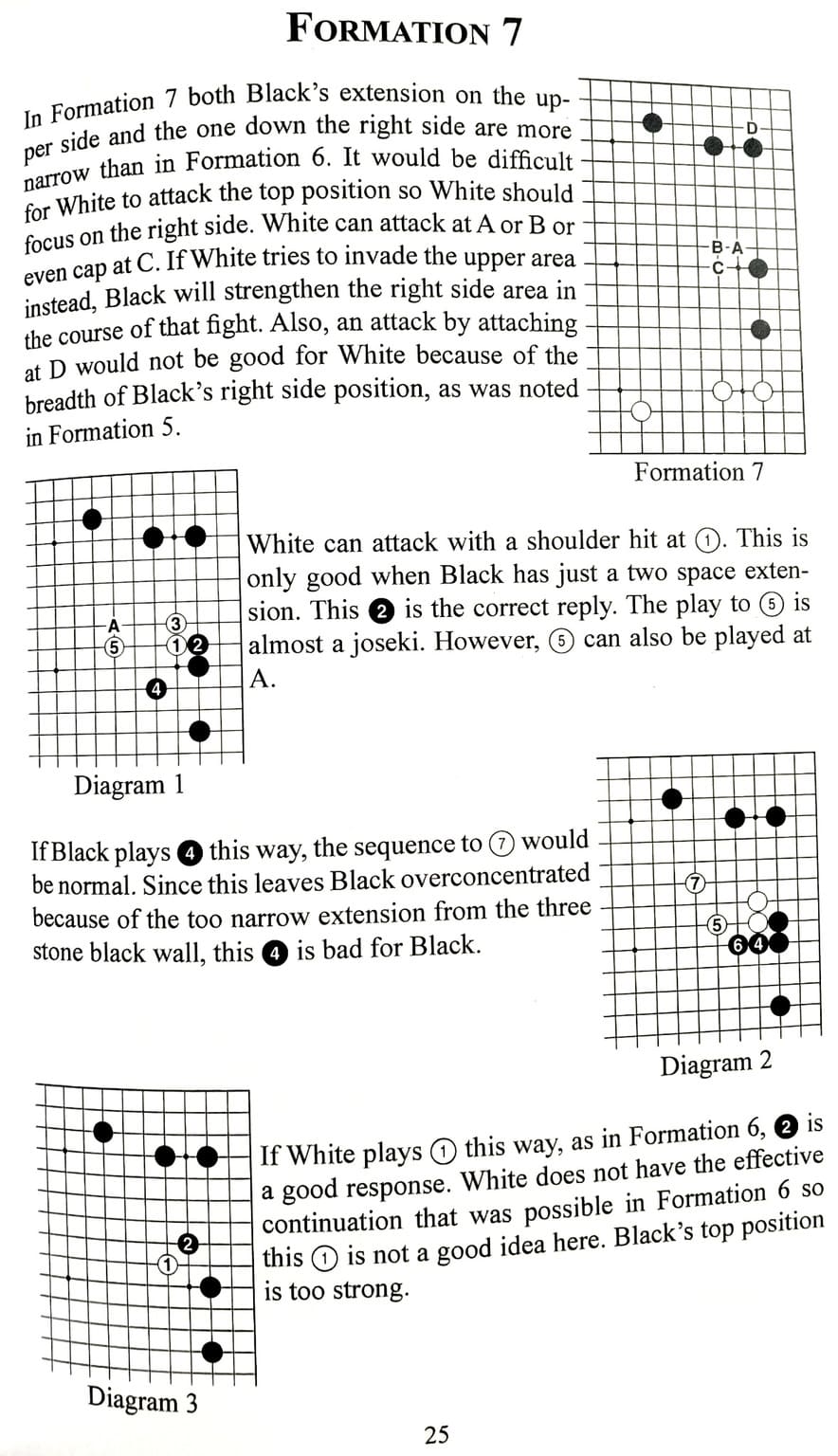
I stumbled over these very unassuming and small books in preparation for a tournament last year and I keep marvelling at how inspirational their insights are. Every go player learns early on how important it becomes to invade and reduce territory, but the majority of learners only ever learn the most basic of concepts. “Playing in the middle of a wide area, so you can extend with a two space extension to the side” or “attaching to create a crosscut” are not complex enough to truly give you a heads up in a difficult situation, so it becomes much more important to learn more intricate concepts, which these books absolutely excel at.
The Books
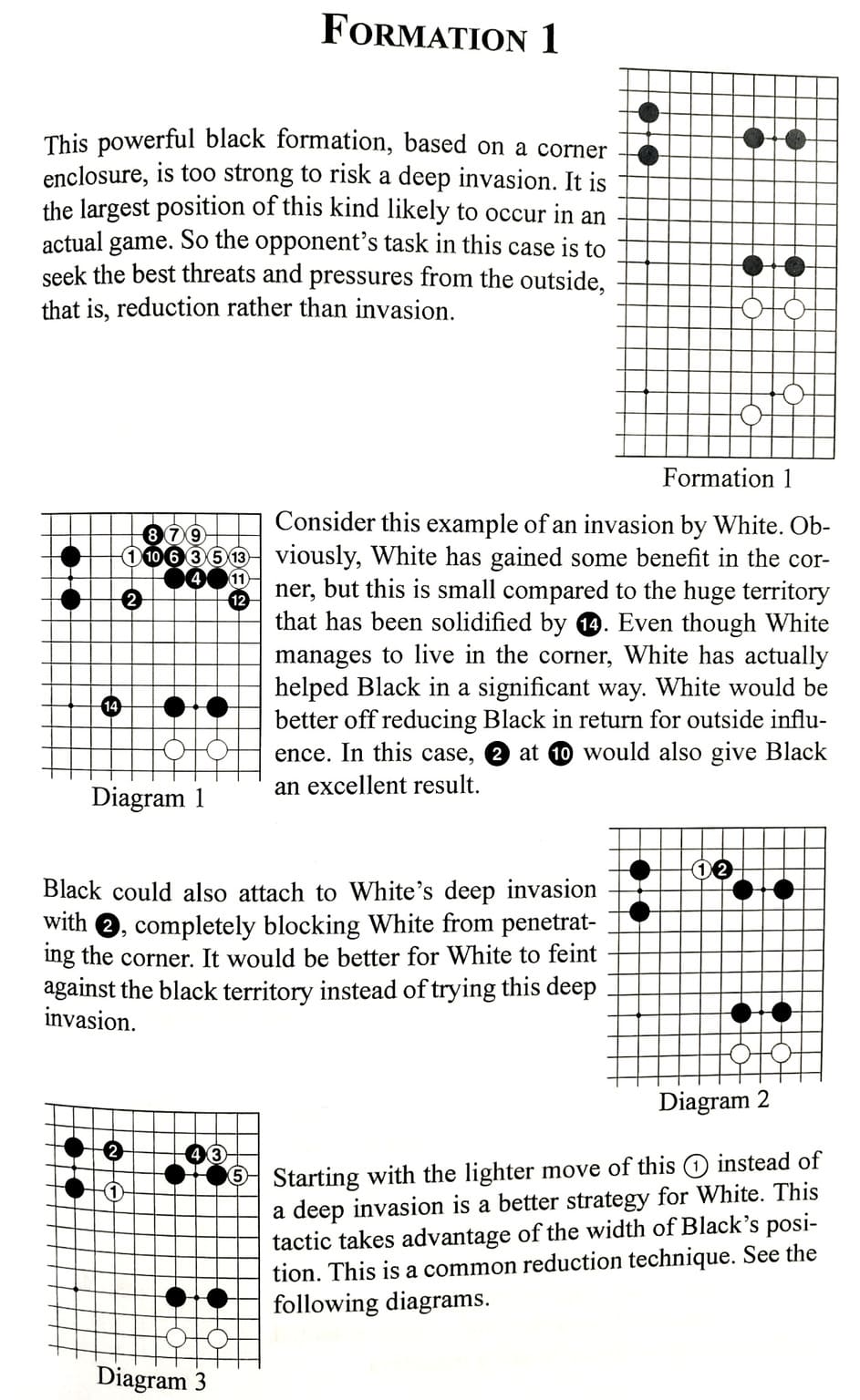
Both of these books have the same approach, starting with very strong formations that in most situations you would not particularly think about invading or getting close to. That includes corner formations reinforced with a total of 5 or even 6 own stones, that you likely almost never see in your own games. However, even if you have a more active and aggressive play style, learning strategies and move combinations to approach or undo these types of situations is surely only ever going to make you stronger, giving you more tools to approach every strong group that another opponent could throw at you.
Each book naturally has a bit of a different focus, as the attempt to invade or reduce are two fundamentally different goals, but they use the same basic way of thinking: How do I create weaknesses in my opponents shape, where seemingly there were none before? Throw-ins could be used to allow for a more successful reduction or as sacrifice to create a stronger living shape for a planned invasion. At SDK level, most of these strategies feel somewhat random, where you start a difficult fight, because you know you can achieve “something” without knowing what exactly the outcome will be.
The first chapter in Reductions threatens a throw in on the outside, to allow for life in the corner. Players have of course many different options to deal with these kinds of threats and this book then shows how all possible defenses still leave some aji to exploit for different purposes. Later chapters then go over other subtle changes that different shapes might lead to and how aji that threatens an invasion can also help you strengthen your own weaknesses.
Invasions on the other hand focusses more on your own shapes, how you can prepare an invasion or how you can continue after putting a stone into your opponents territory with Keimas, attachments or crosscuts. “Invasions” feels a bit more natural, as this type of invasion is something Go players at least try to accomplish even at a lower play strength, but “Reductions” really opens up new ideas beyond what you currently might deem possible.
The Art of Closing: Guanzipu
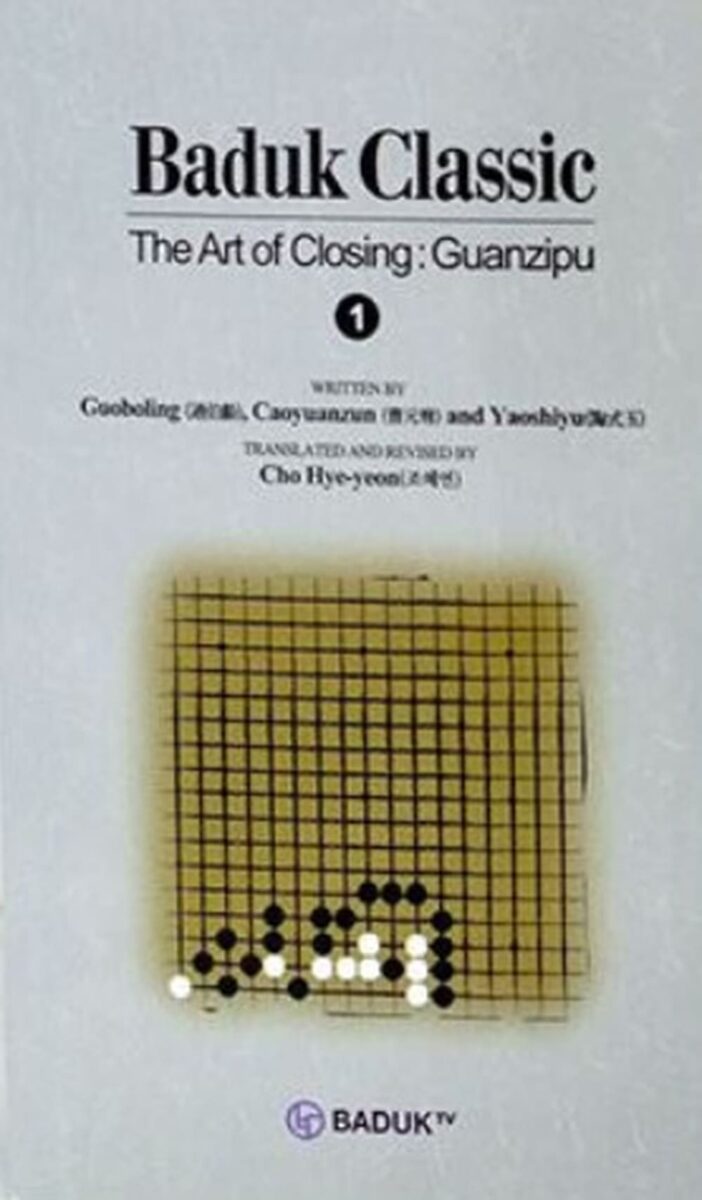
by Guoboling, Caoyuanzun & Yaoshiyu
“The significance of the endgame has been neglected not because of its difficulties, but because of its simplicities.”
Why Guanzipu?
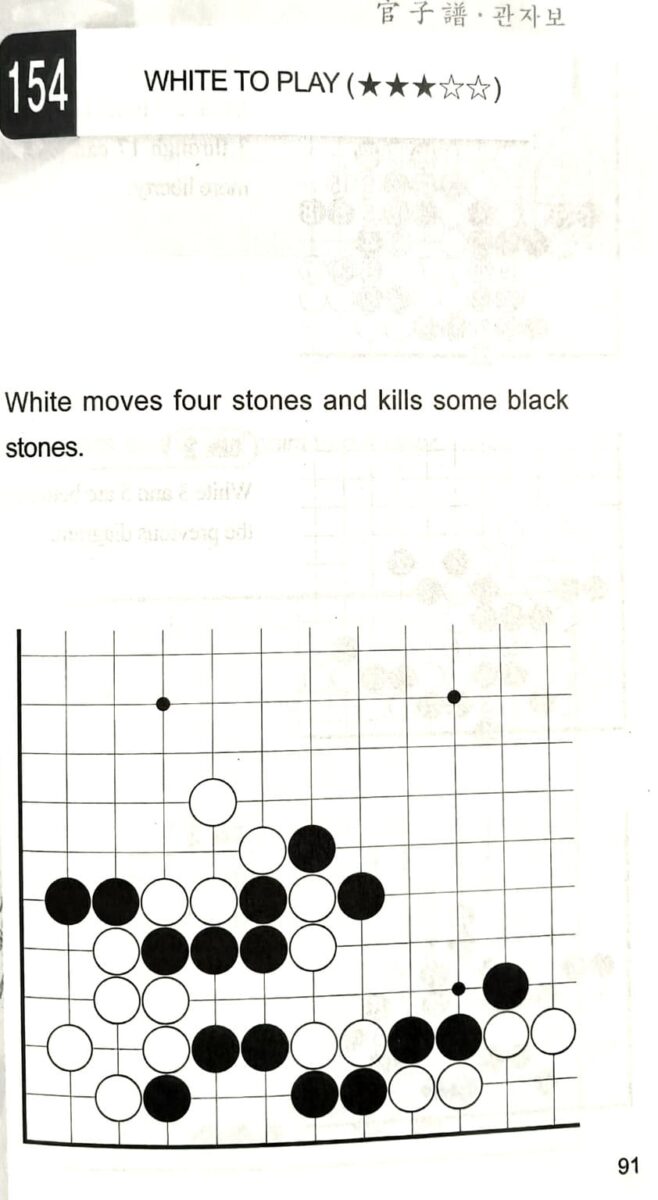
When asking stronger players how to reach dan level, the most common answer you will hear is “do life and death problems”. While it is true that this is indeed one of the most reliable ways to get stronger, it does not mean that it’s the most effective or engaging for you. Everyone learns differently, but even then, I cannot help, but recommend this problem collection as it is considered a classic for some very good reasons.The distinct focus on the Aji in endgame shapes can easily swing the game by 10 points or just outright kill a group, if your opponent isn’t aware of these intricacies.
The Book
This is not an easy breezy Go problem collection that you can just casually read through and contains problems that reach from single digit Kyu level all the way up to mid to high level dan challenges. The endgame often seems like a phase of the game, where everything has been mostly settled and we are merely negotiating about fractions of a point.
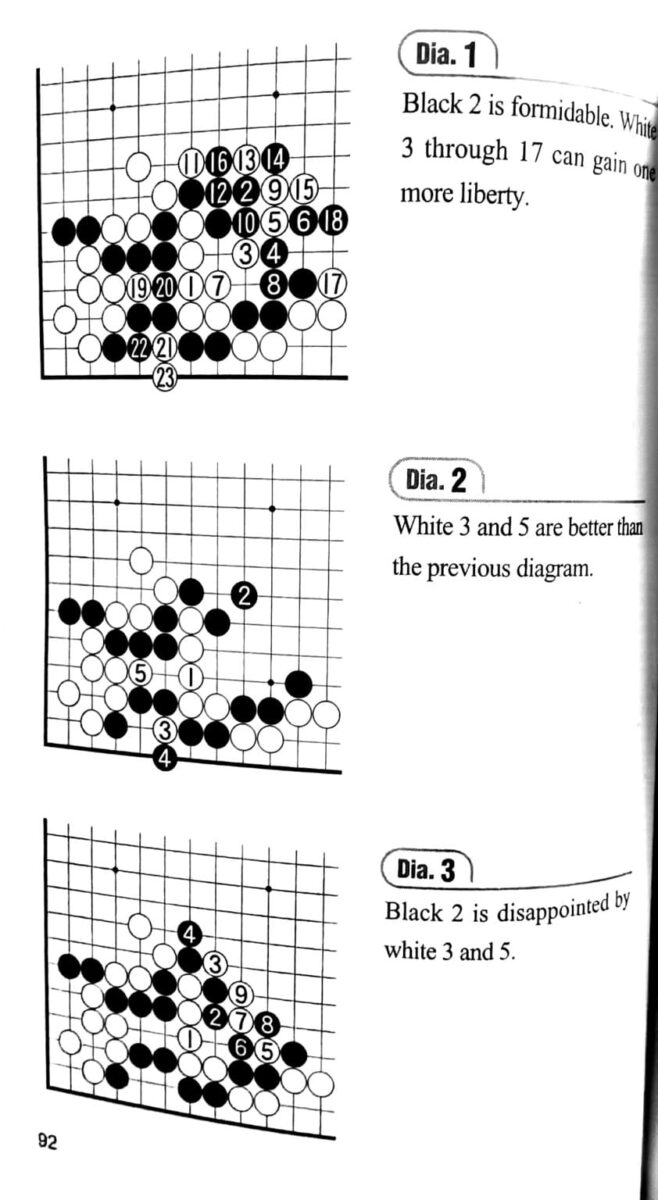
The Guanzipu is a problem collection that corrects that misunderstanding with almost 700 problems that focus on those small and subtle details that you are likely going to miss when looking at a go game quickly or in the heat of a tense tournament match. It will train your intuition for when shapes are not quite as strong as they might seem, focussing particularly on shapes that you might instinctively ignore occasionally and endgame profit.
The full version of this problem collection also comes with helpful diagrams and explanations explaining the pitfalls and counterplayers that an opponent might come up with, making this not only a problem collection, but also a book worth studying for fighting/killing techniques, but it might be a bit hard to get, in which case I still highly recommend looking for the problem collection online.
21st Century Dictionary of Basic Joseki Volume 1 & 2
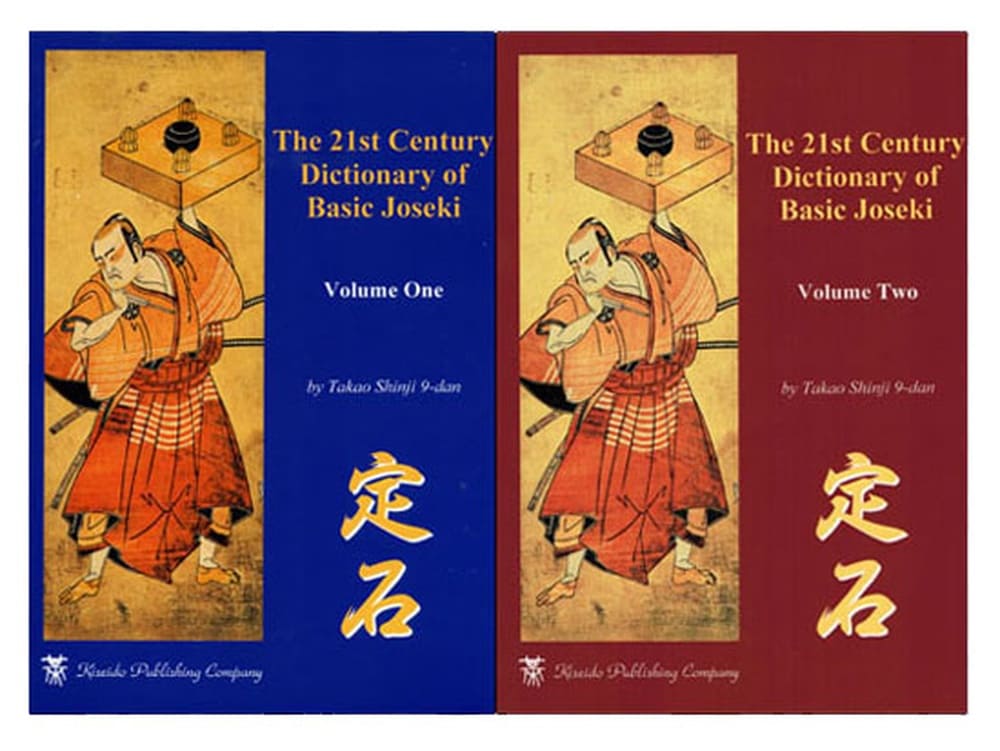
by Takao Shinji
”Josekis evolve day by day. There really is a continuous advance. Even as you look at this book, new Josekis may be coming into existence.”
Why a Joseki Dictionary?
I have recommended Joseki Revolution by Shibano Toramaru on the approach to modern Joseki in the last part of this book recommendation series and now you are going to get a recommendation most people would not suggest to you anymore: Grab a general Joseki compendium. I still think it is more important to learn modern Joseki sensibilities as suggested in the last article and there is a reason many professional and stronger players suggest to not bother learning Joseki at all: Unless you do a massive blunder, they don’t really matter for the outcome of the game. But we are going … beyond and these types of books still contain a treasure trove of inspiration that will allow you to develop in other ways, while still having an immediate impact on your game performance.
The Books
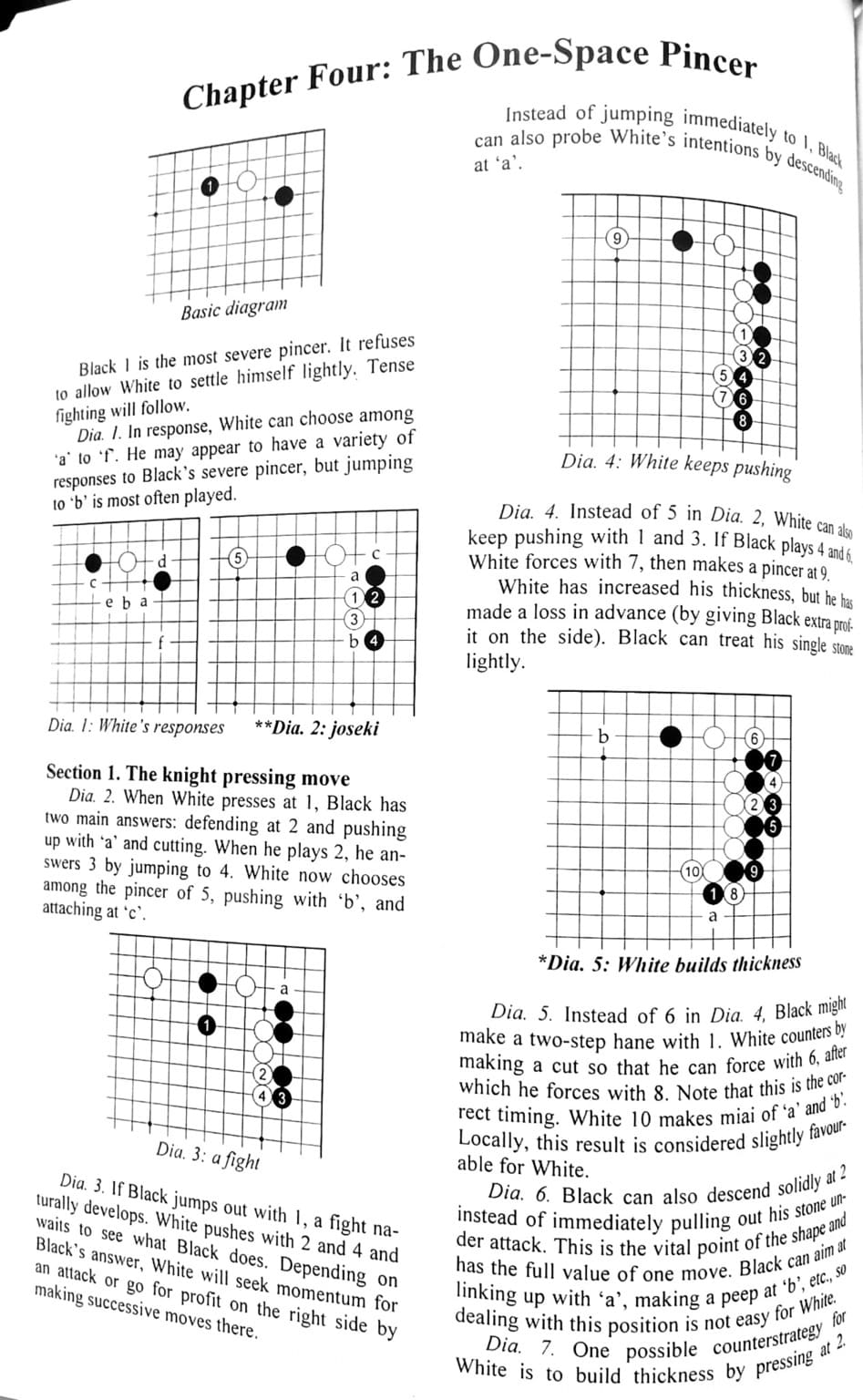
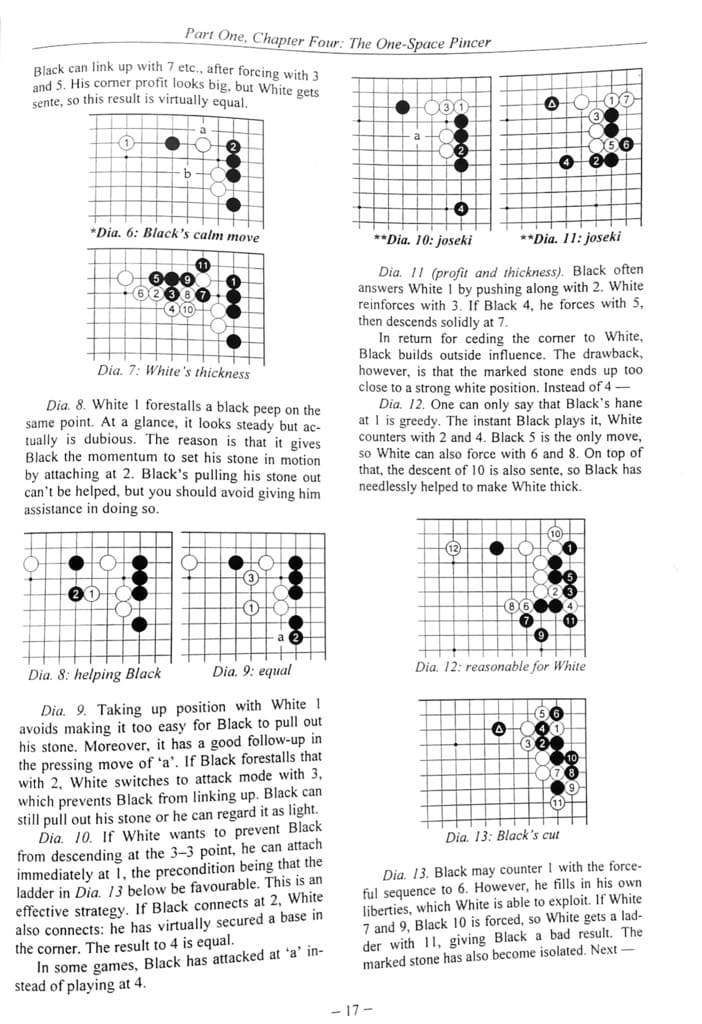
To start with the most important aspect up front: Even strong Dan players often only have a very basic understanding of the subtle differences of similar Joseki variations. A seemingly simple decision about a particular shape or the type of jump could mean your Joseki is a lot more efficient for certain stones on the outside. This particular set of books does not only just list the Joseki options, but gives you in depth explanations about any decision made for any of these Joseki: why to choose a crosscut, why to pick certain directions or what the differences are between different pincer formations. It is still true that these types of decisions won’t decide your games entirely, but if the idea of starting the game out with a few extra points in your pocket, it is absolutely still worth a look.
On a more inspirational note, I absolutely love experimenting with Josekis people have not been using regularly. If you have more experience and knowledge about complex variations, it can often catch your opponents off guard. I had dozens of tournament games where my opponents spent 20 minutes just on thinking through the Joseki variations I knew by heart, which of course gives you a significant time advantage. But even aside from the tournament impact, it’s just incredibly inspirational to read about Joseki that have been used hundreds of years ago already and how they are still able to teach you something about the importance of different shapes with Takao Shinji’s elaborate explanations.
This set of books is split into two parts. The first book is focussing entirely on variations of the 3-4 opening move with about 120 different follow-up Joseki variations and their potential complications and pitfalls. The second book instead focuses on the 4-4, 5-3, 5-4 and 3-3 points. The most expansive section of the book deals with about 80 Joseki variations of the 4-4 point, while the other, more exotic corner moves admittedly might not have received the most in-depth explorations, but still contain plenty of worthwhile insights into their move sequence. Another element that deserves a shoutout is the inclusion of significant Tenuki variations, offering a learner the option to leave a lot of Aji and unfinished shapes in exchange for tempo on the rest of the board, which increases your strategic options tenfold, especially as you get closer to the Dan level and you will start appreciating tempo more and more.
As a final recommendation in the spirit of going “beyond”, I want to impart one final inspiration: Untranslated Asian Go books. There is only a very tiny amount of Go books that have been published in English compared to Korean, Chinese or Japanese. Many people attempted to learn these languages just to be able to read these books, but these days, after the advent of AI and picture writing recognition, you can translate everything in front of you with a single button. English books more often than not focus on basics and there are only very few exceptions that focus on more special topics such as positional Judgment.
If I continue a book project, it would likely be presenting some of these and their knowledge in video form, as there are many, incredibly insightful books that we can analyze ourselves with AI and translations these days. But as with everything else, I hope you can find a way to approach Go in a way that is fun to you. As long as you enjoy yourself, you will keep improving.
It was a very long journey for me to finish this set of articles, but I hope you gained a good idea of what books you might want to give a look and how to find more enjoyment through a seemingly outdated medium that still contains an absolute treasure trove of wisdom. Enjoy your Go journey!



Оставить комментарий