
🎥 An Interview with Zhou Junxun 9p: From Learning Go in the 80s to LG Cup Victory

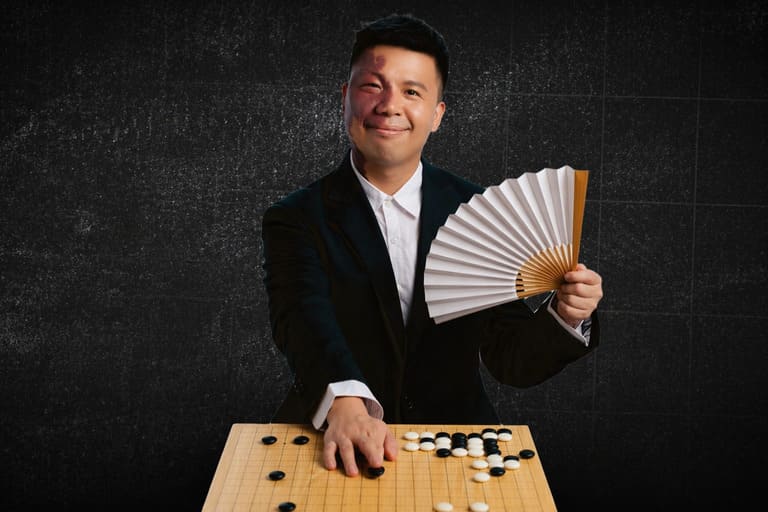

What did it take to become a world-class Go player before AI, online servers, and endless digital study tools? In this interview, Zhou Junxun 9p looks back on the reality of learning Go in 1980s Taiwan, where serious study was difficult, resources were scarce, and even finding a place to practice could be a challenge.
That is what makes this conversation so compelling. Zhou does not describe a polished training system or a clear professional path. Instead, he describes a much harsher environment: smoky Go parlors, very few books, almost no other children pursuing the game seriously, and years of progress built through repetition, endurance, and sheer stubbornness.
The interview is especially valuable because it shows how different professional development looked before the digital age. Today, young players can study with AI, review online, and access strong opponents at any hour. Zhou came up in a world where none of that existed, and his answer to stagnation was often simple: work longer, work harder, and keep going.
At the same time, this is not only a story about discipline and success. It is also a thoughtful reflection on how pressure changes the experience of the game itself. Zhou speaks candidly about the difference between the joy of playing as a young amateur and the heavier burden that came with becoming Taiwan’s top player and eventually an LG Cup champion.
Timestamps
- 00:19 — When Did You Start Learning Go?
- 00:30 — What Was the Go Environment Like in 1980s Taiwan?
- 01:45 — How Did You Learn Go Without Books or Modern Resources?
- 02:16 — What Were the Biggest Challenges to Becoming a Go Professional?
- 03:31 — How Did You Feel About Becoming a World Champion (LG Cup)?
- 04:36 — How Did You Overcome Plateaus in Your Go Training?
- 06:03 — Was Playing Go More Fun as a Low-Ranked Player or a World Champion?
00:19 — When Did You Start Learning Go?
Interviewer: We’re here with professional 9-dan Zhou Junxun for a short interview. First of all, when did you start learning Go?
Zhou Junxun: I was seven years old, so that was in 1987.
00:30 — What Was the Go Environment Like in 1980s Taiwan?
Interviewer: And that was in Taiwan, right? What was the Go environment like back then?
Zhou Junxun: Yes, in Taiwan. In the 1980s, the environment was not good at all.
I sometimes joke with young people today that it was a kind of “Go desert,” probably worse than Europe or America today. There were no real Go schools. If you wanted to learn, you usually had to go to a Go parlor.
Interviewer: A parlor? Like a Go school?
Zhou Junxun: Not really. It was more like a place where adults gathered to play cards, poker, and mahjong, often for money. There was gambling, smoking, and all of that around us.
That was the environment where I learned Go.
Interviewer: At seven years old?
Zhou Junxun: Yes. Back then there was nothing else. No internet, no AI, no modern learning tools.
01:45 — How Did You Learn Go Without Books or Modern Resources?
Interviewer: So how did you learn in that kind of situation?
Zhou Junxun: There were not even many Go books at the time. What we did have was a group of older players who loved the game.
A lot of them had been inspired by Rin Kaiho. He was Taiwanese and had won a professional title in Japan at the age of twenty-three. Newspapers introduced him, and because of that, many young people in Taiwan at the time became interested in learning Go.
So in that sense, the learning environment was poor, but there were still people who loved the game deeply and helped keep it alive.
02:16 — What Were the Biggest Challenges to Becoming a Go Professional?
Interviewer: Was that the biggest challenge back then, or were there other obstacles too?
Zhou Junxun: There were definitely other difficulties.
One problem was simply finding a place to practice. Another was that there were very few other children learning seriously. Hardly any wanted to become professionals the way I did.
Most children would play until around age eleven. Then junior high school began, and at that point Taiwanese kids usually had only two choices. If their families were wealthy, they could go to Japan. You needed real financial support for that, even something as serious as buying a house there.
If your family did not have that kind of money, you went back to school.
My family did not have the money, so I could not go to Japan. But I also refused to give up Go and return to a normal academic path. At that time, I was the only one in Taiwan who stayed and kept pursuing Go seriously without going to Japan.
03:31 — How Did You Feel About Becoming a World Champion (LG Cup)?
Interviewer: Later, of course, you won the LG Cup and became a world champion. What was that journey like?
Zhou Junxun: I started learning in 1987, and then in 1991 I was very lucky. I went to mainland China for a tournament, and there I met Master Song Xuelin from Sichuan, a professional 8-dan.
Meeting him changed things for me. Later, I had the chance to train in China. Then, in 1993, I became professional 1-dan on the mainland.
From that point on, I was able to travel to Beijing and train at the China Qiyuan whenever I had the opportunity. From 1994, when I was fourteen years old, all the way up to winning the LG Cup in 2007, I kept going back to Beijing to train whenever I could.
So the championship did not come from one sudden breakthrough. It came after many years of that effort.
04:36 — How Did You Overcome Plateaus in Your Go Training?
Interviewer: During that long learning process, did you hit plateaus? And if so, how did you get past them?
Zhou Junxun: Of course I hit plateaus.
But “special techniques” would be the wrong way to describe it. In Taiwan, the environment was too poor for that. We have a phrase that roughly means “primitive steelmaking.” It is hard to translate exactly, but the idea is simple: use basic, almost crude methods, and repeat them endlessly.
That was how I trained.
For example, I used to study eight hours a day. But naturally there were periods when I kept losing and did not know what else to do. At that point, eight hours did not feel like enough.
So I increased it to twelve hours a day.
Out of twenty-four hours, half of my time, aside from eating and sleeping, was spent training. It was just long, relentless work.
When my results improved, I would go back down to eight hours. But during difficult periods, I relied on brute force. There were no tricks. No shortcuts.
Today, with the internet and AI, things are much easier for young players. Computers are like invisible teachers. In my generation, we did not have anything like that.
06:03 — Was Playing Go More Fun as a Low-Ranked Player or a World Champion?
Interviewer: One last question. Was Go more fun when you were still a lower-level player, or later, after becoming a champion and reaching 9-dan? Does the joy of the game change with strength?
Zhou Junxun: It is very different.
When I first became a professional, the excitement came from feeling that the future was still wide open. But if you ask specifically about the joy of playing the game itself, then yes, I think I was happier when I was still an amateur 1-dan or 2-dan.
At that time, the pressure to win was not so great. There were many strong players around me, and my attitude was simple: just play as hard as I could. Even if I lost, I could still be happy if I learned something.
Later, as I became stronger, that changed. My results improved, and by the age of fifteen I was already number one in Taiwan. From that point on, playing Go in Taiwan was not really fun anymore.
The pressure became huge.
My father felt that winning was expected. If I lost, it meant I had not worked hard enough. And for many other reasons as well, losing led to painful reviews at home.
So later on, the burden became heavier and heavier. In that sense, being a professional was not fun. The pressure to win was too intense. The pure joy of simply playing was no longer really there.
Interviewer: Thank you very much.
Zhou Junxun: Thank you.


Комментарии