


15 Essential Proverbs Every Go Player Should Know

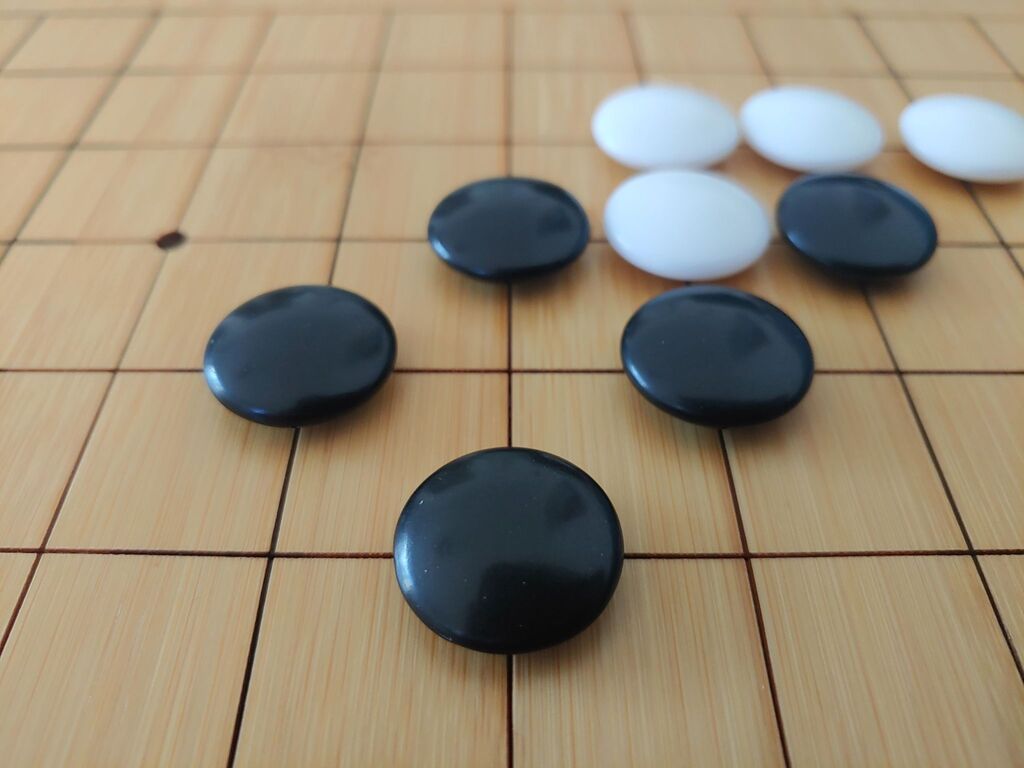
While Go is a game of near-infinite complexity, certain patterns recur so frequently and reliably that they’ve been distilled over centuries of play into concise, memorable maxims. These bite-sized nuggets of wisdom encode fundamental strategic and tactical principles that can guide your understanding in ways that might otherwise take years of trial and error to uncover, and help you cultivate the intuition that stronger players seem to possess naturally.
This collection focuses specifically on proverbs that beginners can grasp and implement immediately. Unlike some of the more abstract sayings that require deeper strategic context or refined tactical reading, these fifteen principles offer concrete, practical guidance that you can put to use in your very next game.
Let’s take a look.
1. Fourth Line for Influence, Third line for Territory, Second Line for Emergency
In the opening, stones are placed primarily on the third and fourth lines of the board. We refer to these moves as low and high, respectively (the high-Chinese Fuseki, a low pincer etc), and the difference between them – which may seem trivial to beginners – can drastically alter the development of a game.
Third-line stones work efficiently along the edge to enclose definite territory, while fourth-line stones radiate outward influence that is used to attack enemy groups and develop large-scale frameworks. Playing on the second line in the early stages of the game is almost always too small and defensive; such moves should be reserved for connecting a threatened group or securing its life.
It’s recommended to use both third and fourth line moves in the opening to create a balanced position.
2. From One, Two. From Two, Three
This proverb describes optimal extensions. From a single stone on the third or fourth line, extend two spaces. From two stones – the minimum height for a wall – extend three, and so forth up to around five or six stones, beyond which invasions become likely regardless of the extension. Nearby friendly or enemy stones may require adjustments, but the general rule of extending one more point than the height of the wall is a reliable default to aim for. Extensions that follow this proverb are neither overconcentrated nor easily invaded: close enough to stay connected and spacious enough to grow; Many difficulties that arise later in a game can be traced back to stones extended too timidly or too greedily in the opening.
Ideal extension spaces from one, two, three, and four stone-walls.
3. Play on the Point of Symmetry
Playing at the center of a symmetrical shape is often the key to creating Miai points (two related points of equal value – when your opponent takes one, you can take the other). When both sides of a given shape are identical, playing in the center often allows you to make an eye, connect, or make territory on either side of the shape depending on your overall goal.
This proverb generally concerns tactical positions of life and death, but it may also apply to strategic decisions: When two formations mirror each other, the center point is often the vital point for both sides, and playing there first will give you the positional advantage (see number 6).
A, B, C, D, and E are points of symmetry as well as vital points for both sides.
4. The Ponnuki is Worth 30 Points
This is one of the most famous Go proverbs. The number of points need not be taken literally, as the largeness of the figure is meant to emphasize the power and potential of the Ponnuki. This diamond shape formed by capturing a single stone is far more valuable than its immediate territorial count because it radiates strength and influence in all directions, making it virtually immune to enemy attacks.
A safe rule of thumb is to always jump at the chance to make a ponnuki and conversely to never hand one to your opponent. Follow this rule until you understand the specific exceptions well enough to break it.
The ponnuki radiates influence in all directions.
5. There Are No Ko Threats in the Opening
Ko threats are moves that threaten enough damage to force a response from your opponent, allowing you to recapture a ko in another part of the board. At the start of the game, when the board is largely empty, creating a truly serious threat is unlikely. The powerful ko threats of the middle game and endgame — cutting off large chains of stones or killing isolated corner groups — simply don’t exist yet. Starting a ko fight early is therefore almost always disadvantageous for the player who initiates it. If a sequence leads to a ko in the opening, look for an alternative, or run the risk of suffering a major local loss, and possibly the overall advantage.
Black initiates a ko at 1. When White tries to create a ko threat at 2, Black will simply ignore it and take the ko at 3, then connect it.
6. The Enemy’s Key Point is Your Own
Vital points are rarely neutral in Go. The point that strengthens or weakens your opponent often has the opposite effect on your own stones, and vice versa. This applies to extensions, connections, invasions, life and death and practically any position that arises on the board. The key point for you may not always be the exact move they want, but it is often in the same area. By occupying the point first, you improve your own position while sabotaging their own.
A useful corollary follows from this proverb: If a move isn’t particularly large for your opponent, it’s probably not that large for you either, even if it forces a response (see number 13).
A, B, and C are vital points for both sides.
7. Five Groups Might Live, but the Sixth Will Die
Having too many groups on the board can be dangerous. The more separate groups you make, the more eyes they will all need to survive. Ergo, groups that share eyes are a lot easier to keep alive. Furthermore, creating lots of groups will make it easier for your opponent to set up splitting attacks between two or three of them, and profit greatly from you having to defend each of them separately.
Under the original Chinese rules, there was even a “group tax” point-deduction to emphasize the strategic burden of managing multiple groups. So, if you already have several unsettled positions, strengthen them before creating any more. Connect your stones as much as possible, and aim to have no more than one weak group on the board at any given time.
Shin Jinseo (1p) vs. Chen Hao (4p) at the Young Stars tournament, 2013. Black fails to live with their 6th group and loses the game.
8. Don’t Push From Behind
When your opponent’s stones are extended in a straight line, pushing them from behind often does nothing more than help them get exactly where they wanted to go – solidifying prospective territory or building thickness in their desired direction. Your moves should aim to restrict their position, not escort it. If you find yourself in a situation where your push improves their formation more than your own, consider jumping ahead with a two-space jump or a knight’s move to steal the momentum, or switch gears entirely and approach from a side where your stones carry genuine offensive weight.
Examples of incorrect pushing from behind. In all cases, move 4 should be played at A.
9. Never Ignore a Shoulder Hit
A shoulder hit is a move played diagonally above an opponent’s stone, typically to reduce a growing framework while simultaneously building influence. The main advantage of such a move is that it is usually impossible to surround due to its easy access to the center, as opposed to a deep invasion.
While not as aggressive as a contact move, a shoulder hit is a provocation that demands a response, since ignoring it lets your opponent extend comfortably into your framework, eating into your territory while strengthening their own center position.
In the face of a shoulder hit, the correct response is to protect your framework by extending your stone against theirs.
Moves 1 are shoulder hits that aim to reduce the opponent’s growth potential.
10. Hane at the Head of Two or Three Stones
The hane is a diagonal move played from a friendly stone in contact with an enemy stone or group, wrapping around it to limit its expansion. It is a cornerstone of fighting technique, and played at the head of two or three stones in a row, it applies maximum pressure by restricting escape routes and creating shape defects. What makes this move particularly effective is that it diminishes the liberties of the string of stones while limiting its influence, thus forcing immediate concessions and securing a local advantage.
The corollary to this proverb is to never allow a hane at the head of two or three of your own stones, for all the same reasons.
Moves 1 cramp the opponent’s position while expanding the side that played the hane.
11. Answer the Attachment with a Hane
When your opponent attaches — playing directly adjacent to your stone — a hane is usually the correct response, as it maintains good shape and prevents them from settling comfortably. The attachment is typically a fighting move that is played with the intention of creating complications, and the hane accepts this challenge on favorable terms by seizing the initiative. More passive responses such as extending to the side or pulling back tend to concede the local advantage without adequate compensation.
It’s worth noting that because contact moves tend to strengthen the responding player through solid local exchanges (via the hane etc), attaching to corner stones early on in the game is generally considered disadvantageous for the side that attaches.
Examples of answering an attachment with a hane.
12. Add a Second Stone and Sacrifice Both
When a stone is beyond saving, the instinct may be to abandon it immediately. But the correct play is often counterintuitive: Add a second stone – not to rescue it, but to make the sacrifice more profitable. This common technique of reinforcing a group before giving it up can be useful in a number of situations: to increase its liberties and force the opponent to spend extra moves capturing it; to reduce your opponent’s eyespace; to prevent kos, and more.
If your stones must die, try to make their death as expensive as possible for the opponent.
Examples of increasing a one-stone sacrifice. The bottom-right is the continuation of the upper-left.
13. Don’t Atari Automatically
Like a check in chess, putting a stone or group of stones in atari is not always a good move. An atari played purely to force a response will often accomplish nothing more than allowing the opponent to fix their position, removing any latent weaknesses that could be exploited in the future. Beginners find it particularly hard to resist the urge to give atari even when it clearly helps the opponent. Before playing one, ask yourself: Does it help my current position? Will it strengthen their own? Conserving an atari often proves to be the strategically superior option, especially if doing so leaves your opponent with shape problems. Sometimes it’s a ko threat you’ll need later on. At any rate, ataris should be played not reflexively, but with absolute purpose.
Examples of bad ataris that strengthen the opponent and leave cutting points for the side that plays them.
14. Nets Are Better Than Ladders
When capturing enemy stones, a net — a loose encirclement that controls all escape routes — is more reliable than a ladder, which corners them in a zig-zag pattern toward the edge. Ladders depend on specific board conditions: a single ladder-breaker anywhere along its trajectory can invalidate the entire sequence, and therefore be played as a free forcing move. Nets are locally reliable and work regardless of what is happening on the other side of the board. So when you have the choice between the two, opt for a net. The broader lesson here is to prefer fighting tactics that minimize dependency on distant board positions.
A, B, C, D, and E are moves that tightly or loosely net the opponent’s stones.
15. If You Don’t Know Ladders, Don’t Play Go
Severe as it sounds, it’s quite true. Ladders are one of Go’s most fundamental tactical elements, and missing one through a faulty capturing sequence is not only one of the most painful ways to lose, but entirely avoidable with careful reading.
Rather than being discouraged by the proverb, take it as instruction: Invest a little effort to learn ladders properly; Read them slowly and carefully, visualizing each step until you have determined the outcome with absolute certainty before committing to it. Since ladders arise in almost every game, the return on investment for learning them is exceptionally high.
For which side do the ladders at □, ○, and △ work?
Having absorbed these fifteen principles, here’s the final and most important one:
Don’t follow proverbs blindly.
Every proverb has exceptions, and Go is simply much too complex for absolute rules. A proverb applied mechanically without understanding its meaning, can be as damaging as not knowing it at all.
These principles describe what is usually correct, what works in the majority of positions, what you should default to when you’re uncertain. But specific situations may demand something different. Sometimes the fourth line is too slow for developing; Sometimes pushing from behind is exactly right; Sometimes the atari must be played immediately.
Proverbs are not laws to be obeyed blindly, but trusted advisors meant to guide your decisions and help you catch mistakes before they happen. As you develop intuition and sound judgment through repeated play and dedicated study, experience will reveal the nuances and limits of these proverbs – and when a position calls for something else entirely.
In the end, Go is not about memorizing wisdom, but about actively cultivating it.
Resources:
Essential Go Proverbs, by John Powers (https://gobooks.com/)
https://gomagic.org/go-strategy-and-tactics/ – Essential Middle Game Tactics
https://senseis.xmp.net/?GoProverbs



Оставить комментарий