


Go Variants

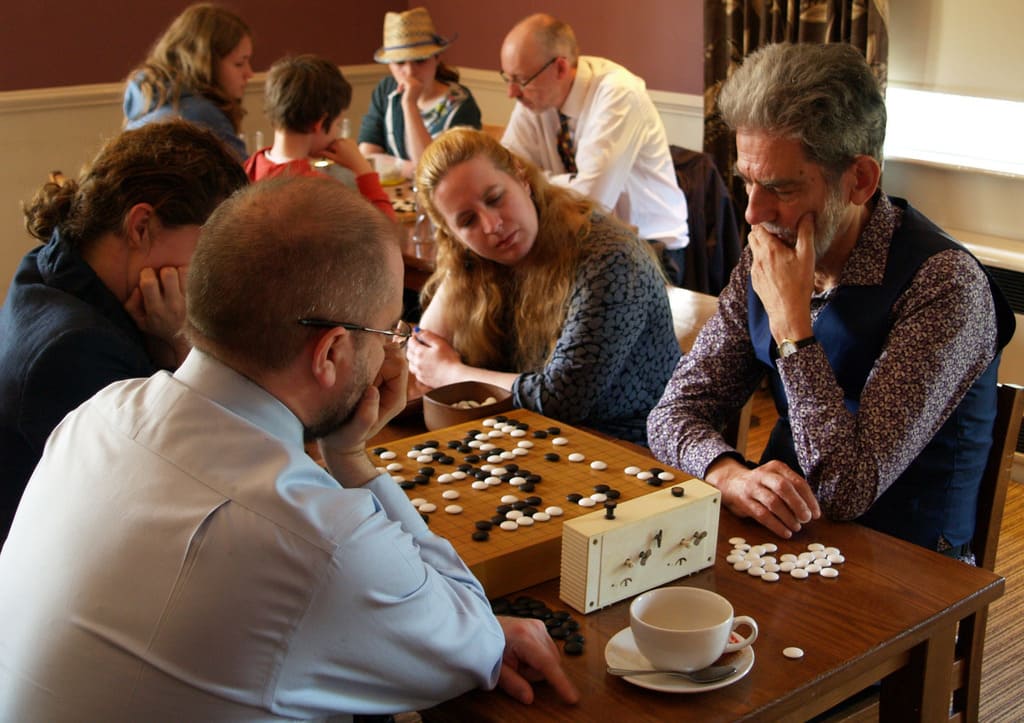
Go variants are changes in the ways you can play Go. Here we share some new and interesting ways to spice up your Go.
Introduction
Every year at the US Go Congress Terry Benson hosts a night called Crazy Go. That evening everyone assembles back in the main play area to play Go variants and meet new people. Variants can present you with new interesting situations you wouldn’t normally get into, scratch your brain in a new way, or just provide some crazy fun.
Rengo
Rengo, also known as Pair Go, is one of the most popular Go variants. In this variant, each color is controlled by two partners who alternate playing each move.
Unlike the rest of the variations you’ll read about here, Rengo has a competitive scene. Each year the Japan Pair Go Association holds a World Pair Go Festival, the Professional Pair Go Championship, and the International Amateur Pair Go Championship.
Rules
- The two partners sit beside each other, facing the opposing pair across the Go board
- Each partner must alternate, playing out of this order results in a three point penalty
- Partners cannot talk about the game
As you’ll see with all these variants, the rules are flexible and as long as you and the other players agree ahead of time you can adjust the rules as much as you like. For instance, if you’re playing casually, maybe you and the other players are okay discussing a situation after it has fully resolved on the board.
Handicap
Pair Go handicap is interesting. If you would like to play with a handicap, simply average the ranks of the two players, then calculate the stone difference as normal.
Why Play Rengo?
Rengo allows you to get into new and interesting positions you wouldn’t always get yourself into in a regular game of Go. You have to be open to your partner’s moves and be willing to embrace their strategy.
Strategies
There are a series of strategies specific to rengo. They typically revolve around the assumption that the pair has one weaker player and one stronger player:
Timesuji – A timesuji, or time-tesuji, typically refers to using a forcing move or ko threat to avoid losing on time while you think out a move on a different part of the board. In Rengo it can be used to ‘pass’ a move to your partner.
Imagine you are the weaker of the pair and you are met with a complicated life and death problem. You’ve read it out thoroughly, but you still aren’t sure what the killing move is. Your partner’s last few moves lead you to believe that they see something you don’t, so instead you play a ko threat on the other side of the board. After your opponent responds your partner will have a chance to play the killing move. This rengo specific technique can be the difference between winning or losing the game.
Choosing black or white – When choosing your color in pair go, there is more to consider than just komi. The play order is typically weaker black player > weaker white player > stronger black player > stronger white player > repeat. If you follow this order, the weaker black player follows the stronger white player. For this reason some consider it an advantage to be white because you don’t want to risk your weaker player falling into a trap set by the stronger opponent.
However, not everyone recommends you use these strategies. North American Professional Michael Chen has this to say about it, “The best thing you can do is play as well as you can… Whenever one player takes the mindset of ‘I don’t know how to deal with this, you deal with it,’ it is bad for you psychologically”. Chen believes that pair go is all about trusting your partner and yourself to play as well as you can, and anything else will hurt your performance and your learning.
A variation within a variation
Let me know if this sounds familiar to you. You go to your local Go club, excited to play Go with your friends, but when you count off you realize you have an odd number of players. What do you do? Does someone sit out and watch? Maybe you have a strong enough player to do a simul match. Well, what about a 2v1? Rengo can be easily modified to have two players play against one. Take the strongest and weakest of the three and pair them up against the player in the middle, then just calculate the handicap as described above and you’re off. Now no one has to miss out on the fun.
Multi-color Go
Multi-color go is another creative way to involve an odd number of players, or just have fun with a group of four.
Multi-color go is exactly what it sounds like. You have 3+ players but instead of teaming up like in rengo you introduce another color. This requires you to have another set of stones. While there are companies that make colored stones you can also get creative and use things like coins or decorative glass gems. You can also try it online at https://dipgo.net/
Specifics to Consider
Area scoring – You should use area scoring, also known as Chinese rules. This is because if two players work together to capture a stone it is unclear who that prisoner should go to. By using area scoring you avoid having to worry about prisoners at all.
Politics – In multi-color go you can discuss strategy with the other players, create alliances, and work together or betray them.
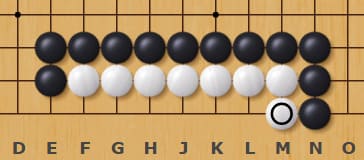
Take this situation for instance. Normally, white would be alive after playing the marked stone, but because there is a third player, it is possible to kill white if black and red work together. (For all diagrams assume the play order is black > white > red.
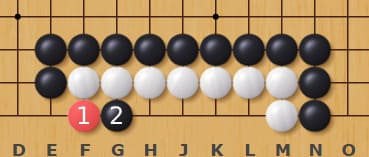
However, when white dies it is black who stands to gain territory from it. This kind of situation is a great chance for red to get something from one of the players. “I will help you kill white but you have to let my corner group live,” or “I will let you live, but you owe me a favor.”
Seki
Seki works differently when it comes to multiple players.
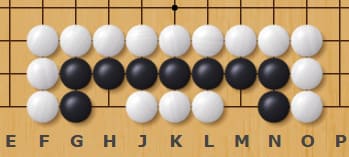
This situation would be a seki in an ordinary game, but in this case, Red has the power to ruin the seki.
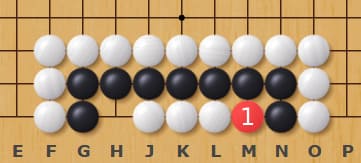
If red plays at M1 black will be able to capture 4 stones at once (3 white and 1 red) this creates a 4 space eye which lives. Except… that it doesn’t live. White plays at K1 and then Red can play at L1 to kill, or tenuki to allow Black to make two eyes.
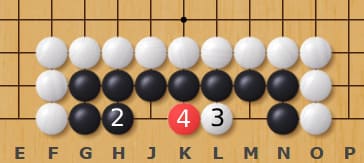
Once again, Red has an incredible amount of bargaining power in a white/black fight.
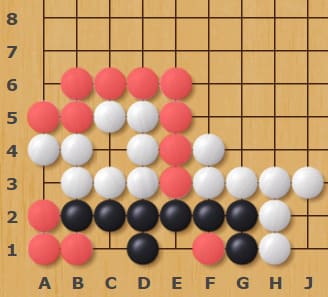
But that doesn’t mean that sekis don’t exist in multi-color go, just that they are less common. Below is an example of a 3 person seki. Neither white nor black can approach the red stones in the corner without putting themself in atari. Likewise, red cannot capture either of these groups because they are also too short on liberties.
Zen Go
Not all the variants on this list are made to accommodate an odd number of players, but I have one more for you. In zen go an odd number is actually a requirement.
How to Play
First get together a group of 3+ players. Ideally this should be an odd number. Players sit in a circle around aboard, and go around the circle playing the move they think is best for that color. Since there are an odd number you will switch off between playing for black and playing for white. This means the goal isn’t to win, instead it is to play the best move.
There are a lot of advantages to playing a game of zen go. You’re not focused on winning or losing which means you can fully focus on understanding the game. You can also openly discuss the game with the other players which can make it a great educational tool. Even more so than rengo, zen go will put you in positions that you normally wouldn’t get in.
This variant is called zen go because of the connection to the Zen principle of non-action. This idea is all about letting go of the ego and being one with the flow of nature. In this case we are giving up the urge to win and we are learning to go with the natural flow of the stones.
“True mastery can be gained by letting things go their own way. It can’t be gained by interfering.”
– Laozi, Tao Te Ching
Additional variations
Another similar variation involves not going in a set order, but instead just jumping in when you see a move you think is interesting. This can get chaotic, but on the upside it works with an even number of players too.
Traitor Go
I felt compelled to add traitor go to this list, as it is a favorite of the Chicago go clubs. If you want a variant that adds a bit of chaos and randomness to your game, then this is the variant for you.
How to Play
The idea of traitor go is that you have a few of your opponent’s stones mixed in with your own, so that when you draw a stone there is a chance you will draw one of your opponents stones instead. When this happens you still have to place it where you intended to put your stone. It can be incredibly frustrating, or incredibly rewarding.
If you want to be formal about it, you could get a small drawstring bag to obscure your stones, and announce the move before drawing a stone so that there is no chance of you changing your move after seeing which stone you get. With that said, this is a casual variant. So you can also just hold the bowl of stones under the table if you don’t have a bag, and play on the honor system so that you don’t have to announce your every move.
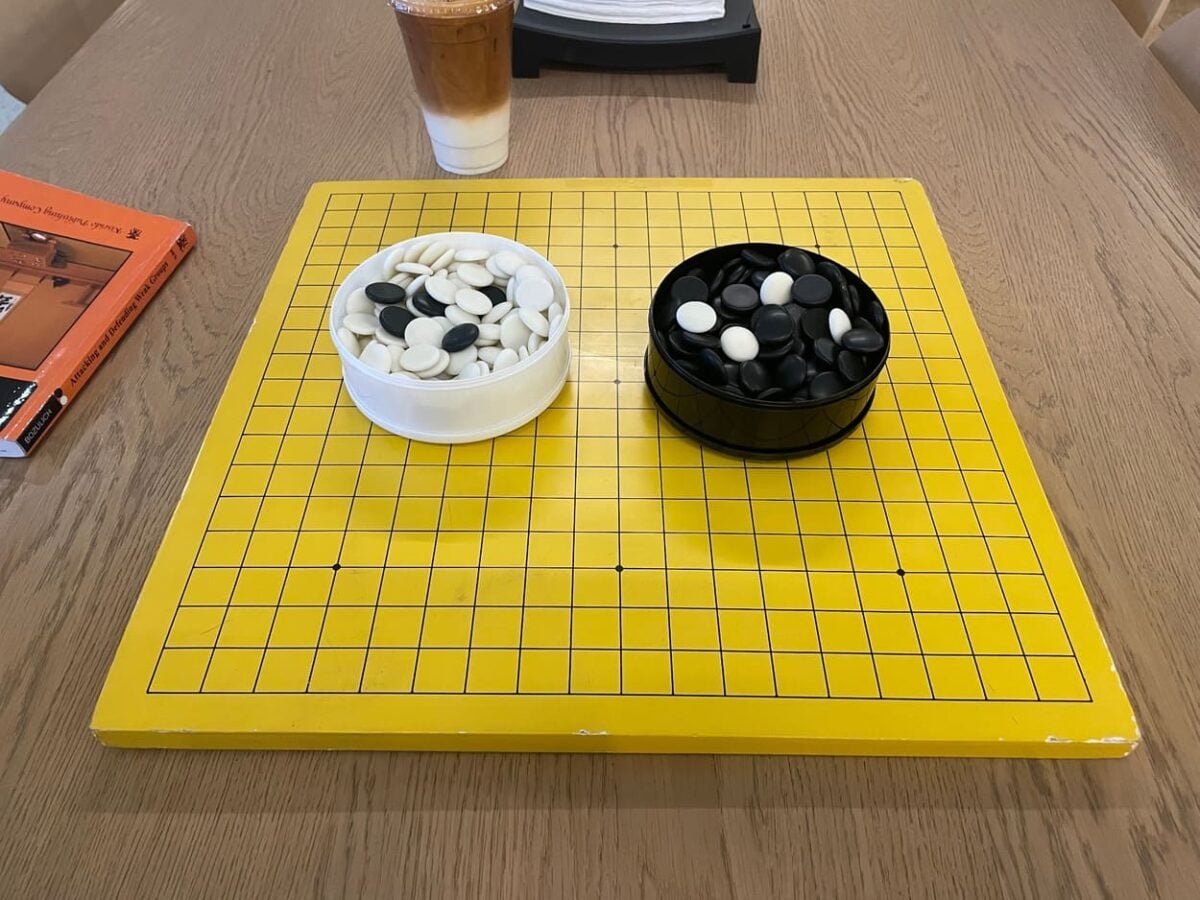
How many stones should you swap?
I recommend starting with 10% of your stones, but I encourage you to play around with this number to see how chaotic of a game you like. You can also put extra traitor stones in one player’s bag as a type of handicap instead of the traditional star point handicap stones.
Strategy
While this game involves luck, there is still a good deal of strategy that is added too. For instance, traitor stones are much more deadly if pulled during a fight. On the other hand, a traitor stone pulled during a peaceful part of the game might be worth a large move, but it is unlikely to result in the death of a group. For this reason, keeping track of which player has more traitors left can inform whether or not you want to start a fight.
A unique situation
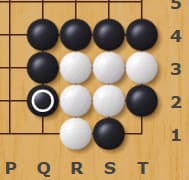
Take a look at this position. White can capture the two black stones by playing at T1. It is the only way for white to live. What happens if the white player pulls a black stone out of her bag? Normally, a black stone at T1 would be an illegal move because it’s suicide, but when played by white in traitor go it’s legal. The three black stones would be removed and black could throw-in at T1 to kill the white stones.
Pixel Go
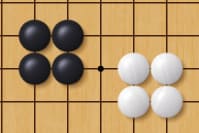
Pixel go is a variant where you don’t play a single stone. Instead, you play a “pixel” which is a 2×2 group of stones. You can ‘aim’ the group anywhere, but stones are only placed on empty spaces.
Pixel Tsumego
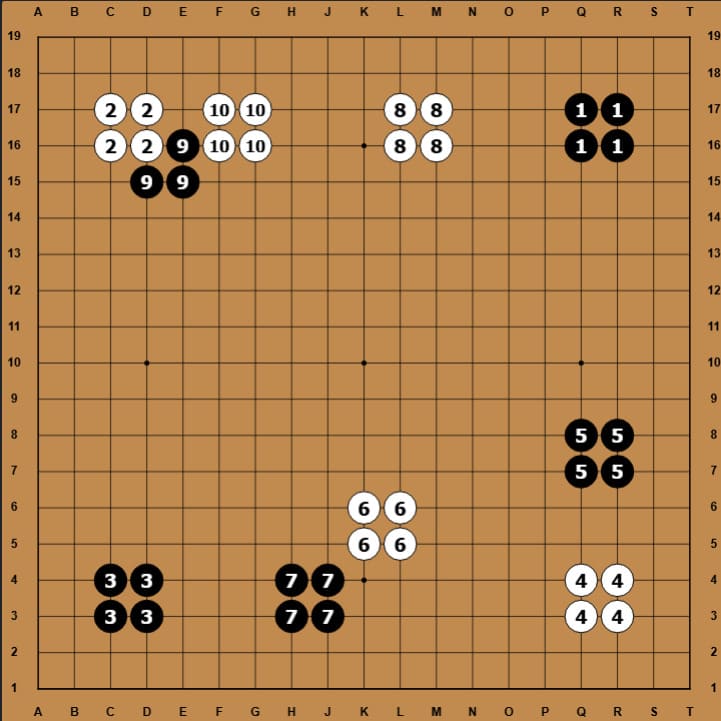
There are a lot of unique scenarios in this game that really make you think, particularly in life and death. See if you can solve this pixel tsumego problem. Is the black group alive or dead? Does it matter whose turn it is?
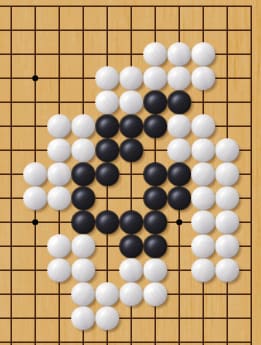
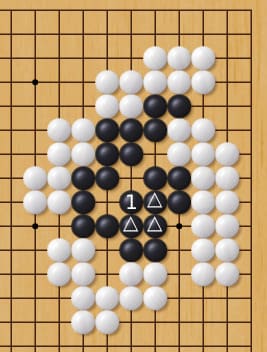
You might say it’s alive if it’s black’s turn, because black can play a stone at 1 and make two eyes. Note that there are already stones at the △ stones so only one new stone is placed. However, this group is still dead in pixel go.
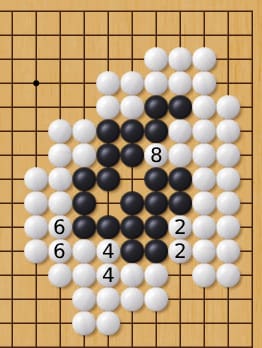
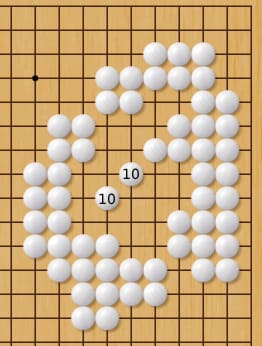
To take the stones off the board, white first needs to fill all the outside liberties with 2-6. Then they can expertly place a pixel in both of black’s eyes with 10.
Give pixel go a try and see what other strange situations you can find!
In an ordinary game this shape would be alive. But in pixel go white can set a pixel right in the center and take out both eyes at once.
One Color Go
One color go is a challenge variation. In this variant you play with only a single color of stones between both you and your opponent. This means that you have to remember which stones belong to you and which belong to your opponent. This is as hard as it sounds, so smaller boards like 9×9 or 13×13 are recommended. Playing one color go can be a good tool to improve your memory and visualization skills.
It’s not uncommon for the game to end with two confused players, but it’s fun to see how long you can go. You can try it out against a computer here.
4 in a row Go
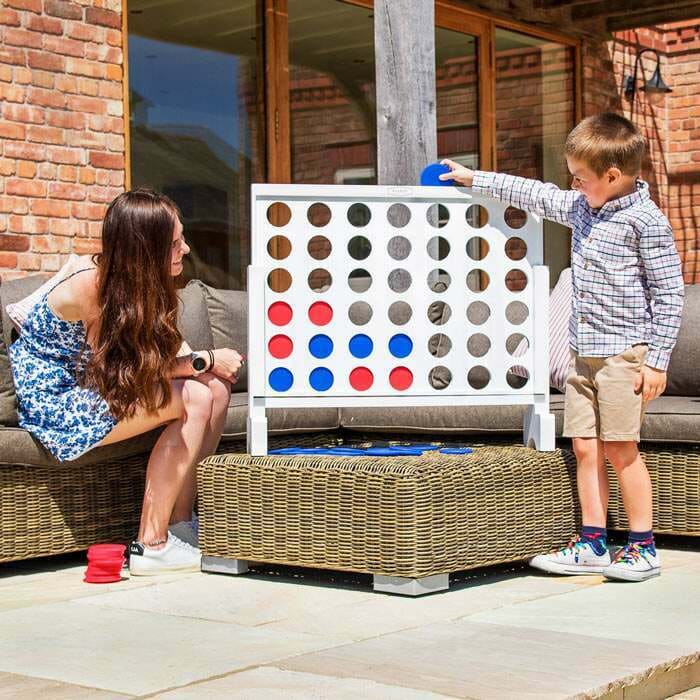
4 in a row go is inspired by games like Gomoku and Connect 4 where the goal is to line up a certain number of pieces in a row. In this variant the goal is still to win by territory, but whenever you place a stone that gives you 4 in a row you get an extra turn. This number of stones is completely adjustable based on your preferences and it can throw wrenches in some joseki, fights, and even life and death.
Coin Go
As the name suggests, all you need to play this variant is a couple of coins. You and your opponent spread a few coins around the go board. These quarters behave as walls. They cannot be captured, don’t count towards territory, and don’t provide a liberty to their neighboring stones. This is an easy way to play with an irregular board shape, and every game is guaranteed to be unique. This is a pretty new variant, created by a Canadian Go player named Felix Léger in 2022.
Setup
To start, you have two options for placing the coins. You can either do it randomly by dropping coins and seeing where they land, or you and your opponent can take turns playing them.
Coin Tsumego
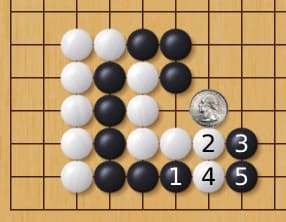
Give this tsumego a try. Black to play, how can Black use the coin to their advantage?
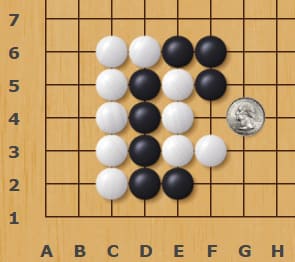
Answer: Black drives white towards the coin, allowing them to capture white against the edge.
See more variants on youtube:
Do you have a favorite that I missed? Let me know, I’m always looking to try new variants.




Оставить комментарий