
Beyond the Board: Six Go Concepts That Rewire How You Think About Investing

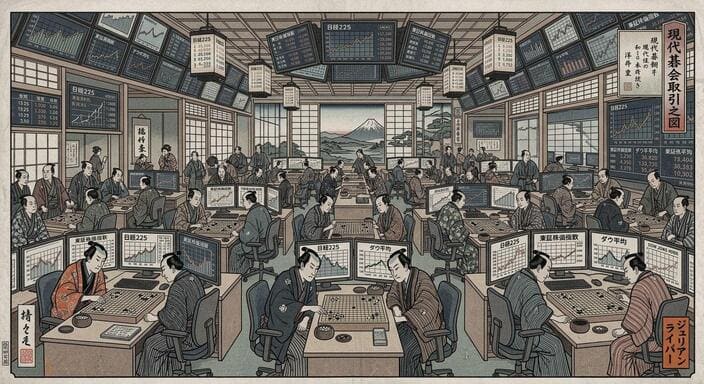
A few years ago, I stumbled upon an asset that seemed to me an obvious investment opportunity. I was brimming with excitement. After taking a position, while scrolling through the infinity of Reddit posts, I came across a post about the asset in question. Prone as I am to confirmation bias, I devoured the article immediately, and to my great surprise, the author considered the company in question a corpse. Literally. It was dizzying. How, from the same data, had this Redditor and I arrived at such diametrically opposed conclusions? Had I been wrong? Was my reading that flawed? Suddenly, a violent realization imposed itself upon me. The author of the post had the posture of a chess player. I had the reading of a Go player.
The Go player is a financial investor who doesn’t know it yet: every move is an investment, every position a potential promise of future gain. Strategies play out, reversals occur. The Go player continuously shuttles between local and global readings of the board, their mind oscillating between established sequences and infinite possibilities.
We Go players know something that chess players don’t. Our game isn’t about destroying a king. It’s about building influence, controlling space, and letting the opponent’s own momentum turn against them. Long before the first capture, everything is already being decided by the invisible architecture of the stones.
What if this logic didn’t just describe a game, but the deepest structure of financial markets?
For decades, finance has been trapped in military thinking. Chess gave us the language of attack and defense, of beating the benchmark and crushing the competition. Sun Tzu refined it with cunning and terrain. But both models share a fatal flaw: they think in terms of conflict. There is an enemy. There is a fight. Winning means winning it.
Markets are not a battlefield. They are a field. And a field isn’t fought, it’s read.
My book, The Go Edge, proposes a different model. It mounts classical portfolio theory on an entirely new chassis, bringing together the physics of markets, strategic logic, and the geometry of Go into a unified framework designed not to predict the future, but to read the present with a depth that standard models cannot reach.
Here are six core concepts from our game that become operational investment tools.
1. Aji (味) — Latent potential
In Go, aji is the residual potential of a position, a latent threat, an unactivated possibility, an energy stored in the configuration of the stones that may be released at some undetermined future moment. A stone with aji doesn’t look strong today. It may not occupy visible territory. It doesn’t attack. But it exists in the field, and its very existence constrains the opponent’s decisions.
This is the core concept of The Go Edge, and the one that makes the other five legible. Without aji, a stone is just an allocation. Territory is just a gain. A reversal is just luck. With aji, everything acquires a causal, measurable, and anticipatable dimension.
Physicists will recognize something familiar here. Schrödinger’s cat, simultaneously alive and dead until the box is opened, is a surprisingly precise analogy. A position with strong aji contains several futures not yet collapsed. Threat and promise coexist in the same stone. Opening the box too early, activating aji before the board demands it, is precisely the mistake the impatient investor makes when trying to crystallize latent value the market isn’t ready to recognize.
In financial terms, gold during periods of euphoric growth is the canonical example: seemingly dormant, underperforming equities, it silently accumulates energy that a change of regime releases with a brutality that nothing in classical models could have anticipated.
2. The Stone and Its Position — Value Is (in fact) Relational
A Go stone has no value in itself. Its worth comes entirely from where it sits on the board, the stones around it, and the influence it exerts on neighboring intersections. An isolated stone in open space is nearly worthless. That same stone, placed at the right spot at the right moment, can decide the game.
This is something classical fundamental analysis cannot see. It photographs the stone without reading the board. A company with excellent fundamentals, solid cash flow, healthy balance sheet, defensible competitive position, may carry trapped aji if it operates in a late-cycle sector, if its asset class is massively overweighted by consensus, or if the macro configuration has shifted to a regime that neutralizes precisely the virtues its fundamentals express.
Fundamental analysis tells you what the stone is. The Go Edge tells you what the stone is worth — right now, in this field, at this phase of the cycle.
3. Territory and Influence — Two Ways of Counting Wealth
In Go, victory is calculated in territory, the intersections enclosed and controlled at the end of the game. But during the game, what matters is not territory already acquired: it’s the influence currently under construction. Influence always precedes territory. You don’t win territory directly, you build influence, and that influence converts into territory at the opportune moment.
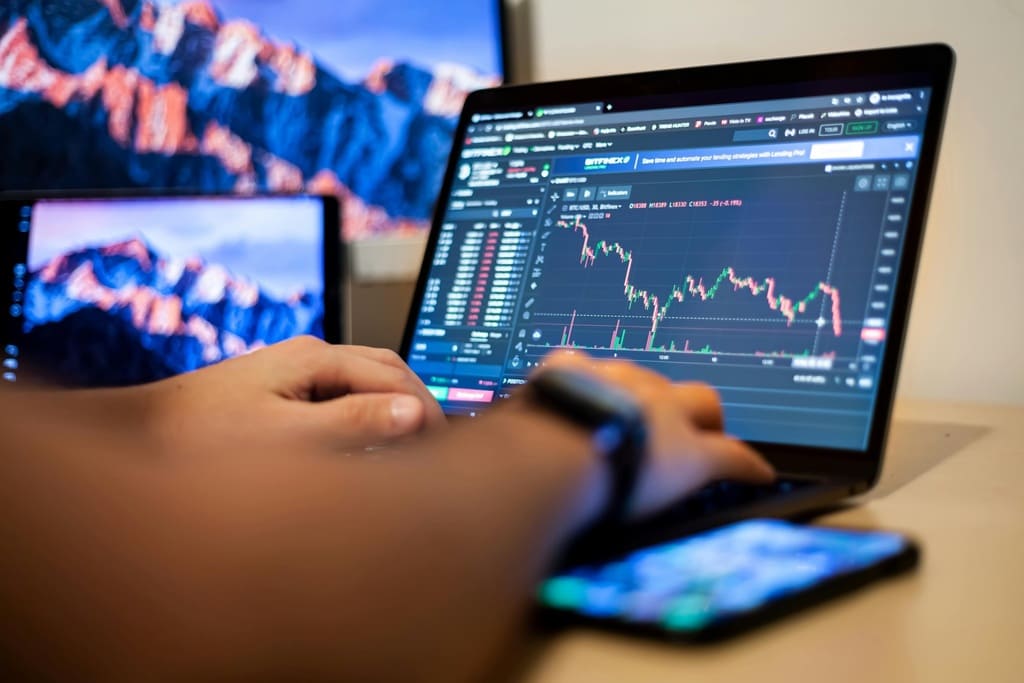
Finance has a name for the failure to grasp this distinction. Behavioral economists call it short-term bias — the tendency to overweight immediate gains and ignore positions with latent value. This bias is precisely what the Go-oriented investor exploits: while the crowd chases visible territory, they build the invisible influence that will make that territory accessible at the moment of the shift. Once a Go-beginner starts to strengthen, he no longer confuses moyo for territory (as I did for decades).
Aji is the link between the two. It’s the energy accumulated in influence positions that converts into territory during a regime change.
4. Utegaeshi (打ち返し) — When Strength Becomes Self-Defeat
The utegaeshi is (in my opinion) one of Go’s most sophisticated concepts. It designates the situation where an opponent, in capturing what appears to be a weak or isolated stone, triggers their own capture, because the stones they just played find themselves immediately encircled by pre-existing influence.
The beauty of the utegaeshi is that it requires no direct attack. The strategist doesn’t need to act at the moment of reversal: the configuration they have patiently constructed makes the reversal inevitable and automatic. The opponent destroys themselves through their own initiative.
The 2008 financial crisis was a pure utegaeshi. Over-leveraged positions, accumulated silently over years of low volatility, appeared strong right up until the moment the cycle turned. Then, forced margin calls triggered a cascade of liquidations. The speculators who had pushed their stones furthest into enemy territory were captured not by a counter-attack, but by the weight of their own leverage snapping back against them.
The lesson is one of the purest expressions of Go applied to finance: don’t fight the force. Let the force fight itself.
5. Sente (先手) — Governing by Initiative
Playing sente means placing a stone that forces the opponent to respond, a stone so charged with potential that ignoring it would be catastrophic. Whoever plays sente keeps the initiative. They set the rhythm, the direction, the theater of operations.
Its opposite, gote is not merely the absence of sente. It’s a posture, and like any posture, it has its own logic of degradation. The investor in gote doesn’t decide, they respond. They don’t read the board, they react to the last stone played. Their time horizon contracts move by move until it shrinks to the next earnings release, the next central bank decision, the next trend.
The most common incarnation of the unconscious gote position is FOMO: Fear Of Missing Out. The FOMO investor doesn’t read the board, they watch others play. They enter the position precisely when the aji has already been released, when the price already reflects the most optimistic expectations, when the stone no longer has any structural liberty to offer. The market needs liquidity to function, and the FOMO investor is the ideal liquidity provider.
A strategist-investor seeks to minimize their gote moves and maximize their sente sequences, not through aggression, but through the strategic economy of energy. Sente in investing is not hyperactivity. It’s placing positions that anticipate cycle inflection points before they occur. It’s the market coming to you, not the other way around.
6. Tesuji (手筋) — The Move Nobody Sees (But Wishes He Had)
If aji is potential at rest, and sente is anticipatory initiative, the tesuji is something more precise and more rare: the locally brilliant move that maximally exploits the configuration of a given situation. It is not merely optimal but unexpected, invisible to most observers, obvious in retrospect, and transformative well beyond its apparent local reach.
A concrete example. In the mid-2010s, while virtually all investors concentrated on Apple, the most visible, most contested stone on the technology board, a careful reading of the underlying geometry of semiconductors revealed a different configuration. ASML, the Dutch manufacturer of extreme ultraviolet lithography machines, occupied an absolutely unique influence position: a de facto technological monopoly on the equipment indispensable to manufacturing the most advanced chips, near-impassable barriers to entry, and a valuation still modest relative to its structural aji.

This was not a bet on future disruption. It was the reading of an aji already present in the board’s configuration, a position whose influence was silently accumulating the energy of the semiconductor revolution while everyone was looking elsewhere.
The tesuji is not accessible to all investors at all times. It requires three simultaneous conditions: deep knowledge of the board’s geometry, the capacity to read aji where consensus sees only calm, and the conviction to play a move that no one else is yet playing.
The Board Has No Edge
An empty Go board is an invitation. Not a promise, an invitation. It guarantees nothing. It offers a space, vast, open, physically structured, in which a rigorous reading produces, over time, better decisions than uninformed intuition or a model blind to its own incompleteness.
Financial markets make the same invitation. They do not reward the most intelligent, the fastest, or the best connected to information. Over the duration of cycles, that of the patiently constructed opening, the rigorously navigated middle game, the soberly played endgame, they reward those who have understood the geometry of the board, who maintained their dry powder when others were fully invested, who held their corner stones when consensus abandoned them, and who recognized the utegaeshi for what it was: not a crisis to survive, but a physical consequence to traverse with the serenity of someone who had seen it coming.
This book is itself a cornerstone. It does not claim to close the debate, it claims to open it onto a territory that the financial literature had not yet explored with this precision. Joseki evolve. Frameworks sharpen. The board endures.
Place your stones with care. Build your influence with patience. Let physics do its work.
Beyond the Board is drawn from The Go Edge — Reading the Markets as a Living Board (Julien Leiber, 2026), available on Amazon in Kindle, paperback, and hardcover editions. Julien Leiber is a self-taught investor trained in Egyptology at the University of Strasbourg, who discovered Go in the early 2000s. The Go Edge builds a unified investment framework at the intersection of the physics of financial assets, macroeconomic cycle theory, and six foundational concepts of Go. https://www.amazon.com/dp/B0GXH4LMCK
The board is waiting.





Комментарии