
Chapter 1: The Twilight of the Gods

“Look on my works, ye Mighty, and despair!”
—Ozymandias, Percy Shelley
The Match of the Century
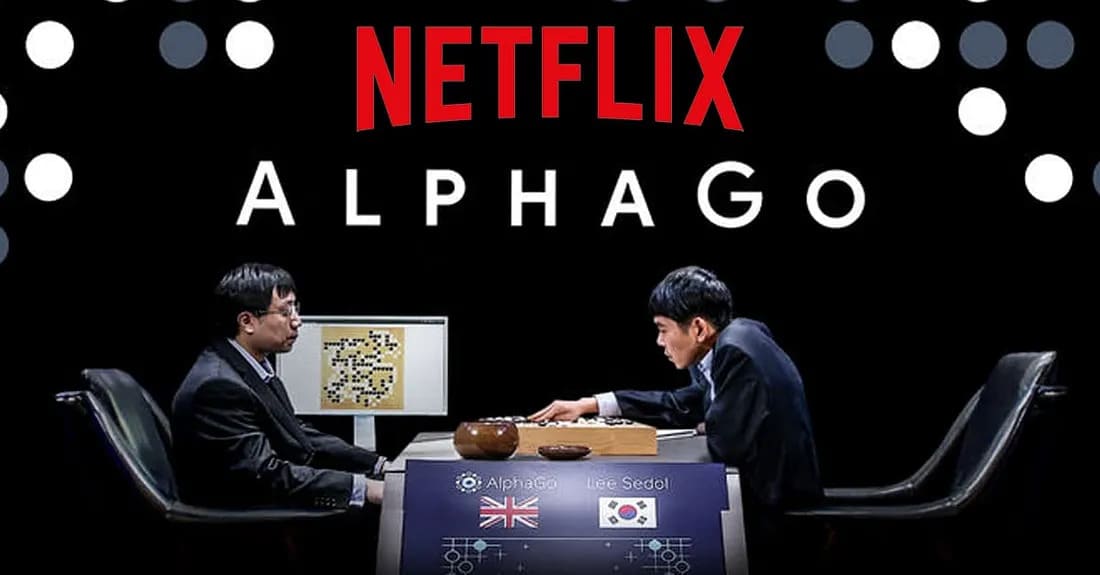
I still remember the day of the first game between Lee Sedol and AlphaGo. It was March 9th, 2016, the second week of the spring semester (I was in college, majoring in philosophy).[1] I remember everyone was riveted by the game; the whole country was abuzz with excitement due to the first official match between a human Go player and a machine. And it wasn’t just any Go player—it was Lee Sedol, the living legend who had been reigning over the Go world for a decade.
I also remember that I simultaneously appreciated and despised people’s attention. I appreciated it because not a lot of people knew how to play the game, let alone had interest in it. People my age, those in their 20s and 30s, mostly regarded it as being old-fashioned, hard to learn, and, above all, boring to death. Even today, coming by a person my age who knows how to play Go is one in a million. So, whenever I told my friends that I love Go, they would look at me like I just time traveled from the Stone Age or something. But because of this match of the century, I was suddenly the guy to turn to and ask around. It felt pretty good, to be honest. I mean, when would a nerd like me ever get this kind of attention?
Yet I despised the attention because I knew it was due to the hype, not to a genuine interest in the game. It was the same kind of media hype that you could easily observe from Korean YouTubers that interview a bunch of foreigners, asking their impressions about Korea. You know what I’m talking about, if you have had the pleasure of a Korean asking you questions like “Do you know kimchi?”, “Do you know BTS?” or “Do you know Son Heung-min?” It’s actually funny to watch these YouTubers because the foreigners know exactly what the Korean viewers want to hear, and millions of viewers, who also understand exactly that the foreigners are just saying what they want to hear, love them nonetheless: “I love kimchi! I love BTS! Son is the best! Hangook saranghaeyo (I love Korea)!”
But I digress. In any case, I just hard-sold how this Eastern boardgame is “way better” than the Western one, so I guess I am the same. What I particularly didn’t like about the hype, though, was that people who didn’t know about the game were genuinely questioning who will win. Every Go player was sure that Lee would win. The only Go players who thought otherwise were the DeepMind team, who invented AlphaGo, and the European Go champion, Fan Hui, who had test runs with AlphaGo and was crushed.
Now, you’d think the first time a pro Go player was officially defeated by a machine would have caught the attention of the other players. After reviewing the games Fan played against AlphaGo, however, the pro Go players assessed AlphaGo to be around pro-level 5 Dan, which was surprisingly high for a machine, but still not as high as 9Dan, the level Lee was at (Fan was a 2 Dan player at the time). After all, European Go champion might sound impressive to those unfamiliar with the game, but to a serious Go player, it meant that you are the chess master of Who-knows-where, Wyoming. Or it meant that you are the best boxer in…well, Who-cares-where, Wyoming, far away from Las Vegas, the boxing capital of the world, which, in the world of Go, is East Asia, particularly Korea and China.[2] While Fan Hui is an amazing person with great humility, he and Lee weren’t at the same level. They weren’t even close, objectively speaking. Almost all professional players did not consider Fan’s defeat as something significant. Every Go player was like, “a European Go champion was crushed? So what? We got Mike Tyson right here.”[3]
But before we proceed further, let me explain what a Dan is.
Entering the Realm of Gods
In chess, the players of the highest rank are called masters. Depending on their Elo ratings, the players are given different status as masters, like Candidate Master (CM), FIDE Master (FM), International Master (IM), and the Grandmaster (GM). To have the title of a master, you must achieve a rating of at least 2,200 and above in the Elo rating system. The players below that rating are given the less glamorous classifications, since, understandably, they aren’t at a glamorous level. Instead, they are given the good old letters of A, B, C, and D. So, if you want to escape the dull alphabetical ranks, you must be really good at the game.
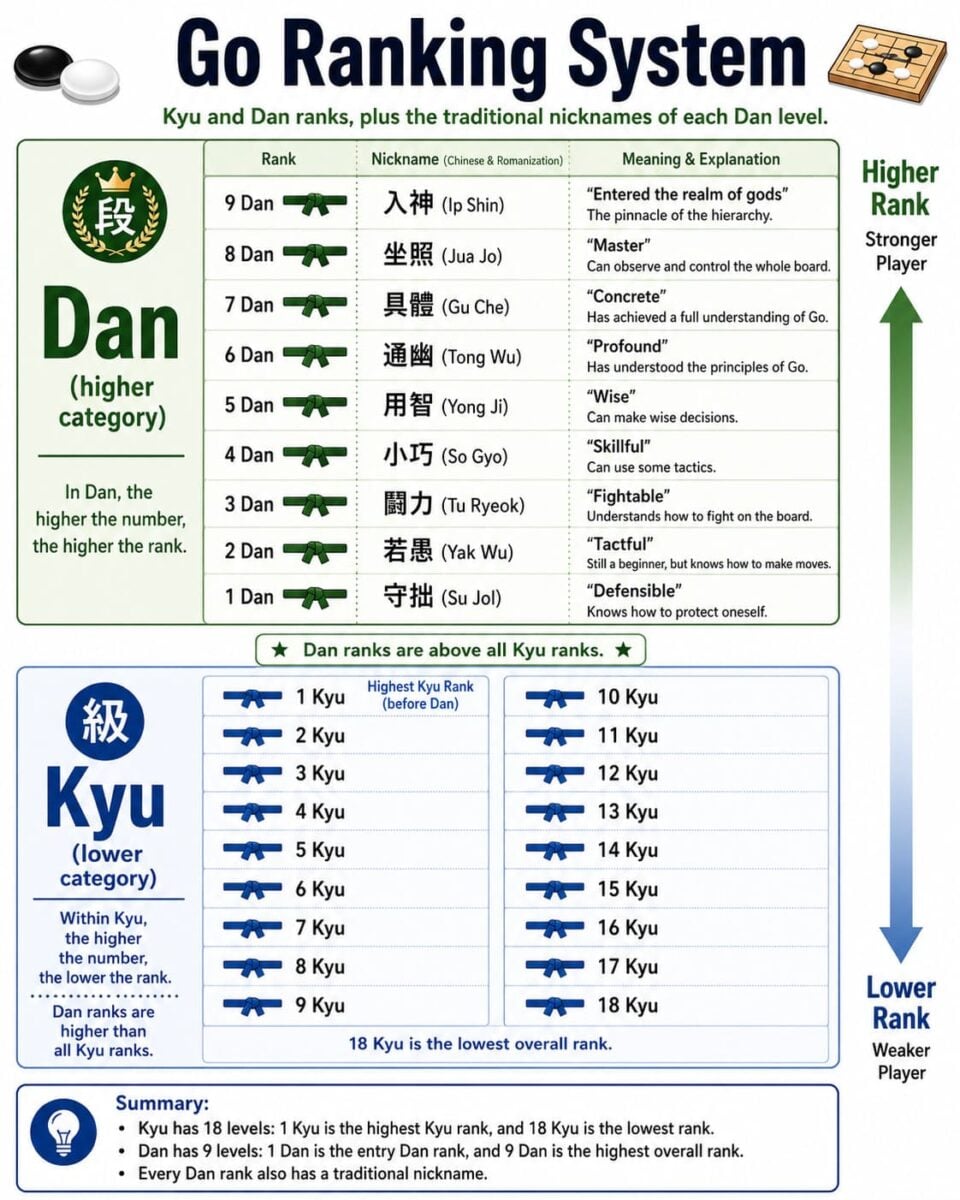
Well, it is pretty much the same in Go, only much more stringent. Basically, two ranks delineate the path of a player: Kyu (級), the rank for those just beginning their journey, and Dan (段, pronounced Dhan, like Khan), the mark of a master. There are 18 levels in the Kyu rank, and the larger the number, the lower the rank.[4] There are 9 levels in the Dan rank, and the larger the number, the higher the rank. So, as you become advanced, you ascend from 18 Kyu to 1Kyu, crossing over into the realm of the Dans, all the way up to 9 Dan.
Now, it is generally understood that the Dan level is quite hard to achieve. So, being a master of the game and all, you are given special perks once you get there—every level in the Dan rank gets a cool nickname.
For instance, 1 Dan is also called 守拙 (Su Jol), or “Defensible,” implying that the player has now entered the stage of knowing how to protect oneself in the game. Yes, that’s right. After moving up the ladder 18 times, andonly after that, you reach the level where you now understand the basics of defense (encouraged much?). Then comes 2 Dan, also called 若愚 (Yak Wu), or “Tactful,” meaning the player is still a beginner but knows how to make moves. 3 Dan is called 鬪力 (Tu Ryeok) or “Fightable,” representing a stage where the player understands how to fight on the board. Then, it’s 4Dan, or 小巧 (So Gyo), which means “Skillful,” implying the player can use some tactics. 5 Dan is called 用智 (Yong Ji) or “Wise,” representing a stage where the player can make wise decisions.[5] 6 Dan is called 通幽 (Tong Wu) or “Profound,” signifying the stage where the player has understood the principles of Go. 7 Dan is called 具體 (Gu Che), meaning “Concrete,” implying the player has achieved a full understanding of Go. 8 Dan is called 坐照 (Jua Jo) or a “Master,” representing the stage where the player can observe and control the whole board. And finally, 9 Dan, the pinnacle of the hierarchy, the master level of the master levels, is called 入神 (Ip Shin), or “the one who entered the realm of gods.”[6]
Now, back in the days, as you can imagine, every Go player’s dream was to gain the title of Ip Shin. It carried a different weight than the rest of the titles, much like Grandmaster in chess. It was an honor unlike anything else. And it was more than just a title; it was an affirmation—an affirmation that they could compete against the divine prowess of the God of Go, should such an entity exist. In fact, most 9 Dan players, if not all, sincerelybelieved they could compete against God.[7] Of course, they didn’t think they could be evenly matched against God without any handicap, as bold as they were, but the Ip Shins did frequently ponder, “What is the gap between an Ip Shin and the God of Go? What would it take to even the match?”
Even Match Against God
As mentioned earlier, Black always moves first in Go, which gives a definite advantage over White. To offset this, Go employs a unique system of compensation known as “komi.” Komi refers to the number of points awarded to the White player at the end of the game to balance this initial disadvantage. In a standard game, the White player receives 6.5 or 7.5 komi, depending on whether the Korean/Japanese rule or Chinese rule is used. Go is a game of winning territories, with each intersection considered 1 point. Thus, 6.5 komi means White is given 6.5 points at the end of the game. While “0.5” territory doesn’t technically make sense—as there are no “0.5” intersections on the board—this half-point is attributed to ensure that the game will not end in a tie. Except in very rare cases, Go games do not end in a tie, unlike chess (that’s right, we Go players think ties are for sissies).
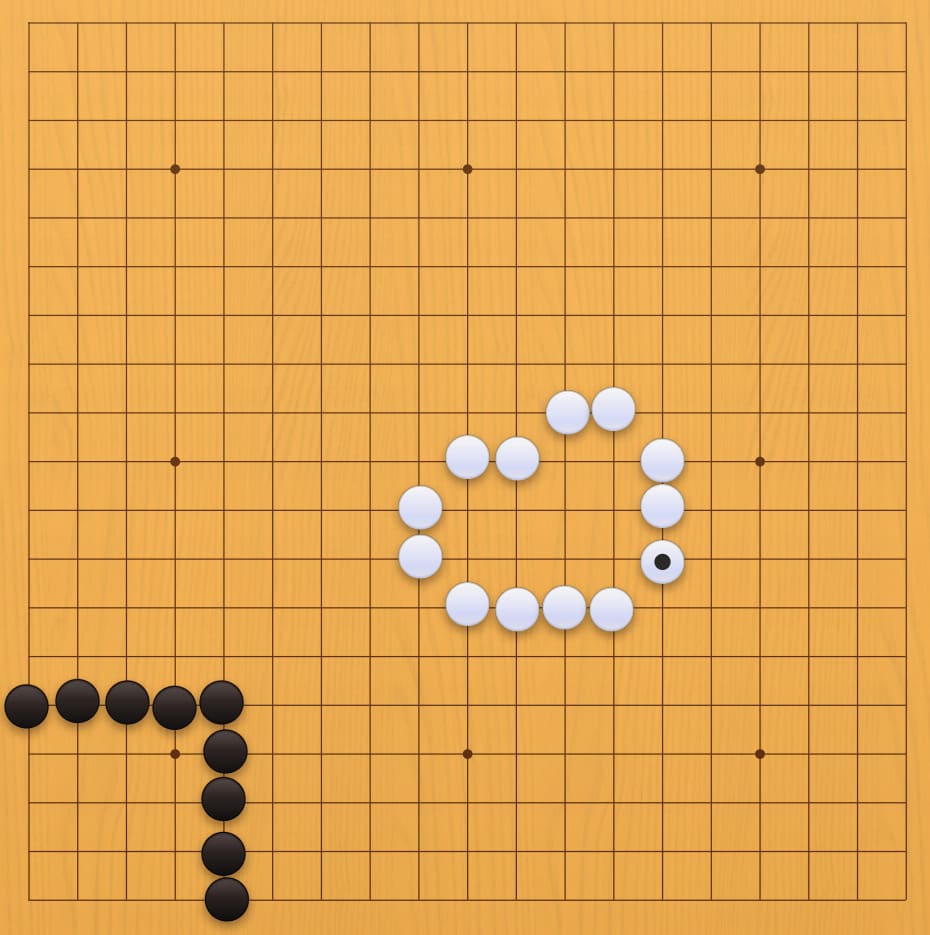
The objective of Go is to gain more territory than the opponent. To gain territory, your stones must surround intersections. In Figure 4, Black stones are surrounding 16 intersections, whereas White stones are surrounding only 10 intersections. Therefore, Black is ahead by 6 points on the board. However, White is awarded 6.5 komi at the end of the game. So, if we assume the game ends as it is, White would have a total of 16.5 points, resulting in a 0.5-point victory over Black.
Now, when players of differing skill levels compete, the higher-skilled player typically plays as White and doesn’t receive any komi (except for the 0.5 komi to prevent a tie). Depending on the skill gap, White players may even give Black players a handicap by allowing them to place stones on the board prior to the start of the match. For instance, a 2 Dan player might be afforded a 3-stone handicap against a 5 Dan opponent. Similarly, a 5 Dan player might receive a 2-stone handicap when facing off against a 7 Dan player. Thus, typically, a one-level difference in ranking corresponds to a one-stone handicap (see Figure 4).[8]
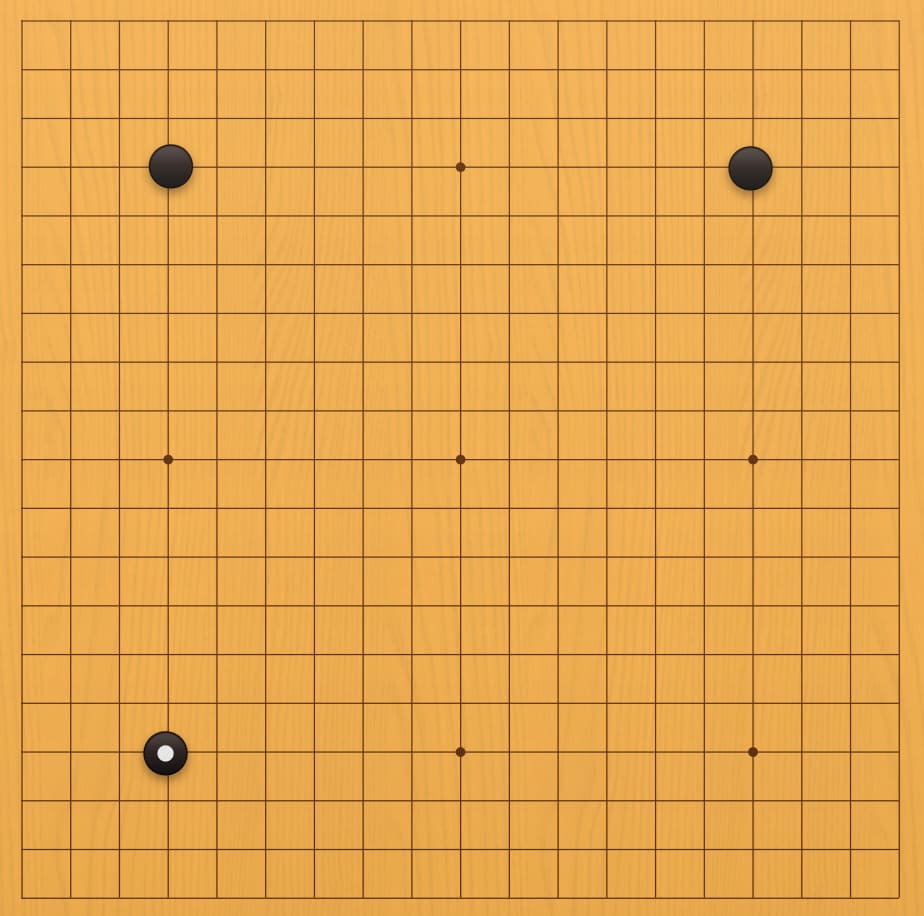
In games with two or more stones handicap, White always plays first.
However, as the skill levels of both players increase, the burden of handicap escalates exponentially for the higher-level player. This is because even the disadvantaged player becomes skilled enough to effectively utilize the given handicap. As a result, the game becomes less about numerical advantage and more about strategic depth and adaptability at higher levels of play. Thus, beyond 4 to 5 Dan, you rarely see games with more than a 4-stone handicap. At such a level, a handicap greater than four stones becomes virtually meaningless.
If this is a bit confusing, think in terms of chess. If Magnus Carlsen, one of the greatest grandmasters in history, were to play against a beginner like me with the handicap of his queen and bishops, he’d likely still win. But if he played against a player above 2,000 Elo rating, he’d probably have a hard time without his rooks. Thus, in Go as in chess, the handicap given depends not only on the absolute skill difference but also on the skill level of the weaker player.
For example, the gap between me and a pro is literally wider than the Grand Canyon. Be that as it may, I still have some understanding of how the game should be played. So, if given a 5 or 6-stone handicap, there is no way that I would lose the game. That is like having a 100m race against Usain Bolt with a 50m head start. Sure, Bolt might win against a toddler even if they get an 80m advantage, but he sure as hell can’t beat someone who averages 12 seconds for a 100m run with that kind of handicap (in case you are wondering if that’s true, I asked ChatGPT, and it said I would win. So, it must be true). Likewise, a 9 Dan player can easily beat a 1 Dan player even with a 9-stone handicap—which is the maximum handicap you can get in Go—but it is so much more difficult for a 9 Dan player to beat a 6 Dan player with a 3-stone handicap.
And this is where it gets really interesting. As mentioned earlier, the Go players wondered for ages what it would take to even the odds against the God of Go, and the general consensus among pro Go players was that a top player would have a fair match with a 2-stone handicap. In fact, when asked the question, Wu Qingyuan, A.K.A. Go Saint (more commonly referred to as Go Seigen, following the Japanese rendition), answered that a 2-stone handicap would suffice to match the God of Go.[9] Lee Sedol, answering the same question, gave the same answer.
Now, after reviewing the games Fan played against AlphaGo, the pro Go players, including Lee himself, assessed the machine to be more than two levels below Lee, meaning that AlphaGo would require a two-stone or greater handicap to be evenly matched against Lee. Lee even stated that the real contest essentially hinged on whether he would lose a single game, as losing one would be the same as losing the entire match, even though it was a best-of-five series.[10]
THAT is how much confidence the Go players had in Lee’s effortless victory, including, and perhaps especially, Lee himself. The gap between Lee and AlphaGo was estimated to be wider than the gap between the Ip Shins and the God of Go. As their title suggests, the Ip Shins considered themselves demigods of the Go world, having achieved godhood with the sheer might of their minds, their eyes fixed upon the Mount Go-lympus, waiting for the day of their ascension into full-fledged divinity. So how could a lowly artificial intelligence created by mere mortals even register on their radar? So high was Lee’s confidence—and our confidence—reaching as far as the sun that hung in the sky that fateful afternoon of Game 1.
And can you really blame us? It wasn’t like AlphaGo was the first machine to challenge a professional human Go player. It wasn’t like we hadn’t seen all the machines before AlphaGo collapse like houses of cards within 30 moves. In 1987, a prize of 40 million Taiwanese dollars—equivalent to over 1 million US dollars—was offered for a program that could beat trainee professional Go players with no handicap.[11] However, the prize was never claimed because the only games any program could win against a human player were those with an eleven-stone handicap or more.[12] Fast forward 10 years to 1998, one year after Kasparov’s defeat, the Go players could still beat programs even when given a 25- to 30-stone handicap. A 25- to 30-stone handicap is pretty much the same as playing chess with just two pawns and the king.
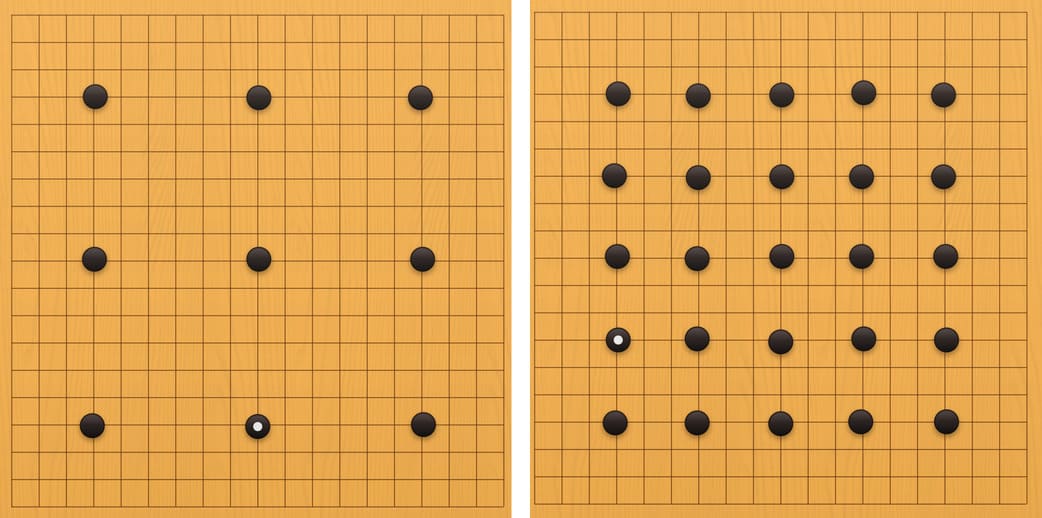
Remember, Go is a game of filling in the board, the objective of which is to gain more territory than your opponent by surrounding empty intersections with your stones. Even if you don’t understand the game at all, you can tell that a 9-stone handicap (on the left) gives the player so much advantage, while a 25-stone handicap (on the right) is just ridiculous. But even with that kind of handicap—and more—programs still could not beat a human player.
Fast forward another 10 years, and finally, in 2008, a program called MoGo defeated a professional 8 Dan, but the victory still came with a 9-stone handicap. Then, in 2014, just 2 years before Lee’s match against AlphaGo, the Go world was surprised when a program called Crazy Stone won a game against 11-time German Go champion, Franz-Jozef Dickhut, who was a 6 Dan amateur. This, by many, was considered an impressive achievement. Let me rephrase that—it was considered very impressive that a program defeated an amateur 6 Dan player. Of course, Fan’s defeat in 2015 carried more weight than the rest, since he was far superior to Dickhut (after all, Fan was an officially recognized professional). However, Lee was also far superior to Fan, which is why, once again, nobody cared. So, a machine is going to play against the legendary player without any handicap? By now, you can probably imagine just how “significant” AlphaGo’s challenge was for the Go players.
On that note, the only significance we saw was the opportunity to once again showcase the unconquered superiority of the Orient through this 4,000-year-old board game. We were excited about all the attention it was set to bring to the game, especially with Google’s DeepMind team being involved and all. As far as we were concerned, the Go board was our altar, and AlphaGo was the perfect offering to honor the ancient spirit of Go that has been pursued for millennia. This machine, the offspring of Western technology and hubris, served as the perfect sacrifice to our venerable God of Go—a tribute intended to attract new believers in the superiority of the human intellect and spread the gospel of Go worldwide.
And, in accordance with our wish, the gospel was spread—more or less. The superiority of human intellect, however, was not. On the contrary, it turned out that was the sacrifice we had to offer.
As we munched on popcorn and sipped our beers, Game 1 initially unfolded just the way we had imagined: an execution. But as the game progressed—our mouths agape, popcorn frozen mid-air, and beers dangling in disbelief—it became clear that it wasn’t AlphaGo that was being humbled. It was Lee, the god of gods of his era, the Ip Shin of Ip Shins, the unrivaled champion with unmatched ingenuity, the master hailed for a decade as the greatest.
Throughout the game, the man who had once regarded AlphaGo as far beneath him found himself dismantled by a force of unprecedented precision. He was ruthlessly stripped of his pride, left exposed and vulnerable, reduced to a mere mortal. In turn, he was looked down upon by AlphaGo—like David from Prometheus—which, with its moves, declared, “Look on my works, ye Mighty, and despair!”
And despair we did.
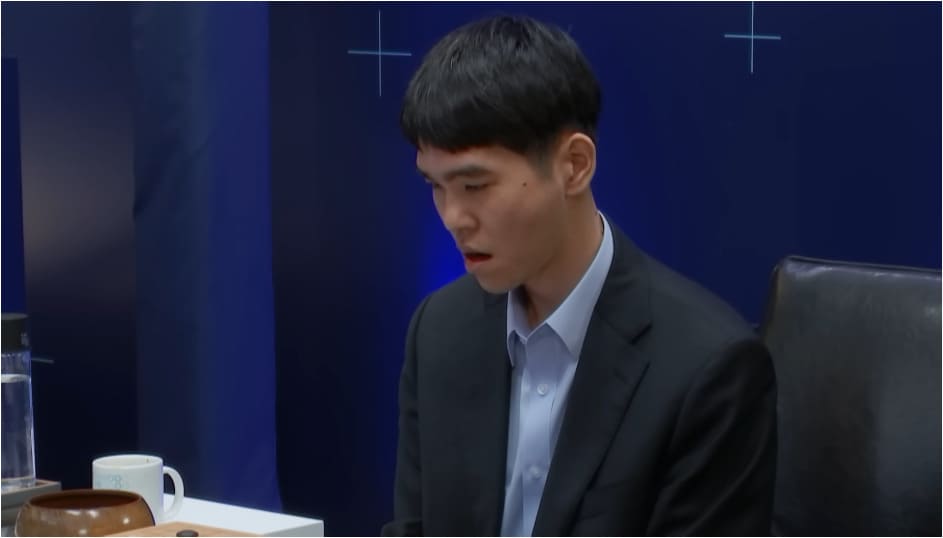
As the final stone fell, sealing Lee’s crushing defeat, the air grew heavy with a mix of shock and disbelief. I remember just how somber the atmosphere was during the post-game interview. Everyone, Go-players and non-players alike, was dispirited, and no one dared to utter a word. The only people cheering were the DeepMind team, who had successfully given birth to a new god—one capable of reducing the complexities of Go to a simple symphony of ones and zeros, transforming the infinite universe on the wooden plate into finite columns of mathematical equations. Lee remarked that he was very surprised by the machine’s level of play. He also said that he had a good game, had no regrets accepting the challenge, and wouldn’t let his guard down for the remaining games. Yet his words offered no comfort to the Go world. There were still 4 games left, but we all knew instinctively that Lee stood no chance against this beast that had emerged from the West. As the saying goes, it became obvious that the Ip Shins were mice at play, pretending to be cats themselves, when the real cat was yet to be incarnated. And now the play was over—the play that had been going on for millennia. Alas, the king of the mice of its time had to admit that it was, after all, nothing more than a mouse. Then we saw how a real cat plays. We saw that AlphaGo wasn’t just winning the game; it was toying with Lee—creating a huge gap in the early and mid-phase, letting Lee catch up towards the end, rekindling hope in our hearts, only to seal the game with a tiny yet definite lead, making Lee and his followers realize that the only reason Lee was able to catch up was because it allowed him to. Later, we learned that it was programmed to win by only a tiny margin, no more and no less, and it did exactly that.
The whole Go community was in a panic as the last thing they imagined came true. Some said they simply could not accept the outcome. Some questioned whether the game had even been fair to begin with. The then secretary-general of the Korea Baduk Association (KBA) complained that Lee was at a significant disadvantage, since AlphaGo had access to all the games Lee had played while Lee wasn’t provided sufficient information about AlphaGo (which, if you ask me, sounded no different from Kasparov’s post-match whining). Some, much like Steven Levy, lamented that humanity is being overwhelmed by its own creation, that we are constantly being deprived of our worth as human beings. Others remarked that it felt as if they were witnessing the awe-inspiring moves of countless Go prodigies throughout thousands of years of the game’s history being ripped of their value in a single moment. In fact, after game 1, Lee himself remarked that it felt like AlphaGo had disturbed the history of Go.
I also remember feeling like the world had come to an end. When the game was over, I quietly slipped away from the group and stepped out onto the streets of Seoul. I found myself standing in Gwanghwamun Square, in front of the statue of Yi Sun-Shin, the legendary admiral of the Chosun Dynasty, who, with only 13 ships, defeated a Japanese fleet of 330 without losing a single one of his own. As extraordinary as that triumph was, it felt like Lee’s victory demanded an even more implausible miracle. It was around sunset and the rush hour traffic was reaching its peak. The city remained the same on the surface, but there was a definite shift in the atmosphere—a hollowness reverberating through the cacophony of the sleepless city. Gradually, as the last remnants of daylight succumbed to the encroaching darkness, the harsh reality set in.
It was the end of an era, the era of the so-called Ip Shins—the twilight of the gods.
The Meaning of It All
Of course, looking back now, it seems that the whole Go community, especially myself, was overreacting. A decade has passed since then, yet Go players are still playing Go as they always have, and I am just as ardent about the game as ever.
Though the echoes of that decisive match still linger in the Go world, it is Lee’s triumph in Game 4 that continues to resonate as a truly historic moment—the only official instance in history where a human defeated an AI. Some even compared this to a person outrunning a race car. This singular, miraculous victory was enough to outweigh all the other defeats, as nobody seemed to remember the moves that AlphaGo made in the other four games. But even those who don’t know Go still recall Lee’s so-called “God move,” the move 78 in Game 4.
What’s more, contrary to our initial belief that the game will lose all its attraction in the After Artificial Intelligence (AAI) era, so to speak, the game has remained largely the same, if not more accessible. Much like Gutenberg’s printing press, which brought about an information revolution in the 15th century, AlphaGo sparked an information revolution in the Go world, paving the way for successive programs that are open for use to everyone.
In the past, only professional players or those who could afford lessons had access to the masters of the highest level. However, AlphaGo and its successors have democratized the game once and for all, transforming it from an exclusive domain into a shared territory for players of all levels. Thus, Go players are no longer constrained by the need to rely solely on the authority of seasoned players. Instead, every Go player, amateur and pro alike, has now become a pupil under the new masters that are unbiased and ubiquitous, allowing for a more personalized and insightful examination of their own games.
Yet, the question AlphaGo posed for me went far beyond the simple matter of the accessibility of the “right moves” for players. It stirred a keen sense of crisis, one that I couldn’t fully pinpoint and articulate at the time. It was, as I discovered much later, the same question that Lee himself faced after the match. It was the same sense of crisis that largely influenced Lee’s decision to retire—a “sense of emptiness and frustration faced with an insurmountable barrier called AI.” In the same manner, as I grappled with AlphaGo’s implications, I slowly realized just how deeply the rise of AI in the Go world was challenging me.
The challenge lay, in short, in the doubts about the value of Go, the meaning of all the moves we had played, and the time we had spent striving to create our own style. In the BAI (Before Artificial Intelligence) era, Go was both a discipline and an art for serious players, with each carving out their own path in the universe on the wooden plate. Back then, there was an enchantment in exploration, in venturing into uncharted territories. However, with the emergence of AlphaGo, untraveled paths no longer existed, leaving only one correct way and a singular answer to the game. The act of forging individual styles, each player embodying unique manifestations of the way of Go and contributing to the discovery of the unknown, was now overshadowed by the inexorable march of technology. Individuality was reduced to mere bias, and uniqueness to nothing more than obstinacy. All Go players, especially the pros, began imitating AI strategies, because if you didn’t follow their moves, what’s left for you was only to lose. In short, AI was—and is—the way and the truth.
The implications of this digital revolution in the world of Go compelled me to reassess the very foundations of my passion. I couldn’t help but wonder, “So then, why the hell do we play Go? What meaning is there in spending our time searching for the right moves?” For me—and for many others—it wasn’t merely a matter of adapting to the inevitable change but a profound reflection on what it means to be a Go player and what the meaning of the history of Go is—or more crucially, whether there is any meaning to the history of Go in this new era. It was more of an existential question of who we are as Go players than of what moves are correct on the board.
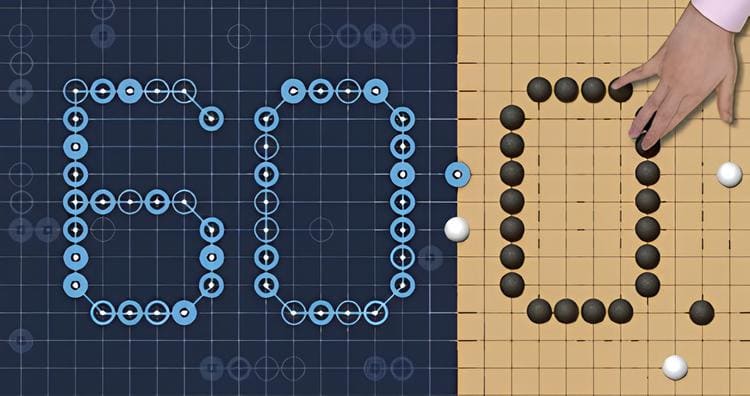
Why do we play Go, indeed? Not in a million years, nor even to the end of the world, will humanity ever be able to evenly match the AIs. In fact, we now know that with a 2-stone handicap, the top players still cannot beat an AI. We also know that not even the best pro players are able to secure a 50% win rate with a 3-stone handicap. So, what does it mean to play Go as a human being? What does it mean to watch others play? Why not just let the AIs entertain us with their incredible abilities and moves that none of us could have ever imagined? When you review the games AIs play against each other, you can’t help but feel a sense of wonder, that these are the true Ip Shins, playing godly games above the clouds. So why do we continue to play Go? What does it say about us as players—and as human beings—that we persist? Is it merely for pleasure, like those slot machines you pull just for the sake of pulling? What is the meaning of it all?
It wasn’t easy finding the answers to these questions. It took me quite a while—a decade, in fact—to figure it out. And I must admit that the answers came not from the game itself, but from the things I have learned in other fields, like philosophy and science. Yet, I must also admit that the answers I found was already there in the game. Ironically, it was the same answers that had been given throughout centuries and centuries of Go history—the answers that our forefathers offered when people of their time asked the same questions, and it is the same answers that, I believe, will be passed down until the end of time. I just didn’t realize it because I didn’t truly understand what “universe on a wooden plate” really meant. I used to consider it only as a cliché, never giving it much thought, simply viewing it as an exaggerated expression used by Go players of old to boast about the game.
But as I contemplated this matter for years, and as I began to see how deeply connected Go is to virtually everything in our lives, especially to ourselves, I began to truly appreciate it. I began to understand how Go reflects life, how it is a microcosm of the universe—which brings us to this book.
“So,” you ask, “what’s the answer to the question, ‘What is the meaning of it all?’”
Here I answer, “Everything.”
Just about everything.
[1] Unlike the universities in the United States, the spring semester begins in March and ends in mid-June in Korea.
[2] Japan used to be one of the trios that reigned supreme, a mighty pillar upholding the arena. However, due to a decline of interest in the game, it has now fallen far behind in the competition. Historically, Japan was the epicenter of the Go World, to the extent that Korean and Chinese Go players would travel there to learn from the great masters. Today, the situation has completely reversed, with Japanese players now crossing overseas to compete in Chinese and Korean leagues.
[3] Fan actually mentions how the Go world dismissed his defeat in the amazing documentary by Google DeepMind, AlphaGo—The Movie. You can watch it for free on YouTube at their channel, so definitely check it out. It’s well worth watching.
[4] While platforms like GoMagic utilize an expanded 30-to-50 kyu system for beginners, the traditional Korean ranking system described in this historical context begins at 18 Kyu.
[5] For those of you wondering about my level, I’m somewhere between being skillful and wise, between 4 Dan and 5 Dan.
[6] Fun fact: the characters provided are in Chinese, but the pronunciations are in Korean. Just as Japanese has Chinese-derived characters called kanji, Korean also has many Chinese-derived words, known as Hanja.
[7] Nowadays, it’s more of a badge of honor than a literal assertion, as all players who reach the professional level are essentially considered to be on the same tier. In any case, a pro-level 1 Dan is undeniably superior to an amateur-level 9 Dan, and no amateur-level 9 Dan can legitimately call themselves “the one who entered the realm of gods.” Only the top 1% of the top 1%—the pro-level 9 Dan—can rightfully claim the title of Ip Shin. There is also some controversy over whether an amateur 9 Dan truly exists. Traditionally, amateur players were capped at the 7 Dan level, with anything beyond reckoned to be a professional rank (however, online Go platforms like Tygem allow amateur players to reach the 9 Dan level within their system). In any case, the assigning of Dan is not an exact science like the Elo rating system; it incorporates some degree of social recognition.
[8] In chess, this would be equivalent to removing certain pieces like the rooks, knights, or even the queen to level the playing field. This is where the 9 dots on the board—called “star points” or “flower points”—come into play. You place the handicap stones starting with the four dots on the corners, then the sides, and then the middle.
[9] I will discuss more on Go Seigen in chapter 2.
[10] At the request of the DeepMind team to gather data for the development of AlphaGo, Lee agreed to play all five games regardless of the net score.
[11] A trainee professional Go player would be at or above the level of the top 1% of amateur players but below that of an official pro player. You could also consider them as semi-professionals.
[12] Earlier I mentioned that a 9-stone handicap is the maximum handicap you can get in Go, but technically, you can place more stones for an additional handicap. However, it wouldn’t be regarded as an official game at that point.


Comments