
🎥 First Class Moves for the Second Line

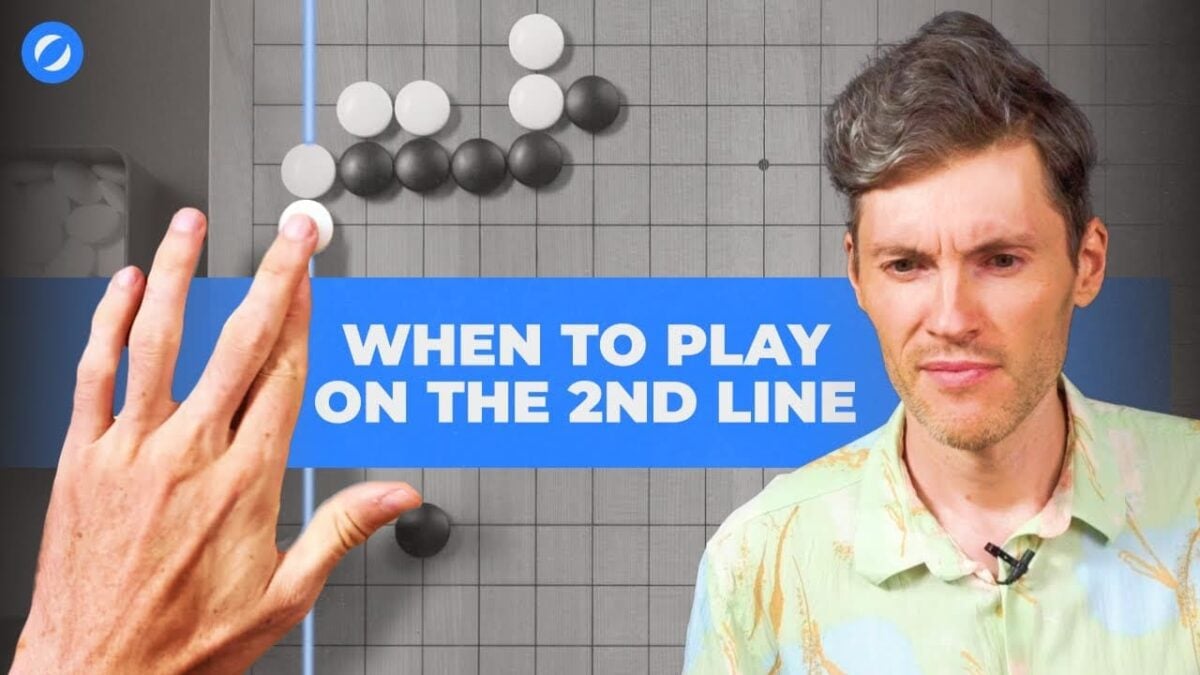

One of the first lessons Go players hear is simple: do not play too low in the opening. The third and fourth lines are where stones usually want to be, while the second line often looks cramped, passive, and small. That rule is useful—but only as a starting point.
Strong players know that good Go is always about context. A move that looks slow in one position can be the best move on the board in another. In fact, some second-line plays are not only acceptable, but absolutely necessary. They can stabilize a weak group, complete a joseki, prevent the opponent from taking profit in sente, or make an invasion work when ordinary moves would fail.
In this lesson, we look at four common situations where second-line moves become first-class moves. You will see why blindly following opening principles can be dangerous, and how a better understanding of local position helps you recognize important exceptions. This is exactly the kind of knowledge that helps beginners move beyond rigid rules and helps intermediate players sharpen their positional judgment.
By the end of the lesson, you should have a much clearer sense of when a low move is truly too low—and when it is the most efficient, practical, and professional-looking choice available.
What You’ll Learn
- When a second-line move is necessary to save stones or finish a joseki
- How to recognize and prevent profitable sente moves for your opponent
- Why “submarine” invasions can be easier than standard invasions
- How to respond correctly when your opponent hanes on the second line
Timestamps
00:00:00 — Introduction
00:01:20 — Principle 1: Saving stones or completing joseki
00:03:22 — Principle 2: Preventing profitable sente moves
00:07:15 — Principle 3: Submarine invasions
00:08:39 — Principle 4: Answering a second-line hane
In the opening, many Go teachers warn beginners to stay away from the first and second lines. There is very little territory there, and low moves are often too small too early. After hearing this advice enough times, many players start treating it as an absolute rule. Then, whenever they see an opponent play on the second line, they smile and assume it must be a mistake.
But Go is never that simple. Like most principles in the game, this one has important exceptions. Context matters.
Usually, when players are told to avoid low moves in the opening, they are being warned against moves that are basically endgame plays with no strategic value yet. For example, imagine a common joseki on the left side, and then Black suddenly plays a small second-line move that only aims at securing a few points. That kind of move is pure endgame. It does not belong in the opening, and White should normally ignore it and take a larger point elsewhere on the board.
So let’s clear up the mystery. In this lesson, we will look at several situations where playing lower than the third or fourth line is not only acceptable, but often the best move available.
00:01:20 — Principle 1: Saving stones or completing joseki
The first big exception appears when a second-line move is the only move that helps your stones, or when it is a necessary part of a local fight or a joseki.
Imagine Black has a star-point stone and White invades at 3-3. Black blocks, White extends, and Black continues to surround. In order to live, White often has to drop down to the second line. It may look low, but it is the move that stabilizes the group.
In another variation, if Black extends in a different way, White may need to slide to the second line to make the corner safe. Maybe White would prefer to stay higher—but in practice, the fight often descends to the second line anyway.
Suppose White tries to resist that idea and plays higher. Black can push, White extends, Black pushes and cuts, and White is forced to connect. Then Black may have a tesuji, such as a nose attachment. If White carelessly runs out, Black can save the cutting stone and create a dangerous fight. So White often captures first, Black continues, and then White again finishes the sequence with a second-line move. That is still joseki. Those low moves are not slack; they are necessary.
This leads us directly to one of the most important lessons of the video: recognizing when a small second-line move is required in order to prevent the opponent from gaining something valuable in sente.
00:03:22 — Principle 2: Preventing profitable sente moves
A second-line move is often correct when it prevents your opponent from taking free profit in sente.
Take the joseki we just discussed. Why does White make that second-line crawl instead of playing a bigger move elsewhere? Because if White does not play it now, Black gets a free atari on the next move. White has to respond, Black gets a useful exchange at no cost, and then Black tenukis. That is exactly the kind of profit you cannot allow.
So even if White would rather play somewhere larger, White must first remove Black’s sente opportunity.
A similar example appears when Black has a secure corner enclosure and White approaches. White may attach because Black does not mind becoming slightly stronger locally. Black hanes, White pulls back, and then Black must defend with a second-line move. Why? Because otherwise White can play a forcing move that threatens the corner and takes away a large part of Black’s territory. White would get that in sente, so Black has to prevent it first.
Beginners often miss this and play a tempting move on the fourth line instead. But then White gets the forcing move, and Black’s corner becomes much smaller. What looked like an active move turns out to be strategically careless.
The same principle appears in older joseki such as avalanche-type patterns. Sometimes Black can choose a solid second-line connection in the corner. After White extends, Black may need another small-looking move to stop White from building a perfect wall and threatening the corner at the same time. These moves do not look dramatic, but they are extremely important. They remove aji, strengthen the corner, and stop White from taking easy profit.
00:07:15 — Principle 3: Submarine invasions
The third exception is the so-called submarine invasion.
Imagine a position where White wants to invade from the side. A normal invasion may be possible, but it can also lead to a difficult running fight. Black may kick, build outside influence, and leave White struggling to make life.
That is where certain second-line moves become very clever. Instead of invading in the obvious way, White can sometimes play a low move that aims in two directions at once. If Black protects the corner, White lives on the side. If Black answers from the outside, White can push once and live in the corner instead.
This kind of invasion is much more practical. Rather than starting a complicated battle, White slips underneath the position and finds an easier route to life. That is why the term “submarine” fits so well. The move looks low and sneaky, but it is highly efficient.
For players who feel nervous about invading strong frameworks, this idea can be especially valuable. Sometimes the best invasion is not the most direct one—it is the quiet second-line move that keeps your options flexible.
00:08:39 — Principle 4: Answering a second-line hane
The last example is also the easiest to understand: sometimes you play on the second line simply because your opponent’s move demands an answer.
Suppose White has invaded the corner and Black has outside influence or potential territory nearby. White now plays a second-line hane to strengthen the corner and reduce Black’s area. Black cannot just ignore it. If Black tenukis, White may continue with another extension and steal a large amount of territory.
So Black answers on the second line as well. Even though the move looks low, it is active: it threatens the White stones and forces White to protect.
After that, Black may or may not add one more reinforcing move later, depending on the overall board position. Sometimes the local follow-up is urgent; sometimes there are bigger points elsewhere. Again, context decides.
And of course, these are not the only exceptions to the rule. There are even trickier cases—but these four are enough to show the main idea. Second-line moves are not automatically bad. In the right position, they are precise, necessary, and often the strongest option available.
As for first-line moves in the opening… that is a topic for another day.
And by the way, you can also watch lessons like this on GoMagic.org, where they come with interactive quizzes inside the lesson and practical exercises afterward. And if you enjoy Go content like this, make sure to follow the channel for more.




Comments