
🎥 The Power of Visualization: How to See Moves Before They’re Played

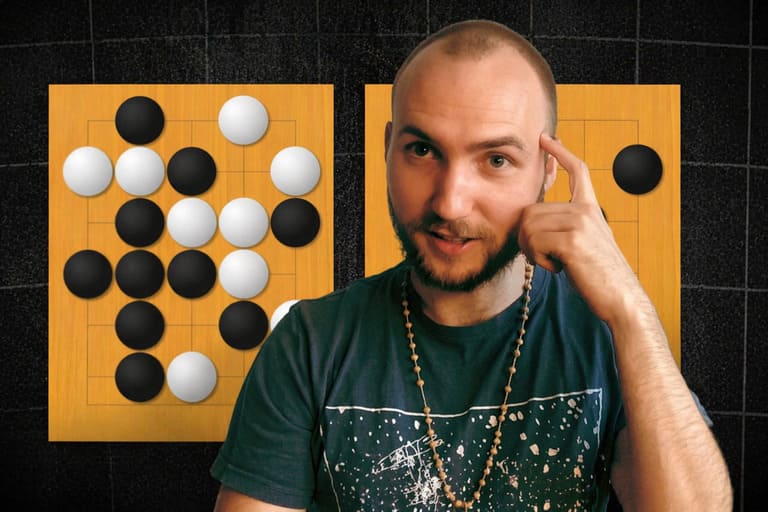

Visualization is one of those Go skills that often stays invisible until you realize how much it affects everything else. In this lesson, Jonas Welticke 6d explains why the ability to hold positions in your mind, track changes accurately, and mentally transform shapes is a foundation for stronger reading, better memory, and more efficient learning.
What makes this video especially useful is its practical focus. Rather than talking about visualization as an abstract talent, Jonas breaks it down into trainable habits. He shows how to start small, how to avoid overwhelming yourself, and how to build a practice routine that is realistic enough to maintain over time.
The lesson is valuable for a wide range of players. Beginners can use it to develop a clearer mental picture of the board, while stronger players will recognize how closely visualization is tied to deep reading, fighting, and keeping long variations under control. Jonas also adds an important psychological layer, explaining how mindset, curiosity, and consistency matter just as much as raw effort.
If you want to count more accurately, remember complex positions longer, and improve the quality of your reading without relying on brute force alone, this is a lesson worth studying carefully. It also comes with visualization exercises designed to help you start practicing right away.
What You’ll Learn
- Why visualization is a core skill for reading and improvement in Go
- How mental images help you remember positions and follow variations
- A simple first exercise for memorizing board positions
- Three practical visualization techniques you can start using immediately
- How to train without depending too much on pattern recognition
- Why sustainable practice and the right mindset matter more than intensity
- Common mistakes players make when trying to build new mental skills
Timestamps
- 00:00 — Introduction
- 00:10 — Why Visualization Is So Important in Go
- 02:06 — What You’ll Learn from This Lesson
- 03:24 — Exercise 1: Memorizing a Position
- 06:01 — Exercise 2: Timed Training
- 06:12 — Technique: Open Eyes, Close Eyes
- 07:53 — Technique: Expanding from an Island
- 09:08 — Technique: Zooming In and Out
- 10:10 — Exercise 3: The 15-Second Challenge
- 10:54 — The Importance of the Right Mindset
- 13:13 — Mistakes in Learning
00:00 — Introduction
Hello everyone. This is Jonas Welticke. I’m a 6-dan Go player from Germany, and today we’re going to talk about my favorite skill: visualization.
Why is it my favorite? Because I believe it is one of the foundations that sets you up for success in learning every other skill you need in order to improve at Go.
Why do I believe that? Well, I became the fastest 1-dan, 2-dan, 3-dan, 4-dan, and 5-dan in Europe, and I think a big part of that came from the visualization practice I started when I was five or six years old.
Of course, hard work mattered too. But everyone who gets strong quickly works hard. What made the difference for me, I think, was that I had a very deep visualization practice from a young age.
For the last eight years, I’ve also been the number one player in Germany. And again, I think visualization has a lot to do with that, especially because I enjoy very sharp, life-and-death style games. I like variations where either you kill or you die yourself. For those kinds of games, accurate reading is essential, and visualization helps tremendously.
Another thing I achieved last year was breaking the world record in simultaneous one-color Go games. I played against twelve people with one color, and to keep all of those positions in your head, visualization is absolutely necessary.
So in this video, you’ll learn how to go step by step from wherever you are now to having stronger mental images that help you learn faster and remember important ideas longer.
00:10 — Why Visualization Is So Important in Go
At the basic level, visualization helps us maintain a stable image in our head. For example, when we read out a variation, it helps us avoid losing track of which moves have been played and which have not.
But at a more advanced level, visualization can do even more. It can help us understand the internal processes that shape our habits and behavior, and even change them. It can also be used in techniques such as a memory palace, where information is stored in a mental space so that it can be recalled much more easily.
We are not going to go into all of that in this video. Maybe that can be part of a future course if you enjoy this one.
For now, let’s focus on the practical side: what visualization is, how it works, and how to train it.
02:06 — What You’ll Learn from This Lesson
We’re going to start with a simple exercise: trying to memorize a position.
Memorization, holding an image, and creating an image are some of the main techniques involved in learning visualization.
In this first example, the task is not to read out a sequence or solve anything. We simply try to remember where all the stones are.
For some of you, this may be very easy. You might close your eyes and still see the whole position clearly. Maybe you could remember it for years.
For others, the opposite may be true. You might feel like you do not really know what a mental image is supposed to be.
And that is completely normal.
If you are closer to the second group, I strongly recommend starting as small as possible. For example, begin with just one stone in the lower right area and keep only that in mind.
What does that mean in practice? Maybe first you remember that there is a black stone somewhere near the lower right. Then you add more detail: it is one line above the edge. On its left is a white stone. Above it is an empty point.
In other words, you slowly build the image. You shift your attention from the stone itself to what is around it, and step by step the position becomes clearer in your mind.
It is a bit hard to explain this only with words, because it is less about verbal description and more about gradually expanding the image in your head.
That is the basic feeling we want to develop.
03:24 — Exercise 1: Memorizing a Position
So this first example is simply meant to give you a feel for what visualization practice is like.
Do not worry about doing it perfectly. The goal is just to notice how you form the image, how much you can hold, and where it starts to become unclear.
That awareness is already part of the training.
06:01 — Exercise 2: Timed Training
For the next exercise, I’m going to give you a timer.
But first, let me share a few small tips that I think are very important for doing this properly.
06:12 — Technique: Open Eyes, Close Eyes
One of the most useful techniques is very simple: open your eyes, close your eyes.
Look at the screen and focus on a part of the position that feels manageable. Then close your eyes and try to keep that section in your mind.
Do not force yourself to take in the whole board immediately if that feels too difficult. If you can do that, great. But otherwise, start with a piece you can handle.
Then open your eyes again and compare.
Maybe you realize that you remembered something incorrectly. In that case, focus on exactly what was wrong, close your eyes again, and try to make that part clearer.
Then repeat. Once you feel that section is stable, move on to the next part. Continue until the full image is assembled.
That is the core of the method.
07:53 — Technique: Expanding from an Island
Another useful technique is to expand outward from what I would call an island.
That means you begin with one stone, one local shape, or one small group that feels clear to you. Then you slowly expand from there: up, down, left, right.
In this way, the image grows naturally instead of all at once.
This is especially helpful if the position feels overwhelming at first. Instead of trying to grasp everything immediately, you anchor yourself in one area and build from there.
09:08 — Technique: Zooming In and Out
The third technique for today is zooming in and zooming out.
You can zoom in on one stone or one local detail, and then zoom out again to the whole board or a larger section of the position.
This is useful in two ways. First, it helps you balance the difficulty of the exercise. We do not want the training to be so easy that it becomes boring, but we also do not want it to be so hard that it becomes discouraging.
Second, zooming in and out helps you understand where things are in relation to one another, which is obviously very important when you are trying to build a stable mental picture.
So for today, our three techniques are:
open your eyes, close your eyes;
expand from an island;
and zoom in, zoom out.
With those in mind, let’s move to the final exercise.
10:10 — Exercise 3: The 15-Second Challenge
For this one, you get fifteen seconds.
For some of you, this position may actually feel easier because it looks more like a normal game position, with more stones and more recognizable patterns.
That can help, because pattern recognition gives you shortcuts. You may recognize that certain stones are connected, that something is in atari, or that a local shape is familiar.
But if the exercise feels too easy, I would actually recommend trying not to rely on those shortcuts.
When we are specifically training visualization, we want to isolate the ability to form and maintain a mental image. Pattern recognition is useful in Go, of course, but in this case it can become a crutch.
If your goal is to strengthen your ability to hold and transform images in your head, then it is good to practice without leaning too much on familiar shapes.
So, good luck.
How did it go?
This exercise was of course more difficult than the earlier ones, especially with only fifteen seconds. It is not likely that many of you got everything perfectly, and that is completely fine.
Do not get upset by that. I do not even know whether I could do it myself in fifteen seconds every time.
The important part is to train.
You do not need to be perfect right away when you are learning a new skill. You just need to keep practicing the ability.
10:54 — The Importance of the Right Mindset
This kind of skill is unusual because it is hard to measure directly. It is not like hammering a nail into wood, where you do the action and instantly see the result.
Visualization happens in your head. It is difficult to show to other people, and sometimes it is even difficult to show to yourself.
Because of that, it is very important not to discourage yourself.
If you want to make a training plan for this kind of skill, I strongly recommend starting gently.
Most of you have probably never trained visualization directly before. So if your reaction now is, “Great, I’m going to do ten hours of visualization every day,” that is probably not going to last.
Could someone do it? Maybe. But in most cases, it is much more likely that you will improve through a long, sustainable practice over months or years.
So your goal should be close to your current reality.
If you have never practiced visualization before, then a good first goal might be something like this: in your next three Go games, close your eyes two or three times and try to picture the position instead of looking at it directly. Or try reading one variation with your eyes closed. Or work through the visualization exercises linked in the description.
Whatever you choose, make it easy enough that you can actually keep doing it.
There are basically three reasons people fail to do what they want to do.
The first is setting expectations that are too high.
The second is not having a clear long-term goal that gives meaning to the daily practice.
For example, when I do visualization practice, I think about the next world record I want to break. I do not want to stay at twelve simultaneous one-color games. I want to reach twenty. And twenty is going to be much harder than twelve.
That makes the training meaningful to me. It gives me a reason to practice.
So find something in your own life that this skill could help with. There are many benefits to visualization. Think about which of them really matter to you. And if you cannot find one, then that is fine too. Do not force it.
But if you do feel curious and motivated, then start — just do not expect too much from yourself too quickly.
The third point, and maybe the most important, is gratitude.
When you begin something new, it is very easy to give yourself no credit at all. You can feel foolish. You can think, “This should be easy. Why can’t I do it?”
Stop there.
Instead, focus on what you are doing better from day to day.
When you learn something new, there are usually many small improvements happening. If all you notice is how far you still have to go, you are going to make yourself miserable.
A much better attitude is this: “These ten small steps were difficult for me, but I did them. So I should be proud of that.”
At one point in my life, even reading five pages a day felt difficult. I could not necessarily explain to other people why that was a big achievement for me. But I knew where I was in my own journey, and I knew that this skill mattered for the life I wanted to build.
So I was grateful, and I want you to be grateful too.
13:13 — Mistakes in Learning
The last thing I want to share before we finish is this: be curious.
Over the years, I have met many people — as a player and as a coach — who felt that they simply could not read, or could not learn to read, or could not visualize, or could never learn to visualize.
The most important thing is not even that you believe me when I say that you can improve. The most important thing is that you stay curious.
Maybe you can train it.
Maybe you can get better.
Maybe, if you stick with it, you will improve far more than you expect.
Do not underestimate what you can achieve in the long term.
And do not overestimate what you can achieve today or tomorrow.
So first, identify how this skill could benefit you. Then think about how much you can realistically do each day.
Maybe you think, “I can do one hour.” In that case, I would probably tell you to cut it in half.
That is actually what I do myself. I think about how much I want to do, and then I usually reduce it. I do the same with my students. Whatever number you first come up with for a week or a month, try halving it. That usually makes it manageable.
And above all, have fun in your own mind.
Closing your eyes can become a very calm and beautiful space. And in that space, you may learn to appreciate the beauty of Go even more deeply.
So I wish you good luck.
This is Go Magic.
By the way, you can also watch these lessons on our platform, gomagic.org. There, you can watch them with interactive quizzes built into the lesson and practical exercises afterward.
And if you enjoy these Go videos and do not want to miss future ones, make sure to like the video and subscribe to the channel.
This is Go Magic.





Thank-you Jonas! Really appreciate your teachings and insights to the art of visualisation! I will definitely give it a try (I think it’s like learning a new language) and hope it will add to more colours to my Go journey! 🙂