
🎥 Time Management in Go: Stop Wasting Time

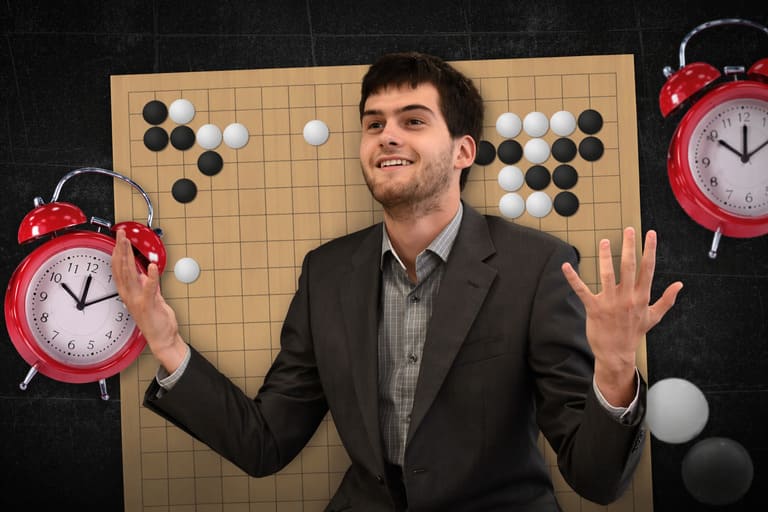

Time trouble is one of the most common ways to lose control of a Go game. Even strong players can reach the first serious fight with only seconds left on the clock, not because the position demanded it, but because too much time was spent earlier on opening choices that were never going to decide the game by themselves.
In this lesson, Lukas Podpera 7d offers a practical answer to that problem. His central idea is simple but powerful: if you want to have time for the moments that truly matter, you need to stop wasting it in the opening. That does not mean playing carelessly. It means choosing simpler, more manageable variations when the position allows it, instead of diving into joseki jungles that demand heavy calculation from move one.
The video is especially useful because it stays concrete. Lukas walks through several well-known opening patterns and shows how players can avoid turning them into time-consuming complications. Along the way, he explains why even slightly suboptimal but stable opening choices are often worth it, especially for amateurs and tournament players who need a clear head for the middlegame.
This is a valuable lesson for anyone who regularly falls behind on the clock, overthinks joseki, or feels that their real game never begins until they are already in byo-yomi. It is not just about speed. It is about using your thinking time where it has the greatest practical value.
What You’ll Learn
- Why the opening usually does not decide the game on its own
- How simpler opening choices can save time for later fighting
- How to avoid getting dragged into complex joseki you do not know well
- Practical examples involving the Flying Knife, Windmill, Taisha, and Avalanche
- Why strong amateurs often lose games through poor time allocation rather than poor understanding
- A real tournament story showing how better time management can change results
Timestamps
- 00:00 — Introduction
- 00:42 — Why Openings Don’t Decide the Game
- 02:19 — Example 1: Avoiding the Complex Flying Knife (3-3 Invasion)
- 04:43 — Example 2: Avoiding the Windmill Joseki
- 07:48 — Example 3: Avoiding the Taisha Joseki
- 09:10 — Example 4: Avoiding the Avalanche
- 12:38 — Real-Life Story about Pro Qualifications
00:00 — Introduction
This is a very familiar situation, right? You are in time trouble in a serious tournament game, and the annoying sound of the clock tells you that you really need to make your move.
But is it possible to avoid that? Is it possible to improve at dealing with time pressure?
These are very relevant questions.
My name is Lukas. I’m a 7-dan player from the Czech Republic, and today I want to share some advice on how to handle time pressure better.
First of all, it is important to realize that avoiding time trouble is definitely possible. One of the best ways to do it is by playing faster at the beginning of the game.
We should not forget one important thing: the opening does not necessarily decide the game. Of course, if we are very strong in fuseki and opening theory, we may gain a small advantage. But I do not really believe that the game is usually decided there.
So how can we save time? How can we play faster?
One answer is simple: avoid unnecessary complications. Think less about fine details in the opening, because in most cases the game will be decided in the middlegame or eventually in the endgame.
Another way to improve is to play many fast games and become more comfortable with short time controls, such as twenty or thirty seconds per move, or even less. But even then, I do not think anybody can play at their very best under heavy time pressure.
Very often my students ask me whether getting an opening advantage is enough to help them win the game. The answer is: partly, yes. But the advantage you get in the opening is usually not large enough to decide the result by itself.
The decisive moments come later.
So I would like to show you a few examples of how to avoid thinking too much in the opening, how to simplify certain situations, and how to save your time for the important moments later in the game.
00:42 — Why Openings Don’t Decide the Game
Let’s put a few stones on the board and look at some typical situations.
We’ll begin with a classic 3-3 invasion, which is one of the evergreen positions of modern Go.
White plays a move that already leads into more advanced territory, and this is often the point where complicated variations begin.
Of course, Black can simply answer in a straightforward way, and White can continue in a calm manner as well, creating outside thickness while Black takes the corner. The game then continues very simply.
But if Black chooses a sharper response, we enter a famous and highly complicated variation that is now known as the Flying Knife.
At that point, there are endless branches. White can hane, Black can block, White can go up, Black can cut, and from there we can easily reach dozens or even hundreds of AI-developed continuations.
Can anybody study all of them? Maybe world-class players can. Most of us cannot.
And if you have not studied them properly, or if you start thinking deeply at the board, the risk of going wrong becomes rather high.
02:19 — Example 1: Avoiding the Complex Flying Knife (3-3 Invasion)
So how do we avoid this?
Black can simply choose a calmer continuation. Instead of starting the Flying Knife, Black can force White to connect and then fix the corner in a simple way.
I do not think that Black gets a bad result there. It is just a simpler one.
And that is the point. In this kind of line, we can solve the corner in ten seconds. If we enter the Flying Knife, we can easily spend ten minutes or more deciding which branch to play, wondering whether the opponent knows something new, or even worrying that we may be punishing ourselves rather than the opponent.
White also has simpler options. White can extend, Black can extend, White can keep things light, and the corner becomes settled without turning into a major theoretical battle.
This is how you avoid the Flying Knife: by not allowing the opening to become a test of memory and nerves when it does not need to be.
04:43 — Example 2: Avoiding the Windmill Joseki
Let’s say the game continues simply, and later White approaches one corner. Black approaches another, and White pincers.
Now, with one more move, we enter another modern evergreen: the so-called Push-and-Cut joseki, also known as the Windmill.
It has a cheerful name, but it can quickly become a very serious theoretical fight.
Again, the question is not whether the variation is good. The question is whether you know it well enough, and whether you really want to spend so much time there.
If you are Black, one easy way to avoid this is simply not to choose the move that invites the Windmill in the first place. That is what I often do when I know my opponent understands these variations better than I do.
Instead of entering that joseki, Black can strengthen the approaching stone with a jump, a light extension, or some other simple supporting move.
Black can also attach directly in the corner, which used to be very common before AI and still leads to playable, understandable positions.
All of these continuations have something in common: they are simple. They do not require deep theoretical knowledge at the board, and they do not force us to spend unnecessary time in the opening.
Let’s say Black just settles the local shape in a clean, straightforward way. The game continues, and I do not think either player has lost more than a point or so.
Even if one side has lost a point, does it really matter in our games?
Maybe it matters for top-class monsters like Shin Jinseo, Ke Jie, Ichiriki Ryo, and other elite professionals. But it definitely does not matter that much for the rest of us, and especially not for amateurs.
07:48 — Example 3: Avoiding the Taisha Joseki
From there, White might play a move that could lead into another historically famous and extremely complicated joseki: the Taisha.
I am sure you have heard the name before.
And if we start following one of the sharp continuations, the variation becomes difficult very quickly. There are many possible branches, and even the lines I am showing here are not the hardest ones. There are much more complicated ways to play.
So how do we avoid it?
White can simply choose a more ordinary move from the start. If White plays more calmly, Black can answer by crawling along the third line, taking points and accepting a straightforward result.
Did Black make a mistake by simplifying? No.
Black took territory, White took influence, and the position is balanced.
Again, the corner is solved in ten seconds.
Another possible simplification is for White to choose a modest move on the outside. Then Black can attach underneath, White hanes, Black comes back, White connects, Black extends, and White extends as well.
Of course, there are still details here. Should Black connect solidly or use a hanging connection? Should Black extend on the third line or fourth line? These are real questions.
But they are not usually game-deciding questions.
The important thing is that we know roughly what we are doing and do not sink a large amount of time into details that have only a small practical effect on the outcome.
09:10 — Example 4: Avoiding the Avalanche
Even here, White may still choose a move that creates complications. White can go down, hane, and suddenly we are entering the Avalanche joseki, another famous variation that used to be very popular in the previous century.
From that point, things can become absolute madness. There are many branches, many cuts, and many possibilities for both players. Again, if you love this joseki and have studied it deeply, that is fine.
But if you have not studied it, and your goal is to save time for later, there is no reason to let yourself be dragged into it.
Black has several simple ways to avoid complications. One of the most common modern choices is just to descend on the second line. White extends, and now Black can safely turn, push a few times, or leave the area and play elsewhere.
Black is secure in the corner. White gets outside influence. Nobody has anything to complain about.
Black can also connect in a very straightforward way, White can extend, Black can jump, White can tidy up the shape, and the game continues.
And if Black actually wants to play a large Avalanche, White still has options to simplify. White can play atari, make a hanging connection, and steer the position back into something much easier to handle.
From there, the fuseki can continue in a very normal, calm fashion.
This kind of opening can easily be completed in a minute, or in a few minutes if both players remain careful. But it does not need to consume ten minutes or more, and no unnecessary time has been wasted by either side.
So these are just a few examples of how to save time in typical modern Go positions: avoid difficult variations when you do not need them, simplify early, and keep your thinking time for the moments that really matter.
12:38 — Real-Life Story about Pro Qualifications
I would like to finish this video with a story from relatively recent experience.
Many of you know that I have tried to become a professional player, and I have taken part in several European pro qualification events. This story comes from the most recent one.
There were two players there. I will not name them, but both were around 6-dan level in Europe. Neither was the main favorite to become an EGF professional, but both definitely had a chance. Their European ratings were quite similar before the tournament.
They also had something important in common: both were known for playing very calmly in the opening and then running into severe time pressure later.
One of them decided to adjust. He learned from the mistake of wasting too much time early and switched to playing very simple fuseki. In fact, he played so quickly in the opening that, because the event used Fischer time, he often had more time on the clock after the fuseki than he had at the start.
He still sometimes got into time trouble later, but not around move one hundred in the middle of a difficult fight. More often it happened in the endgame, where twenty or thirty seconds per move can still be manageable.
And that player scored eight wins in eleven rounds, which is a very impressive result.
The other player, however, kept doing the same thing as before. He continued spending a great deal of time in the opening.
If someone had made statistics, I think the average move number where he fell into time trouble would have been around move sixty or seventy.
I still remember our own game. The opening was calm, and the first real fight started around move seventy. At that moment, my opponent had only thirty seconds left, while I still had twenty minutes.
Naturally, I got a clear advantage in that fight simply because I had the time to think.
That player finished the European pro qualification with only two wins.
I do not believe there was a huge difference in playing strength between those two players. They were probably very close in level.
But the player who managed his time better won far more games.
For me, that is a very clear example of why saving time in the opening is so useful. Playing unnecessarily complicated lines, or entering positions you do not know well, is not the way to win games.
Thank you for watching this video.
By the way, you can also watch these lessons on our platform, gomagic.org. There, you can view them with interactive quizzes inside the lesson and practical exercises right afterward.
And if you enjoy these Go videos and do not want to miss future ones, make sure to like the video and subscribe to the channel.
This is Go Magic.




Comments