
How to Count Score in Go

If you learn better by watching, skip to the video at the end: Vadim walks through the whole count on a real board.
When the Game Ends
Some games end early, when one player resigns. The rest go all the way: the two of you run out of moves worth making, and you stop. One pass from each player, and the board is final. Now you count.
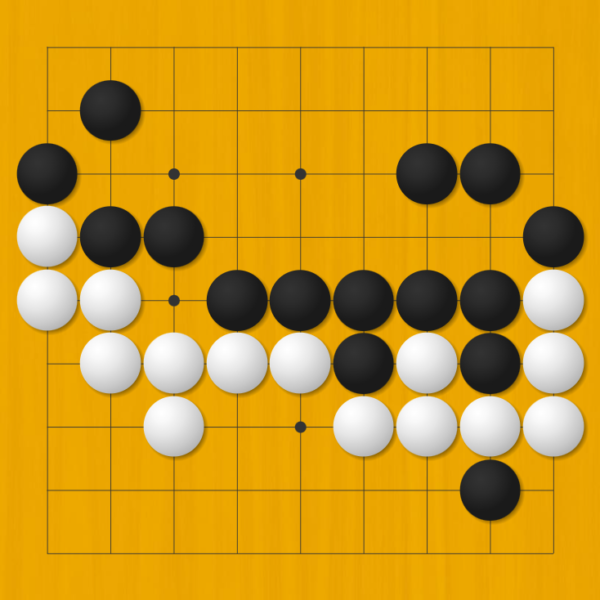
A finished game. Both players passed. Now what?
Two things have to be settled before any arithmetic starts, and they are the same whatever rules you play by.
Neutral Points
Some empty points sit between a black wall and a white wall, touching both. Neither player has surrounded them — these are the neutral points. They are the last thing left to play.
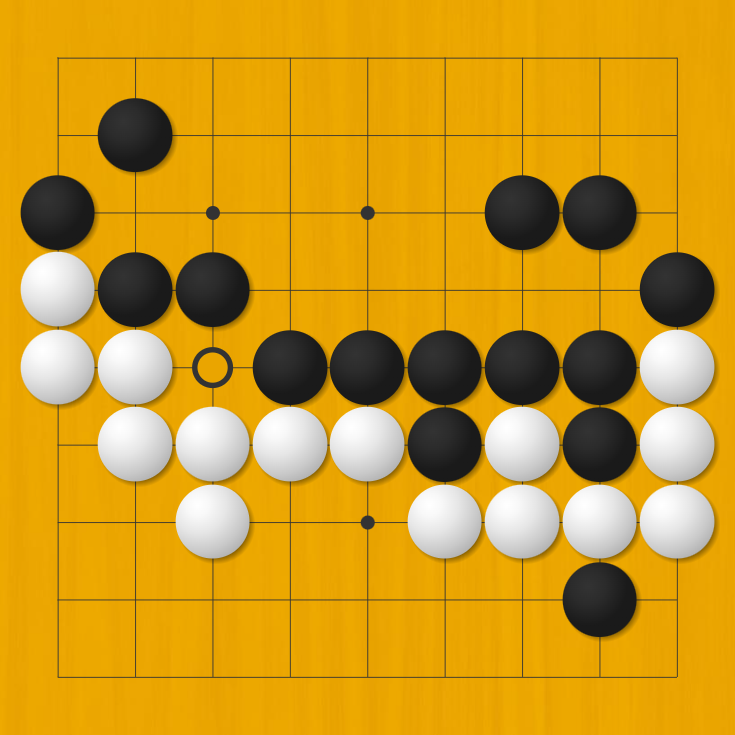
One move from the end of our game. The circled point touches both walls, so it belongs to nobody.
Whatever rules you play by, fill them in during the game, before either of you says pass. Take turns. It costs you nothing, and a board with no loose ends left on it is one that two players are far less likely to argue about.
If you play online and forget, the server sorts out whatever is left once you both pass. Most of the time you will never see this step happen.
Dead Stones
Some stones are still sitting on the board but can never live — a stray stone or an invading group with no room to make two eyes. You do not have to spend moves capturing them. At the end they simply count as captured. Online, the server marks them for you and asks you to confirm.
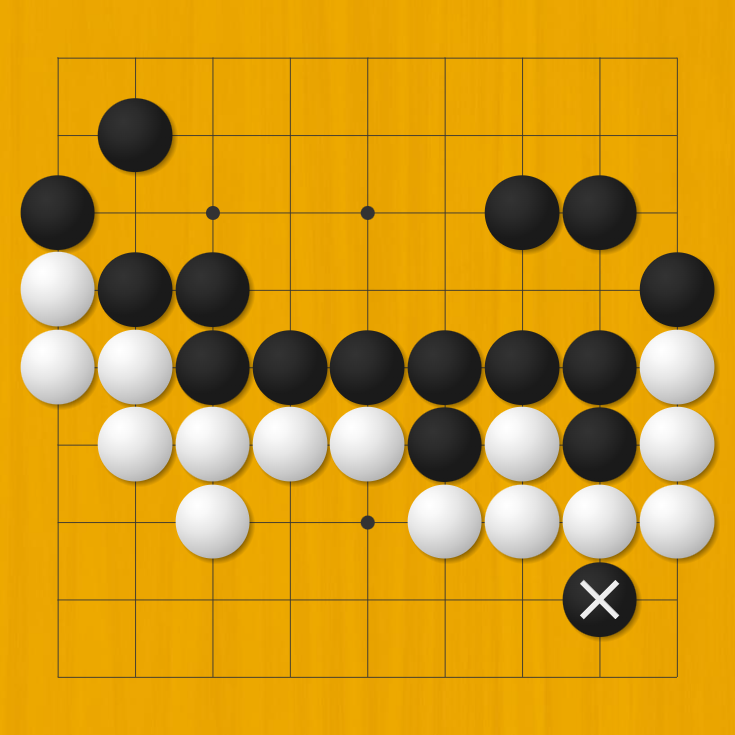
This black stone can never make two eyes. It counts as captured.
If the two of you disagree about whether a group is alive, do not argue: play it out. Online, that is the resume play button. The board settles it, not the chat window.
Two Ways to Count
From here on, the answer depends on which scoring system you use, and there are two.
Territory scoring is what the Japanese rules use, and the Korean rules too. Almost everyone in Europe and the Americas plays this way, and it is what we teach on Go Magic. If you are not sure which one is yours, this is yours.
Area scoring is what the Chinese rules use. It is standard in China, and every Go AI is built around it. The two systems almost always name the same winner, and usually by the same margin, but they get there differently.
Pick yours, and the rest of the guide follows.
What You Are Counting
Two things:
- Territory — empty points your stones surround.
- Prisoners — opponent stones you captured during the game, plus their dead stones left on the board at the end. One point each.
The stones themselves score nothing. A stone sitting alive on the board is worth zero; only the empty points around it count. So a move played inside your own territory is a move wasted — the stone earns you nothing, and it fills an empty point that was already yours.
One thing: area. Every empty point you surround, plus every stone you have on the board. Think of it as owning the point underneath each stone you play.
That is also why the neutral points were worth filling: under area scoring each one you took is a point for you, and each one you left to your opponent is a point for them. They are not neutral at all.
Captured stones do not enter into it. When you capture, drop the stones straight back into the bowl; dead stones at the end count for nothing either. There is nothing to keep track of.
Counting, Step by Step
- Dead stones are treated as captured: each one is a prisoner for the other side, and the point under it is their territory.
- Count each player’s territory and add their prisoners.
- Add 6.5 komi to White. The higher total wins.
- Dead stones are treated as captured: they count for nothing, and the points under them go to the other side.
- Count each player’s area: their stones on the board plus the empty points they surround.
- Add 7.5 komi to White. The higher total wins.
Online, the server does all of this the moment you both pass. The one thing it needs from you is a look at the dead-stone marks before you accept: if a living group has been marked dead, or a hopeless invasion left alive, click it to flip it. Still worth doing by hand once, though — until you have counted a board yourself, the number the server shows you is just a number, and you cannot tell when it is wrong.
Counting at a Real Board
With real stones, two tricks make the arithmetic much faster. The whole routine:
- Fill any neutral points you missed.
- Agree which stones are dead, take them off the board, and add them to your pile of prisoners.
- Put your prisoners into your opponent’s territory. Rather than adding them to your own score, use them to shrink your opponent’s. Same result, half the counting.
- Tidy each territory into rectangles. The borders are already fixed, so sliding stones around inside a territory changes nothing — and 6×4 is far easier to count than twenty-four scattered points.
- Count the empty points that are left. Add 6.5 komi to White.
Agree which stones are dead and take them off the board — back in the bowl, they count for nothing. Then one trick halves the work: count one colour only — its stones on the board plus the empty points it surrounds. The two areas always add up to the whole board, 81 points on 9×9 and 361 on 19×19, so the other colour is whatever is left. Then add 7.5 komi to White.
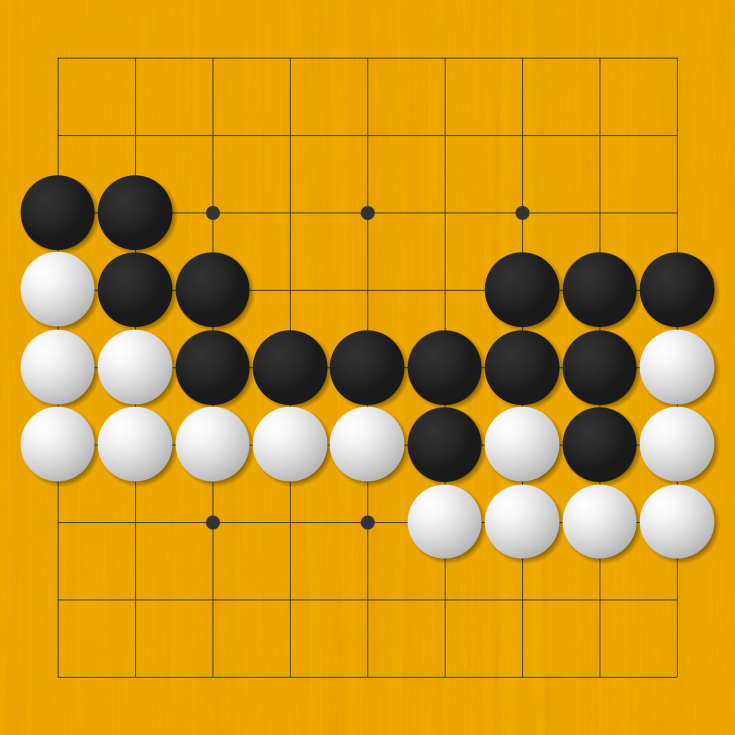
Our board with the stones slid into straighter lines. Nothing has changed except how easy it is to count.
A Worked Example
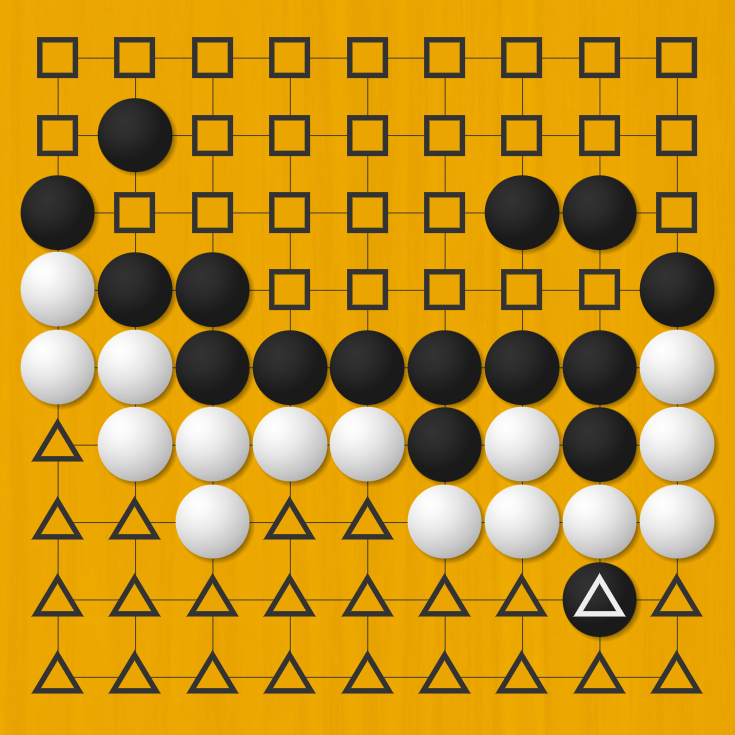
With the dead stone counted as captured, Black has 28 points of territory and White has 23.
Squares mark Black’s territory, triangles mark White’s.
White holds one prisoner — the dead black stone. Black holds none.
| Territory scoring | Black | White |
|---|---|---|
| Territory | 28 | 23 |
| Prisoners | 0 | +1 |
| Komi | — | +6.5 |
| Total | 28 | 30.5 |
White wins by 2.5 points.
At a real board you would drop that prisoner into Black’s territory instead and count 27 against 23. Same 2.5 either way.
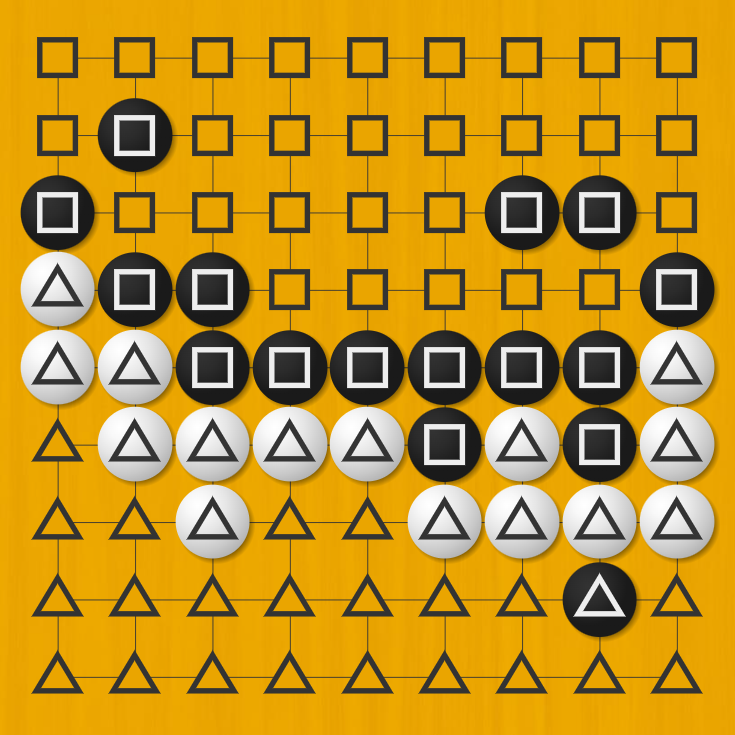
Under area scoring the marked stones count too, alongside the territory they surround.
Squares mark Black’s territory, triangles mark White’s.
No prisoners to fetch, no stones to rearrange. Count what each player has on the board and what they surround.
| Area scoring | Black | White |
|---|---|---|
| Stones on the board | 15 | 15 |
| Territory surrounded | 28 | 23 |
| Komi | — | +7.5 |
| Total | 43 | 45.5 |
White wins by 2.5 points.
Notice the two areas add up to 81, the whole board. That is why counting one colour is enough — the other is whatever is left.
Score this same board by territory — flip the switch above — and the answer is the same to the half point: White by 2.5. Black played one stone more than White over the game, sixteen to fifteen, and under area scoring that stone is worth a point. The extra point of komi cancels it exactly. That is what it is there for.
Komi
Black moves first, which is worth something, so White is given compensation at the end. The half point exists so that a game cannot finish in a draw.
Under territory scoring komi is 6.5 points.
Under area scoring komi is 7.5 points, one more than under territory scoring. Black moves first and so usually finishes the game having played one stone more than White — and under area scoring every stone on the board is a point. The extra point of komi settles that.
In handicap games komi is usually reduced to just 0.5.
Watch It Done
In this lesson from our rules course Vadim plays a 9×9 game through to the end and then counts it on the board — prisoners, territory, komi, the lot. The counting starts at 6:57.

In this video Vadim counts a finished game both ways, shows why the two systems agree, and explains where the difference between them comes from.

Where to Learn the Rest
Counting is the last thing that happens in a game, but it is rarely the thing that decides it. If any of this felt like it was built on ground you have not covered yet — liberties, eyes, why a group lives or dies — that ground is worth going back for.
Our basic 9×9 course is free and starts from the first stone. It takes you through the whole of the game on the small board, where every corner of it is close enough to see, and it ends exactly where this guide begins: a finished game and a score you can work out yourself.

Kommentare