
Chapter 2: The Receding Horizon


Yet all experience is an arch wherethro’
Gleams that untravell’d world whose margin fades
For ever and for ever when I move.
— Ulysses, Alfred, Lord Tennyson
In the Beginning There was a Dumbass
If you are somewhat smart, like me, then you probably believe that the world is better off without all the dumb people. This is, admittedly, exactly the sort of thought that dumb people are famous for having, but let’s ignore that inconvenient possibility for now.
People have been complaining about stupidity for thousands of years. But I suppose Alexandre Dumas put it best with his quote: “human genius has its limits, while human stupidity does not.” I personally wish his novels had observed the same principle of limitation, but that is a separate tragedy for another time.
The funny thing, however, is that sometimes stupidity does produce something good. That, my friends, is exactly how the game of Go came to be in this world—according to legend, at least. In ancient China, about 4,000 years ago, there was a legendary emperor named Yao. This emperor was a wise man, but his son was not. In fact, his son was a legendary dumbass. His son, named Danzhu, not only lived a debauched life but was apparently so dumb that the emperor spent his days trying to figure out how to make him smarter. Then, one day, Yao had an epiphany. Luckily for us, it wasn’t nootropics or anything digestive. Since his son liked to play games, he thought, “Why not invent a game that would finally make him use his brain for once?” The emperor then ordered his servants to get some wood and carve it into a square-shaped board. Next, he took a brush and drew lines on it with 9 dots. Lastly, he ordered them to gather many stones, carve them into rounded shapes, and paint them black or white.
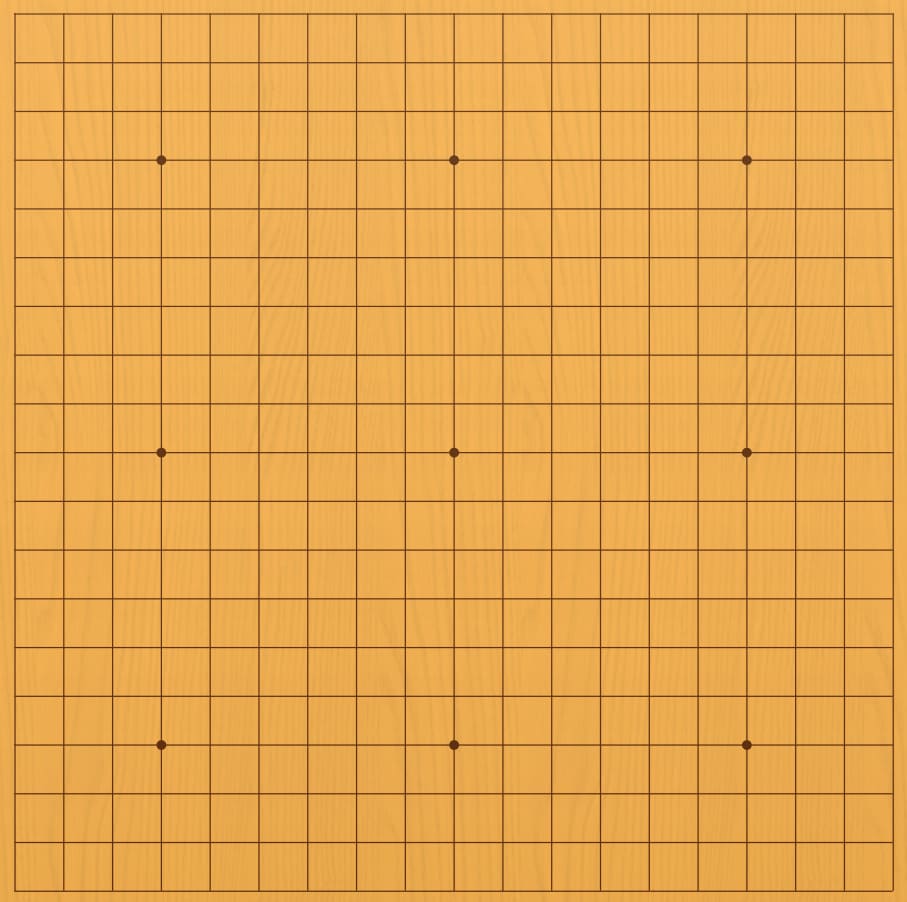
And voilà! The most complex board game humanity has ever seen was born. Sadly, there is no reliable historical record that the son ever played the game his father invented for him, not even once. Sadder still, the legend goes on to say that Yao later abdicated his throne to Shun, a total stranger equal in wisdom to himself. It thus makes one wonder—was creating the world’s most complex board game really the “smart” thing to do to fix his fool of a son1?
Perhaps the emperor was way too blinded by his own affection to realize just how dumb his son was. Or perhaps he was way too smart himself to realize just how complex the game is. I mean, I’m not the best Go player in the world or anything like that, but you kind of have to have a brain to begin with to play the game—that much I know. There’s a reason why the game, despite having such a simple set of rules, isn’t exactly popular even in its birthplace, let alone the world. There’s a reason why you can literally learn how to play the game within 10 minutes, but it takes years to learn how to play the game, if you know what I mean. After all, knowing the rules of Go is not the same as knowing what you are looking at.
In fact, that is one of the first things you realize as soon as you try to play your first “real” game. Here you are, excited to hear that the rules are much simpler than chess and, what do you know, it turns out to be true! So you are all hyped to learn the basic rules: stones are placed on intersections; territory is made by surrounding empty spaces; once a stone is placed, it does not move unless it is captured; stones can be captured by removing their liberties; the goal is to surround more territory than your opponent; and that is basically it. After 10-20 minutes of explanation, they tell you that you are now ready to play. So you sit in front of an empty board, and you pick up a black stone, and, then, you are hit with the truth: “Wait a minute. I just learned the alphabet, and now I’m supposed to read Shakespeare?”
You find out very soon that almost every move is legal, especially in the opening phase of the game, which simultaneously means that almost nothing is obvious. That, supposedly, was Danzhu’s problem. It was also mine, unfortunately. In fact, it still is, to a certain degree. The rules tell you what you are allowed to do, but they do not tell you what matters. That is, they only tell you whether a certain move is possible, but they do not tell you whether a certain move is valuable. The rules don’t tell you if your stones are strong or weak; they don’t tell you which battlefield on the board is urgent; and they certainly don’t tell you whether you are winning or losing at any given time. For that, we need something more than rules. For that, we need patterns.
And the first patterns you learn in Go usually arrive not as full sequences, but as little commandments: take the corners first, then the sides, then the center; do not make empty triangles; urgent moves before big moves; if your stones are weak, connect them; if your opponent’s stones are weak, cut them; if you don’t know what to do, play somewhere else (which, incidentally, is also excellent advice for many social situations, if not all).
Now, these are not rules in the strictest sense. Nobody is going to arrest you for making an empty triangle, although depending on the teacher, you might wish they had. They are more like inherited wisdom. They are compressed packets of experience, if you will, passed down generation after generation, so that the players may have at least something to hold on to when the board begins to look like an incomprehensible grid of despair.
And these proverbs do help. A lot. They are just like grammar books, except they teach you how to “read” the game. Once you’ve got these proverbs registered in your head, you begin to understand the fundamentals: corners matter; shape matters; weak groups matter; timing matters; direction matters, and so on. You begin to understand that while almost everything is legal, not everything is equal. Not even the slightest.
Then, once you get the hang of these little commandments, once you solve enough Go problems and begin to understand at least vaguely why your stones keep getting captured, you may start playing real games with something resembling intention. Those first games might look very different depending on how “smart” you are, but if you are learning from someone much stronger than you, then you will usually begin with handicap games, as I’ve already mentioned in Chapter 1. And it is there, in those handicap games, that you begin to learn something even more seductive, something we Go players call joseki.
Joseki—The World of Right Moves
If proverbs give you a very generalized sense of what is usually wise, joseki tells you what to play next. Joseki, or jeongseok (정석, 定石) in Korean, means “the right moves” or “the (pre-)established moves.” It is basically a series of moves that demonstrate what is the best way to play in the beginning phase of the game. For example, the following is one of the first joseki that you would learn as a beginner.
Figure 12: This is called the nal-il-ja (Knight’s move) approach joseki, which is one of the very first foundational sequences you learn. Even if you don’t know the rules, you can see that Black has staked a strong claim to the upper right corner as its territory (the area marked by crosses), whereas White has established a stable, tentative camp just below it along the side (the area marked by triangles).
Remember how Go is all about securing your territory? You see in the figure above that Black placed the first stone on the star point in the upper right corner. The first thing you need to know about playing Go is that your first moves will almost always revolve around these corners, because the edges of the board already provide a safe, calculable baseline for securing your own territory. Of course, that means White will naturally want to minimize Black’s gain, so White approaches it with its move (Move 2). Notice, however, that White doesn’t just slam a stone directly next to Black’s stone. That’s because such a move is kind of like walking up to a guy in a bar and immediately grabbing him by the collar, the result of which, as you can imagine, will be a messy, unpredictable, close-quarters street fight.
While that is certainly an option and might be the only move you can make depending on the situation, most of the time that wouldn’t constitute the most reasonable choice. In most situations, White plays the nal-il-ja (Knight’s move) approach, leaving a precise, strategic gap. This is no different from what happens when two professional boxers step into the ring. Any boxer worth their salt won’t just rush at their opponent and dive into the “strike zone.” They would keep their distance, circling each other and probing for weakness. Of course, they don’t just keep their distance to be safe; they stay just far enough away to avoid getting hit, but just close enough to maintain the tension and apply real pressure. The nal-il-ja approach essentially functions the same way.
As White maintains the tense, calculated distance, Black has to respond with equal prudence. Instead of panicking and throwing stones randomly to start a brawl, both players engage in a mini-game of leverage: Black attaches a stone to defend the corner (Move 3), White pulls up to avoid getting smothered (Move 4), Black solidifies its borders (Move 5), White extends down the side to establish a safe base (Move 6).
And the result is, as you can see, a perfectly balanced trade. Through that distance management and push-and-pull, the players naturally arrive at mutually acceptable result. That is, nobody winds up knocked unconscious on the street. The volatile situation is resolved into a reasonable sequence: if this, then that. I take this, you get that.
To a beginner who practically knows nothing about how to proceed with the game, this joseki will most certainly provide a sense of visceral relief (it did for me, at least). It is the same sense of relief you would get when a plan you were not entirely sure would work clicks into place, and the world seems to be a much more understandable place. This, I think, is one of the first things that makes Go addictive—the excitement that you are able to conquer the unknown in such an efficient way by placing the stones in a sequence that is not that hard to remember.
Figure 13: How the nal-il-ja (Knight’s move) approach joseki might look like in a real game.
And the good news is, this is just one joseki. There are hundreds and thousands of others. In fact, the more you study, the more you will realize that joseki isn’t a single pattern but more like an entire library of patterns. There are joseki for the star point and joseki for the 3-4 point, joseki for high approaches and low approaches, for attachments, pincers, invasions, counter-pincers, and pretty much every other little outbreak of conflict that could erupt in a corner. Each and every one of them is a small, self-contained martial-art sequence with a beginning, a middle, and an ending that players, over centuries, had come to regard as fair.
My personal favorite, however, was of a slightly different kind. It was the kind that, at first glance, seemed to satisfy the insatiable little greed that I had. As a 10-year-old novice, I was somewhat dissatisfied with the standard scripts, because they seemed all too balanced in my eyes. I hated that my opponent was able to get a “good deal” when I had already placed a stone in my corner. I couldn’t understand why I shouldn’t be able to get both the corner and the sides. And then, sometime around the early 2000s, I found just the joseki I was looking for.
Figure 14: This used to be my favorite joseki. It became quite popular around the mid-2000s and faded into history not long after that.
So here is how it goes. White approaches the star-point stone with a knight’s move (Move 2), keeping that discreet boxer’s distance we just talked about. Black answers with a knight’s move of his own (Move 3). Since Black did not block the way into the corner, White leaps in with yet another knight’s move(Move 4)—and Black, rather than flinch, calmly attaches to White’s side (Move 5).
Now, there are some variations to this joseki depending on how White responds to Move 5. Typically, White, having been denied easy access to the right side, responds with Move 6, and the following sequence of pressure, defense, and containment plays out accordingly. Then, White finally reinforces the corner with Move 14, making sure it has something of its own before Black extends along the top with Move 15.
I loved this one because, unlike the honest even-steven trade of the more basic joseki, it gave me the delicious illusion that I could have it all. The right side? Mine. The top side? Also mine. White got something too, of course—the corner, more or less—but it felt like I had gotten the much better deal. And once you have felt that on the board, it is really difficult not to want more.
On that note, here is something about joseki that nobody warns you about: one joseki gives you relief. Ten joseki give you competence. But somewhere around the hundredth, now that does something to your brain—in a good way, of course. When you start cramming all those joseki in your head, the board stops looking like a vast empty space and starts looking more like charted territory, with all the dangerous waters already marked. Opponent invades your corner? There’s a joseki for that. Opponent pincers your approach? There’s a joseki for that too. Every little outbreak of conflict, it turns out, has already erupted somewhere—thousands of times, in games played by people far smarter than you—and they were kind enough to leave behind the answer sheet. Before you know it, the library of joseki no longer resembles a collection of local patterns. It begins to look like a manual for knowing what to do next.
So, in a way, it feels like a cheat code. I mean, if you really think about it, joseki are basically study notes passed down from who knows how long ago for the same test that has been given for just as long. All you have to do is study hard enough to find and memorize them.
And if that sounds to you less like a game strategy and more like a philosophy of life—congratulations, you have just understood something essential about Korea, something you probably won’t pick up from BTS lyrics or K-drama close-ups, however educational those may be in other departments. You see, in Korean, the word for joseki—jeongseok (정석)—isn’t mere Go jargon. It is the everyday word for the proper way of doing anything. Every Korean student, for instance, was tormented—and is being tormented as we speak—by a math textbook titled Suhak-ui Jeongseok, which literally means The Joseki of Mathematics.
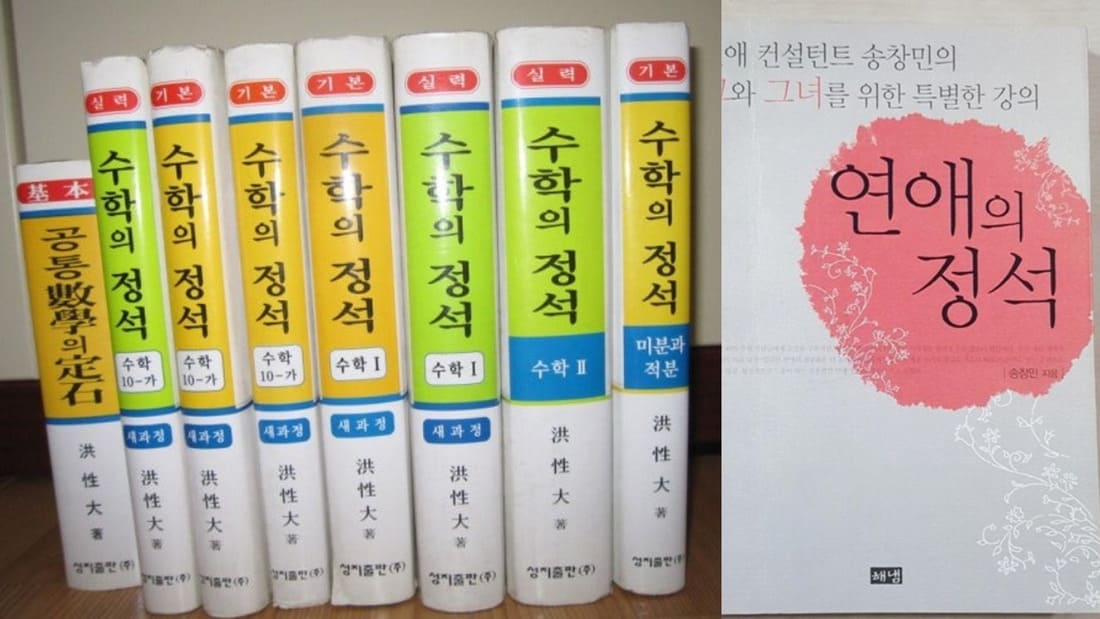
We speak of the jeongseok of studying, the jeongseok of careers, the jeongseok of parenting, even the jeongseok of cosmetics. Long before I ever placed a stone on a board, the logic contained in the word was already shaping the language through which I understood life. There is a reason Koreans call Go “the microcosm of life,” and it isn’t just that we love the game. It is that we sincerely believe life, like Go, is a matter of knowing the established sequences—and that somewhere out there is an answer sheet for everything. Just to give you an example—why do you think Korean kids stay up until 1 a.m. trying to get into top universities? It is because, ironically enough, they already know the answer to the question of what a “good life” in Korea is supposed to look like. In addition, they also know the sequence they are expected to follow to get there: study hard, get the grades, get into SKY, then get the stable job, the apartment, the marriage, the standing, the life everyone else is supposed to envy2. Almost the entire childhood of Korean kids revolves around this unshakable sequence, the jeongseok of life itself, that has been around for as long as modern Korea can remember. As an English teacher who runs his own academy, I am, in my own way, fostering this wicked way of the Korean society.
So when I tell you that I grew up thinking of my life in terms of joseki, I am not being poetic at all. In fact, I am being, irrevocably, Korean. And, for a very long time, I thought I had also found the joseki for my life, the joseki that would give me everything I ever wanted in my life.
The Joseki I Thought I Had Found
For me, however, the sequence did not begin with SKY. Don’t get me wrong—I did get into Korea University, but that wasn’t it for me, because I actually didn’t want to live in Korea. Having spent most of my teenage years in international schools, I’ve always dreamed of living in the States. So, I envisioned a joseki for getting my green card, and it began with Duke University.
To put it simply, Duke was the corner, faith in Christ was the outside influence, and America was the open board waiting beyond it. Love, if God was truly as generous as I believed Him to be, would somehow be both the natural consequence and the final proof that I had played the sequence correctly. Or that was the shape I had envisioned for my life, at least.
And so it happens that, in the fall of 2020, while the world was facing yet another apocalypse, I was actually the happiest I had ever been. Flights were being grounded, offices were shuttering, and everyone was scared shitless and desperately waiting for Pfizer and Moderna to come to their rescue, but amid that global fiasco, I was actually pursuing my dream. And it wasn’t just any dream—it was the “American dream.”
Somehow, in the middle of it all, I had just been accepted to Duke Divinity School. I was going to get my master’s, then my PhD, which would be my ticket to the promised land. I had it all worked out. I could see the whole thing from where I was standing, like the pilgrims sighting the coast of the new continent from the deck of the Mayflower.
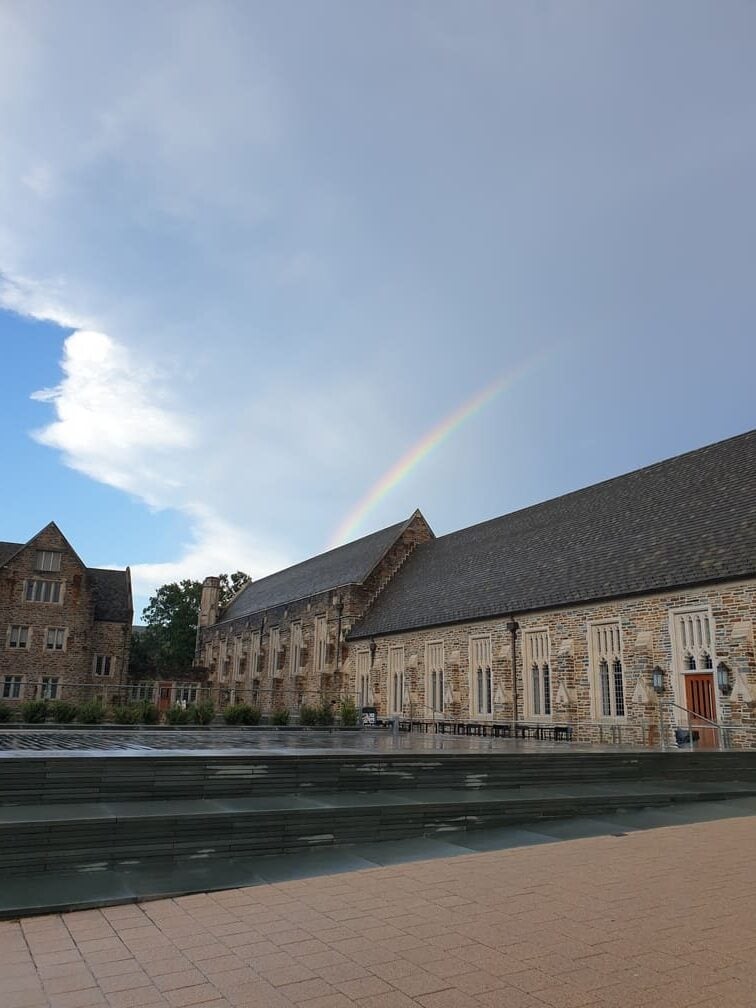
And it felt like divine guidance. After all, God personally taking care of a future seminarian made total sense to me. Sure, I had to spend my first year in Korea taking classes online, but I had made it to Durham by the following fall, and a Catholic acquaintance introduced me to the man who would become one of the best bros I’d ever have—right off the bat, exactly when I needed him, the way, as they say, “the Lord guides along the right paths” (Psalm 23:3). For the first time in my life, I was certain that God’s plan and my plan were one and the same, and that His plan was to give me everything I needed. Or wanted, for that matter.
And what I really wanted, of course, was to find the love of my life.
And find her, I did.
There was just one problem though: she had a boyfriend back in Korea. So I did what a good old-fashioned Christian would do—I prayed about it with all my might. I literally staked all my “soul” on this matter, or at least that’s how I felt. And, for the first time in my life, I “heard” back from God: a voice in my head, loud and clear, saying, “Be patient and she will come.” It was a promise, underwritten by God Himself.
Now, I wasn’t one of those “speaking-in-tongues, gifts-of-the-Spirit, talks-to-God-before-breakfast” types. Au contraire, I was more of a “show-me-the-wounds-and-let-me-stick-my-fingers-in-them” kind of Christian. So, naturally, I didn’t believe it right away. I mean, I was crazy about her, but I wasn’t crazy crazy, if you know what I mean. So, naturally, I waited to see if things would turn out the way they were supposed to turn out. And, as fate would have it, the real crazy thing happened: it started coming true.
Two weeks before her boyfriend was due to fly to the States so they could decide whether they were serious enough to get engaged, she found out he’d been cheating and ended it. She was wrecked, and I was the one who was there. I brought her food she wouldn’t eat; I sat with her while she cried about a man whose “stupidity” I was, quite frankly, appreciative of. I told myself it was decency, and maybe some of it was, but I’d be lying if I said I wasn’t thrilled watching the prophecy fulfill itself. It felt like I was in one of those gospel stories, finally able to understand what it’s like to be one of the disciples.
Every night she needed me was another rung. Every hour she let me stay was God nodding with a gentle smile. Every day we studied together until the library lights went out was another stone settling into place. And so it happened that one of those nights, somewhere past midnight, she stopped reading, looked at me, and asked me what I wanted with her. I told her the truth: I told her I wanted to be with her.
Then she kissed me. Or I kissed her. I genuinely don’t remember, and it didn’t matter, because for once in my life the distinction didn’t seem to exist—there was just the kiss, and the absolute certainty that God had been right all along.
And for the next ten minutes, the world was perfectly aligned. For the first time in my life, I had everything I had ever wanted: a girl in my arms, a bro in my corner, and the promised land beneath my feet. I had played the joseki perfectly, and now begins my real journey, or so I thought.
The fall began in the very next minute.
I won’t bother you with all the details, but it began with a small lie I had told out of embarrassment, because I didn’t want her to know just how worried I had been about her. To me, it was a ridiculously small act of pride. To her, it evidently meant something else.
The moment I admitted it, her whole expression changed. She said she needed to rethink what had just happened, that perhaps we should forget it. And just like that, with one wrong move, my stairway to heaven twisted beneath my feet and became a stairway to hell.
That night, after she left me sitting there dumbfounded, I tried to wrap my head around what had happened. I mean, the kiss was supposed to be the proof! For months, the voice in my head had said, “Be patient and she will come.” Well, I was patient—God knows I had been—and she came, exactly as promised. So if the kiss was not the beginning I had believed it to be, what, exactly, had been whispering to me?
The problem wasn’t that I had caught God lying. If it were only that simple! No, the problem was far worse: I could no longer distinguish the voice of God from the voice of my own wanting. In the one moment in which I had been stake-my-life certain, the two had been speaking through the same lips—mine.
And once I realized that, I began seeing the same mechanism everywhere. In fact, I couldn’t believe that I didn’t see it happening earlier. I had taken her grief as providence. I had taken her need for me as God’s hand. I had written a heartbroken person into a story whose ending I’d already decided—a story in which she was no longer fully a person in her own right, but a crucial piece of a “prophecy” she had never agreed to join.
Then, as it became clear that we would never be together, I turned the same suspicion toward my faith. I had to re-examine the belief that had driven my whole life. And what I found was that my “faith in Christ” seemed to contain everything except that—faith.
I loved the poetic verses, the beautiful hymns, the theology, the philosophy, the mysteries, and the inherent contradictions of the religion. I loved the identity of being a so-called “God-loving man,” and I loved the shape of my life—a shape that was held together only because it was contained within the ready-made structures of Christian communities, where I could temporarily keep both my deepest sense of loneliness and my desperate hunger for meaning at bay. But, at the end of the day, I had never truly loved Christ himself, nor could I appreciate what a death on a cross two millennia ago had to do with my life here and now.
Which brought me, inevitably, to the doctorate. Because why, exactly, was I pursuing one? I had told myself that it was a calling. I had good evidence, too: I had translated three theology books from English into Korean. Three. I did the work well and liked the work. The problem was, however, “I am competent at translating theology” doesn’t quite translate to “I am destined to devote my life to theological scholarship.” Those are not the same. Not even close. But I needed them to be the same, and so they were.
And there it was. Pull the prophecy, and the faith came with it. Pull the faith, and the calling came with it. Pull the calling, and the only thing left holding up my entire American dream was the paperwork.
Now, as devastated as I was, I managed to convince myself that the meaning didn’t matter. You sort through the wreckage and salvage whatever is, well, salvageable. Even though Duke had never been a calling, God had never spoken, the faith had been a mere costume, and the romantic dream became my worst nightmare, I was still in the States, my promised land. And a life, unlike a calling, doesn’t require you to believe in it. It just requires you to keep it running.
So, as graduation approached, I started looking for a way to stay. America was no longer a destiny, but my last remaining lifeline. The most obvious path was church work. One Korean church had offered me a position that would almost certainly have provided the documents I needed to stay. But I could not in good conscience serve as a “minister” and pretend like I believe in a god I no longer really believed in. So, I began looking outside the one field in which my degree was worth much of anything. I didn’t care what the job was; I just wanted one thing: the good old H-1B visa sponsorship.
And I found one.
The University of Michigan in Ann Arbor had an opening at its Asian library—the kind of position that could sponsor a work visa, the kind that turns “I am here” into “I am allowed to remain.” I interviewed, and it went exactly the way I wanted it to go. Smooth as butter, which, by then, I really should have known was a bad sign.
They offered me the job. I accepted. That night, I slept better than I had in months. Not happily—I was past happy—but solidly, like a man who had finally gotten his feet beneath him after a long fall. I had saved something. One thing. The last thing. But, all in all, the most important thing. I went to sleep certain of it.
The next morning, before I had even finished my coffee, they took it back.
As it turned out, they had mistaken me for a U.S. citizen—my fluent English had apparently allowed the assumption to go unchallenged—and through three interviews, no one confirmed that I would require visa sponsorship. Despite what the posting had indicated, the position could not provide it.
So, there I was, having the same experience yet again. For one night, the future had seemed fully and finally mine again. By breakfast, the future I had already begun living inside had ceased to exist. Apparently, rock bottom had a basement. It wasn’t the loudest loss or anything—losing her was louder, and the collapse of faith cut deeper, but it was certainly the lowest, because it removed the last thing still standing. The soul of the dream had begun dying in a conversation past midnight. Its body died over a cup of coffee, by email, before nine in the morning.
And that, in essence, was the story of my American dream. In the end, it proved to be just that—a dream, and nothing more.
Right Moves, Wrong Board
Now, some of you may be wondering why I am telling you one of the most embarrassing episodes of my life. It’s a fair question, and, believe me, I would much rather talk about something else than to drag you through what is basically a story about a 30-year-old man believing in destined-to-marry-her kind of crap. Yet, I told the story because, as much as I hate to admit, it captures, almost too perfectly, the first cruel lesson Go teaches you after you get used to playing joseki and the rest of the board begins to matter.
Let me show you what I mean on an actual board.
The game I want to look at was played between Shin Jin-seo of Korea, playing White, and Yu Zhengqi of Japan, playing Black, in Game 12 of the 23rd Nongshim Shin Ramyun Cup World Baduk Championship.
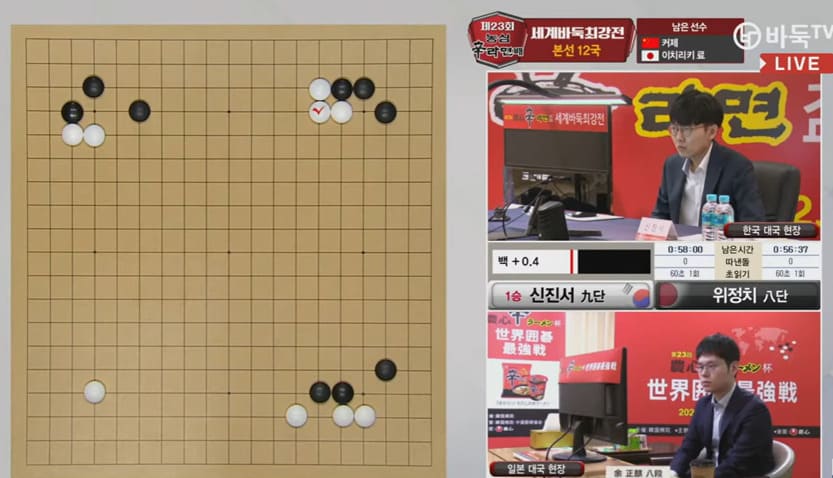
If you look at the board, nothing particular is going on. The two players followed some of the most basic sequences in three of the corners, and, as you can see from the AI evaluation shown during the broadcast, the board remains almost perfectly balanced with White ahead by only about 0.4 points.
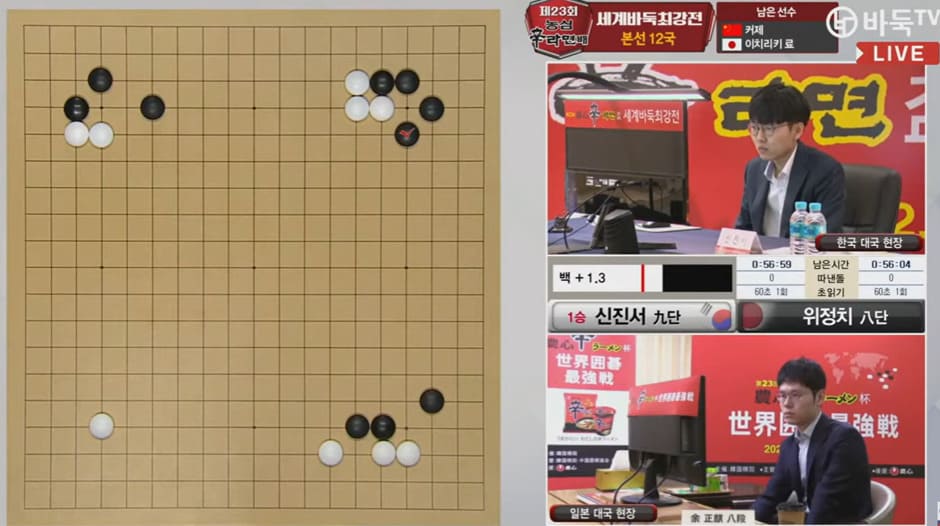
The problem starts to occur when Black completes its local exchange. You can see that the win-rate bar moves slightly in favor of White, which indicates that what seems like a typical move is actually not the right choice here. Fortunately, it is not a fatal mistake, and 1.3 points is practically nothing in the early phase, which means it is still anybody’s game at this point.
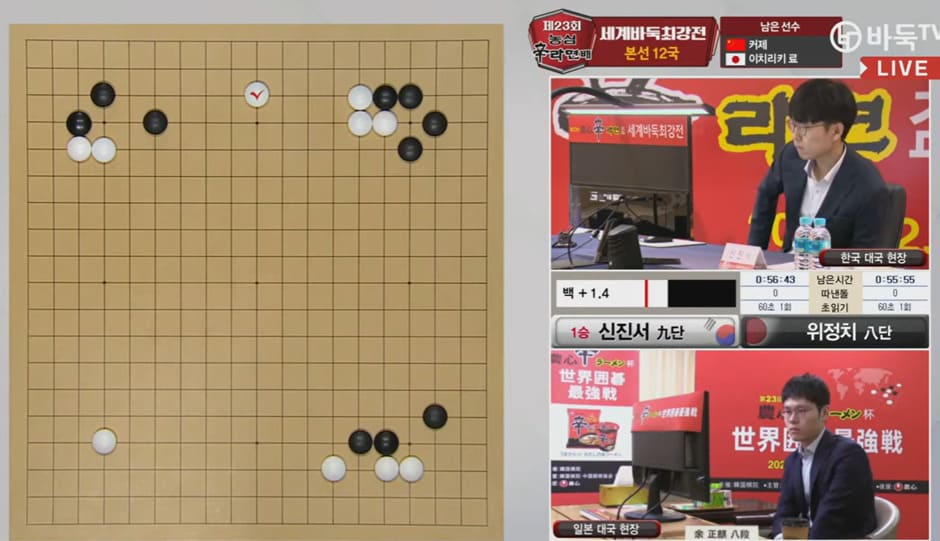
Then, Shin also completes White’s side of the local exchange. It is, again, the most basic move from one of the most basic joseki you can learn. AI barely reacted as well, with White’s estimated lead remaining at about 1.4 points.
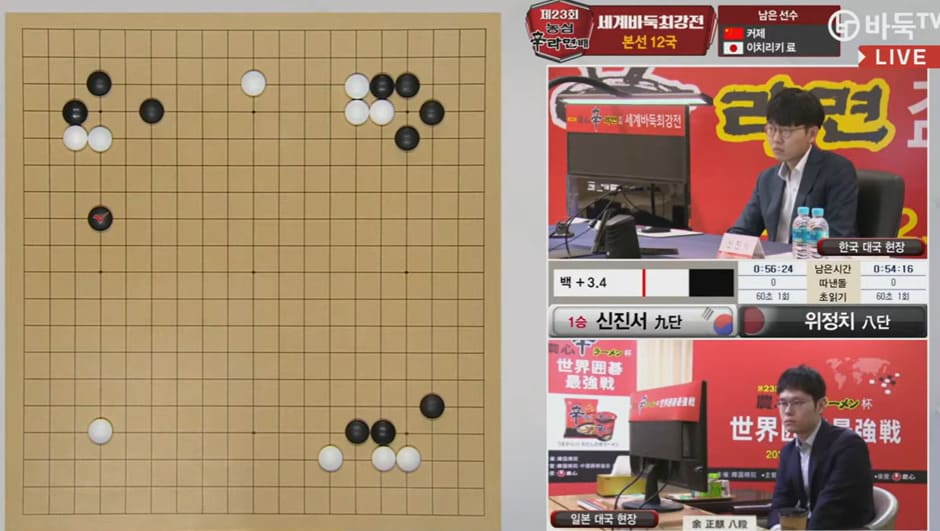
The real problem starts to emerge in the next move. Yu responds to White’s move by returning to the upper-left and playing the kind of move that looks perfectly normal to any experienced Go player. To put it simply, White didn’t continue its sequence in the upper-left corner and played its move on the top side of the board. So, after responding to White’s move by playing the joseki from Figure 17-20, Black pressures White’s stones, trying to punish it for the “unfinished business.”
And here’s the thing. If it was any other game, it would make perfect sense to try to punish White for leaving its stones unprotected. The move is not absurd. Not at all! It is not even remotely strange. If Yu had placed a stone in some completely ridiculous spot—say, at the edge of the board for no apparent reason—then all we can probably infer from that instance would be either he lost his mind or that he misclicked on the board (which, by the way, actually happened to Shin in the Finals of one of the top Go championships). Yu, however, played a perfectly natural sequence of one of the most basic joseki. That move belongs to the shape. It follows the rhythm of the local exchange, and I would’ve also considered playing that same move. I mean, any experienced Go player looking at the upper-left corner could understand exactly why Black wanted to play that move.
The AI, however, tells us that a move that seems natural is, in fact, a serious mistake. It is not fatal, as in you’ve-just-handed-the-game-away fatal, but it sure was costly, as in you’ve-just-punched-yourself-in-the-face costly. As you can see in Figure 20, more than two points were given away in a single move, which, at the professional level, and especially this early in the game, is not some negligible rounding error you can just brush off. It indicates that you are going in the wrong direction. It was clearly a major mistake, and Yu never fully recovered from the deficit.
But, you ask, if Yu was just following a well-known sequence and responding to White’s lack of investment in the upper-left corner, what exactly makes that move a mistake? After all, the move did not suddenly violate the rules of Go. It did not form some hideous shape that would make a teacher reach through the screen and slap Yu’s hand. It followed the logic of the corner perfectly well. White had left two stones hanging in the upper-left, and Black tried to pressure them. Locally speaking, the move made complete sense. The problem was that, even at this early stage, the game was not being played locally. The problem was that what looked like the last move of the old sequence on the upper-right corner—White’s extension along the top—wasn’t simply part of a local sequence. Because of the rest of the board, the stone had gained an entirely different set of possibilities, projecting its influence toward the upper-left and coordinating with White’s stones there.
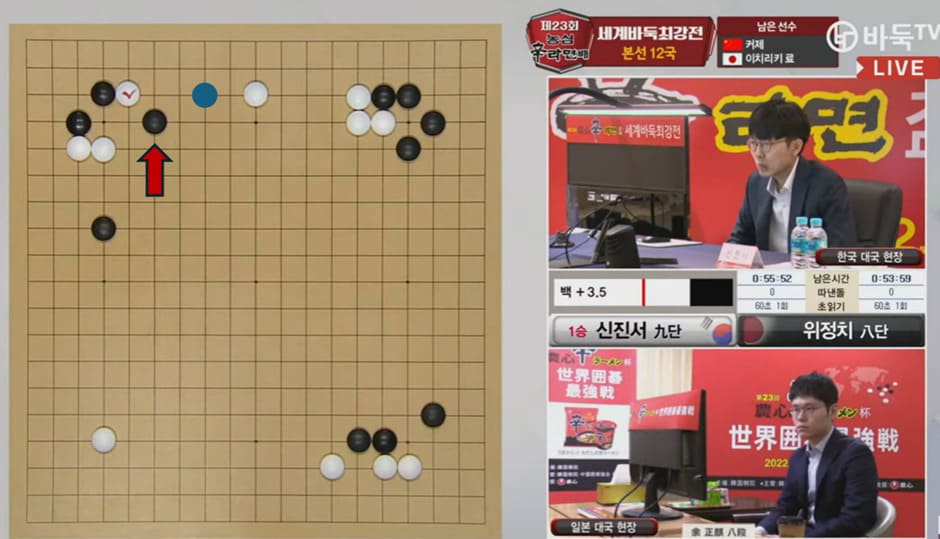
And this is where a difference of just one line—one intersection farther from the edge—becomes crucial. As you can see in Figure 21, Black’s stone indicated by the arrow is on the fourth line instead of the more usual third line. To put it simply, this move has the advantage of applying more pressure on the White stones on the upper-left, but it has the disadvantage of being counterattacked by the move you see in Figure 21 (marked by a check mark). There is a proverb in Go which says, “Secure yourself before attacking others(我生然後殺他),” and it becomes relevant in our board position here. By pressuring White’s upper-left stones from below, Black became vulnerable to White’s counterattack, and, as you can see in the following moves (Figure 22), Black not only failed to capture White’s stones in the upper-left but also allowed White to secure substantial territory along the top and build considerable potential on the left. The better choice, according to the AI, was to secure Black’s territory by playing the blue spot in Figure 19, before applying any pressure to White’s stones. In any case, the local stones were not going anywhere, which means Black did not need to settle the matter immediately. The corner looked urgent only because our eyes—and even professionals’ eyes—had been trained to complete the sequence we already recognized.
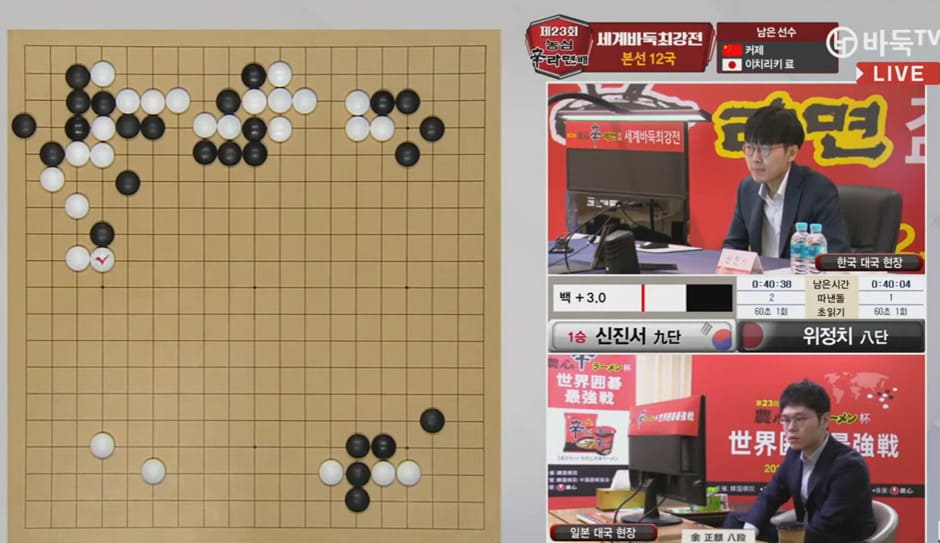
That, my friends, is what makes the mistake so revealing. Technically speaking, there was absolutely nothing inherently wrong with Black’s move. If you put the same move into another position, then it would become an excellent move. If you remove White’s stone from the top, rearrange one or two stones in another corner, change the direction in which Black wants the game to develop, and the judgment will reverse completely.
All that is to say: the move was not wrong in and of itself. It was just wrong here. And that one little word “here” contains just about the entire problem I am trying to tackle in this chapter.
The problem with joseki—or, more precisely, with joseki books—is that they present sequences in isolated corners so that we can understand them. We mentally crop the board, the same way we crop an image to focus on the part we want, removing everything outside the frame that might distract us from what remains within it. And inside that frame, that little world of whatever remains, a move can be strong, weak, efficient, slow, balanced, or even unreasonable. What makes the problem more difficult, however, is that this act of isolation works. And it works quite well, I might add. It’s plain obvious that studying one corner is far easier than studying all 361 intersections at once, just as a grammar lesson at a time is far easier than trying to swallow the dictionary whole.
Yet, the isolation is still artificial. No corner is actually separate from the rest of the board. We treat the corners as such because doing so makes it easier to study, remember, and reproduce. And once we reduce the board to a size we are comfortable with, we pretend that, even if only temporarily, whatever lies beyond the boundary we have drawn does not matter. The trouble begins when we forget the word artificial. It becomes even worse when we forget the word temporarily.
That, in essence, was Yu’s problem in the game.
That, in essence, was my problem in Durham, NC.
Earlier I mentioned that my American dream proved to be just a dream and nothing more, but the problem wasn’t that simple. The excruciatingly painful part about my American dream was that none of it had been simple imagination. Duke was real. Durham was real. The girl was real. The kiss was real. Even the job offer was real, for one brief night. These were all real! I didn’t pull them out of thin air. That was precisely what made the dream so trustworthy.
The error, however, was that I had mistaken their arrangement for the world. I had taken a handful of real—but independent—events and pressed them together to form a single shape: God guiding, love arriving, vocation unfolding, and, alas, America opening. And because the shape held for quite a while, I began to live inside it. It stopped being one of the many possible readings of events and started becoming the structure of reality itself in my mind.
The result?
Well, you already know.
[1] For the technical nerds already opening their mouths: yes, there are old records that say Danzhu did play the game. For example, Bowuzhi (博物志), often translated as Records of Diverse Matters, states that “Yao created weiqi; Danzhu was good at it” (堯造圍棋,丹朱善之), and other sources connect the invention of Go to Yao, Shun, and their allegedly foolish sons. However, if Danzhu really was that much of a fool—and other traditions do seem rather committed to that point—the claim that he became good at Go only makes the story more suspicious, not less.
[2] SKY stands for what’s traditionally considered the top 3 universities in Korea: Seoul University, Korea University, and Yonsei University.


Comentarios