
🎥 Honinbo Shusai vs Go Seigen: Game of the Century

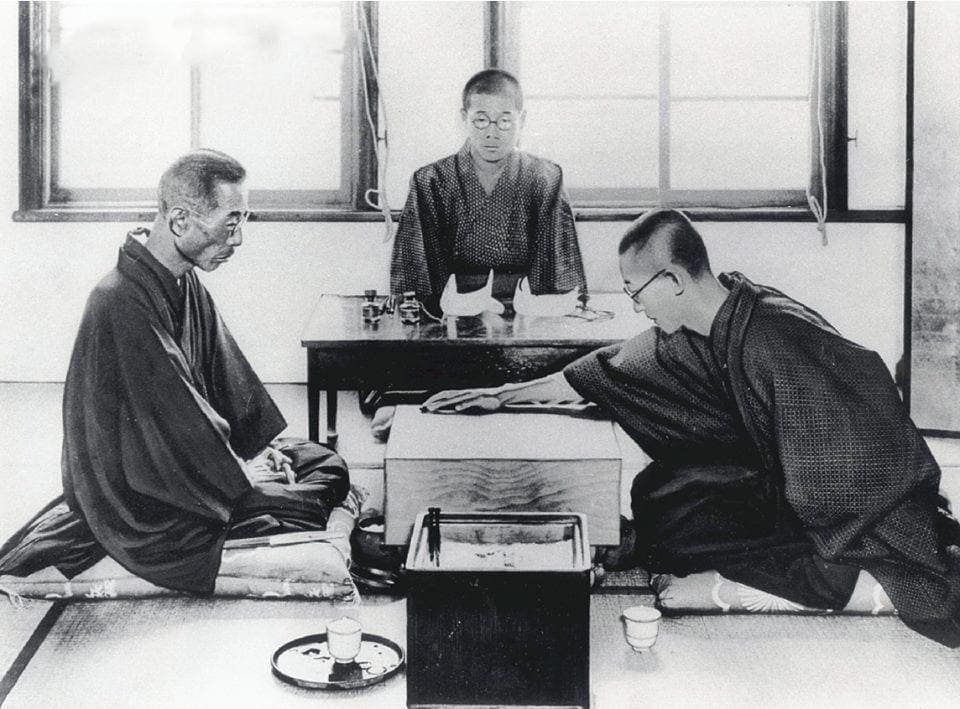

Step back to 1933 for an in-depth look at the legendary “Game of the Century” — a pivotal Go match that transcended the board and left a lasting mark on the history of the game.
This epic battle featured a dramatic confrontation between the 60-year-old Meijin Honinbo Shusai and the 19-year-old prodigy Go Seigen. The match is remembered for Go Seigen’s groundbreaking, unorthodox opening moves that challenged centuries of tradition, met by Honinbo Shusai’s masterful strategic responses and deep positional insight.
Played under the unique rules of that era, each player was allowed up to 24 hours of thinking time, and the game was adjourned a record 13 times. These extended breaks allowed Shusai to consult with his students between sessions — a highly controversial practice at the time that eventually contributed to important changes in professional Go, including the introduction of the sealed move rule.
This historic encounter was far more than just a game; it represented a symbolic clash between classical Japanese tradition and a bold new revolutionary style that would transform the future of Go.
What You’ll Learn
- Why Go Seigen’s opening was so shocking in 1933
- How Shin Fuseki challenged classical Go theory
- Why Honinbo Shusai’s adjournments became controversial
- How the match turned into a clash of old vs new
- Why White 160 became one of the most famous moves in Go history
- How Go Seigen kept fighting even after the decisive tesuji
- Why this game influenced the later use of sealed moves in professional Go
Timestamps
- 00:00 Intro
- 00:38 Game opening
- 04:07 The first adjournment
- 07:11 Japan vs China
- 09:54 Honinbo Shusai’s insightful diagonal move
- 12:25 Score estimate
- 14:10 The Meijin invades
- 18:37 The slow pace of the game
- 19:26 Time for Go Seigen to invade as well
- 23:16 The explosion at move 160
- 28:02 The game is over
00:00 — Introduction
In this video, we return to 1933, before Honinbo Shusai’s retirement game, to look at one of the most famous matches in Go history.
The game was organized by Mainichi Shimbun to commemorate the newspaper’s 20,000th issue and to celebrate Honinbo Shusai’s 60th birthday. Shusai, the Meijin and the great representative of classical Go, faced the young prodigy Go Seigen, who was only nineteen years old and 5-dan at the time.
The players each had twenty-four hours of thinking time. Go Seigen played Black. Honinbo Shusai played White.
Let’s study this game and see why it later became known as the Game of the Century.
00:53 — Go Seigen’s Revolutionary Opening
Looking at the opening today, it may not seem quite as shocking as it did then. Modern players are used to seeing all kinds of experimental openings, and AI has made us more flexible about early corner choices, high moves, and central influence.
But this was 1933.
At that time, professional Go was still deeply connected to classical opening principles. Go Seigen began with san-san, then a star point, and then tengen. In other words, he placed one of his first stones directly in the center of the board.
Before the game, Go Seigen even asked whether such an unusual opening was allowed. He was told it was fine. But after seeing it on the board, Honinbo Shusai reportedly almost quit the game because he felt the young challenger was making fun of him.
Nevertheless, the game continued.
01:42 — Old Style vs New Fuseki
The opening immediately shows the deeper story of the match.
White’s moves are classical: 3-4 points, corner enclosures, and extensions. Honinbo Shusai plays in the established style of the old Go world. His stones value territory, stability, and traditional rhythm.
Black’s position is completely different. Go Seigen builds a strange central formation, using high stones and the tengen move to suggest a new way of thinking about the board. Instead of securing the corners first, he is asking whether influence, flexibility, and whole-board vision can matter even more.
This is what makes the game so historically important. It is not just a game between two strong players. It is a game between two eras.
02:53 — The First Invasion and First Adjournment
Soon, White makes an invasion. In modern Go, we might expect Black to kick, White to extend, Black to jump, and then a more ordinary running sequence to follow. White might settle lightly and make a small life in the area.
But Go Seigen chooses something more unusual. His response works together with the stones he placed earlier in the center. Instead of treating the position only as a local fight, he uses his whole-board formation to pressure White.
Black covers. White jumps, threatening to connect underneath. Before simply protecting, Black presses, aiming to keep White small and prevent an easy escape into the center. Shusai does not like the result of a passive continuation, so he invades the corner right away.
Black then switches to the top side. From a modern perspective, this top-side move looks natural: it takes control of the side and prepares to attack White’s stones.
Black invades again to keep pressure on White, and at this point the game is adjourned for the first time.
That detail matters enormously.
With twenty-four hours of thinking time each, the game could not be finished in one sitting. But under the rules of the time, White had the right to adjourn the game on White’s turn. Since Shusai was Meijin, he also had the privilege of taking White against everyone.
So Shusai could stop the game on his own turn, return home, and study the position before making his next move.
In this match, he adjourned the game on his turn thirteen times.
Even more controversially, during the breaks he could analyze the position with students from the Honinbo school. Many of them were strong professionals. Go Seigen, the young challenger, was at a serious practical disadvantage.
05:17 — White’s First Major Plan
After the adjournment, White returns with a plan.
White attaches. Instead of simply extending, White plays a double hane. Black gives atari.
In this shape, it is important for White not to connect automatically. If White connects, the shape becomes heavy and ugly. Black may get forcing moves, turn one eye into a false eye, or make White’s stones cluster inefficiently.
So White’s plan is to sacrifice. White gives up one stone and treats the surrounding weaknesses lightly. Black captures, White gives atari, Black connects, and then White turns away from the sacrificed stone.
White covers Black’s stone and begins to attack. Black escapes, and White connects.
At first glance, this connection may look passive, but it is almost forcing. If Black ignores it, White has follow-up moves such as hane and double hane that make Black’s shape uncomfortable. So Black jumps to fix the problem.
White immediately prevents Black’s development.
The fight is already becoming complicated, and both players are showing their strengths. Go Seigen is flexible and inventive. Shusai is slow, deep, and willing to sacrifice stones if it improves the larger position.
07:17 — National Pressure Around the Match
The newspapers presented the match not only as old versus new, but also as Japan versus China.
Go Seigen was born in China, where his original name was Wu Qingyuan. In the tense political atmosphere of the time, that framing put enormous pressure on him. Some Japanese nationalists even threw stones at his house during the match.
Yet the game continued.
Black makes a clever cut. The idea is that one stone can be sacrificed. If White captures it directly, Black gets useful ataris and fixes his shape. White cannot accept that result, so he extends instead.
Black extends. The fight continues.
White connects, Black connects, and then Black makes a proper shape move, fixing a cutting point with a beautiful tiger’s mouth. White also has to defend. If White tries to kill the two black stones in the corner too directly, White’s nearby shape is not strong enough. Black can hane, and White’s position may collapse.
So White fixes the shape first, and Go Seigen gets time to live in the corner.
08:27 — Shape, Sacrifice, and Corner Life
The three White stones are now awkward. White needs to save them, but it is not easy.
White pushes. Black hanes.
It would be tempting for Black to play more gently and allow White to fix shape in sente, but Go Seigen avoids slack moves. He keeps pressing. Under this pressure, White cannot think about killing the corner.
White protects, and Black jumps down to live. The corner is alive.
Now White cuts, and Black connects. One White stone might help later if a fight develops nearby, but in the actual game Shusai plays another one. Black covers and kills both stones.
Why would Shusai sacrifice an additional stone?
Because White has a far-reaching plan.
10:03 — Shusai’s Far-Reaching Exchange
If White does not make that exchange and simply cuts immediately, Black can answer in a way that makes White’s future attack fail. After a sequence of ataris and connections, White may be forced into a ko fight that Black can win. In that case, the cut becomes a disaster for White.
But with Shusai’s preparatory exchange on the board, the same Black continuation no longer works.
If Black tries to connect as before, White can cut. If Black attempts to save the stones, White can capture a larger group. This means Go Seigen has to compromise.
Instead of connecting in the ideal way, Black plays differently and allows White to cut.
Up to this point, the game has been fairly even. Strictly speaking, the game was played without komi, because komi had not yet become standard. That means Black began with what we would now understand as a natural first-move advantage. But Go Seigen’s high and experimental opening moves, while revolutionary, also gave White chances. From a modern point of view, some of those moves are criticized by AI because they do not secure enough corner profit.
So after the opening, the game becomes close.
12:27 — A Nearly Even Game and a Missed Chance
Go Seigen now needs to solidify his central area.
In the game, he fixes the elephant jump. The move is big, but it is gote. Before playing it, he may have had the chance to make several sente exchanges to strengthen his territory.
For example, Black could have forced White to answer in a way that strengthens Black’s wall and removes weaknesses. After several such exchanges, Black would reach the next stage with a small advantage and could then choose whether to defend, invade, or expand more aggressively.
But in the game, Go Seigen defends without first strengthening his area.
This gives Honinbo Shusai the chance to make a daring invasion.
14:09 — White’s Daring Invasion
Shusai invades Black’s framework before it is fully reinforced.
The invasion threatens to cut through and kill Black’s stones, so Go Seigen must respond. White then attaches, trying to start a fight. If a fight begins, White’s earlier stones will become useful.
Black hanes. White cuts. Black has to save one stone, so Black extends. White covers.
Now Black has two problems: the two stones on one side and the single stone nearby. Go Seigen finds a remarkable idea. It looks as though it should not work. White can extend, and Black cannot simply connect because of atari.
But Go Seigen is prepared to sacrifice the two stones.
White gives atari. Black extends and saves the important stone. White captures the two stones. Now Black captures two White stones in return.
At this moment, Black probably should have inserted a forcing exchange before capturing. Go Seigen does not do it, and Shusai immediately sees the opportunity.
White plays a move that prevents Black from ever getting the ideal tiger’s mouth shape.
If Black could play that tiger’s mouth, his shape would be excellent and White’s exchange would look terrible. But the shape contains a ladder problem. If White peeps and cuts, Black can only rely on a ladder. That means White may later use a ladder breaker in the surrounding area.
Because the position is too uncertain, Go Seigen does not play the beautiful tiger’s mouth. He connects more simply.
16:38 — Proper Shape Under Pressure
Next, Shusai cuts and threatens to connect on the second line.
This is a good moment to pause and think: how can Black prevent White from connecting underneath?
A direct atari looks natural, but it fails to solve the problem cleanly. White can capture, and Black’s shape remains bad. White still has ways to connect the stones or cause trouble.
In the game, Go Seigen finds the proper shape: a jump.
This move threatens to extend and save everything by killing the two White stones. White has to capture, and then Black can take the two stones.
The two White stones cannot live, but White can sell them at a very high price.
White plays in a way that threatens to reduce Black’s territory. If Go Seigen insists on capturing everything locally, Black’s position becomes cramped and sad. White will connect, force Black to block again, and leave future sente moves that reduce Black repeatedly.
So Go Seigen says, in effect: no way. He turns to another big move.
White connects all stones. Black follows up and keeps pressing. The move also threatens to attack White’s larger group, so White must protect.
Finally, Black has time to play at the top, and White connects at the bottom.
18:37 — Shusai’s Long Calculation
We now reach another playing session, and this moment shows what kind of player Honinbo Shusai was.
White jumps, threatening to continue into the center. Go Seigen responds after only two minutes by blocking.
Shusai then thinks for three and a half hours. After all that time, he adjourns the game without making a move.
When the game resumes, after all that deliberation, he still blocks on the second line.
Black cuts. White connects. Black gets sente to strengthen the center. White connects again, and now Black is thick in the center and strong at the top.
It is only natural that Black can now play more aggressively.
It is time for an invasion.
19:36 — Black’s Top-Side Invasion
Black invades the top.
If White blocks from the outside, Black can connect and live in the corner. If White blocks differently, Black can extend and kill the nearby stone. Either way, White risks losing a lot.
So Shusai first makes an exchange to strengthen himself. If Black responds passively, White may try to attack and kill the invading stone. But Black does not respond, and a large exchange follows.
Black invades. White blocks. Black starts to escape. White jumps. Black pushes.
At this point, White could continue simply, but then Black would connect all his stones while White would be left with a group inside Black’s area. That seems too unsafe.
So White makes a shape move: an attachment.
After atari, Black’s stones almost escape, but White lives at the top. Black connects, White defends, and then Black takes profit by cutting and capturing three White stones.
However, this leaves White with sente.
White uses sente to enlarge the base and reduce future danger. This move is very important. If White does not play it, Black can play there first and force White to live very small.
21:50 — A Dangerous Forcing Move
Before responding in the corner, White plays a forcing move.
If Black simply connects, White may take the corner or tenuki to play a large point elsewhere. Looking back, perhaps Go Seigen should have connected. That would have made all of Black’s stones safe and linked together.
But in the game, Go Seigen resists. He takes the corner instead, saying: if you cut me, I can live.
Black connects. White gets sente and threatens Black’s stones. White then cuts, and this is also sente against the corner. If Black ignores it, White can hane and hane again. As the proverb says, hane brings death.
So Black has to live.
Now White jumps, and Black’s stones are under attack.
Go Seigen handles the situation smoothly. White threatens to cut, but instead of connecting passively, Black plays a move that also threatens White’s shape.
Even with all this brilliance, however, Black does not see what is coming next.
23:25 — White 160: The Bomb Tesuji
At the beginning of a new playing session, Honinbo Shusai unexpectedly plays the move that made this game legendary.
White 160.
A bomb. An explosion. A tesuji.
White invades at a vital point. The move threatens to connect to the top stone and also to the left. If Black blocks, Black may be forced into a cutting sequence where his shape is not strong enough.
After a series of ataris, cuts, and connections, Black ends up with only two liberties and must capture in a way that allows White to take four stones. If that happens, the game is effectively over.
This incredible move completely changes the flow of the game.
24:26 — The Controversy Around White 160
White 160 became the most debated move of the match.
There was a rumor, never confirmed and never fully disproved, that the move was not actually found by Honinbo Shusai himself, but by one of his students, Maeda Nobuaki.
In December 1936, three years after the game, Shusai commented on the discovery of the move. He said that he had only two hours left on his clock and could not afford to waste even a minute. At the critical moment, he calmed himself, looked at the board as if he were studying someone else’s game, and suddenly saw White 160 “in a flash.”
We will probably never know exactly what happened.
But it was likely this move that tipped the game in White’s favor.
And Go Seigen deserves credit as well. After seeing such a powerful move, he did not collapse. Instead, he found a strong counter-sequence.
25:40 — Go Seigen’s Counterplay
After White 160, Go Seigen manages to keep most of his central points.
The two White stones cannot easily escape. If White tries the obvious move, Black has a tesuji that captures them. So White prepares to escape in a different way, threatening to cut.
Black makes a threat. White pushes.
By this point, Go Seigen knows he will lose some of the stones, so he makes an exchange first. Otherwise, he will not be able to get it later.
White responds. Black gives atari. White defends on the left.
Now Black needs to capture the two stones. Black jumps.
Honinbo Shusai is going to capture five stones — but how?
This is another good moment to pause and think.
If White plays directly, Black can connect and all the stones are safe. So White needs a tesuji.
In the game, White throws in.
Black captures. White gives atari. Black captures again. White first takes sente, Black blocks, and then White captures with a snapback.
27:22 — The Snapback and Final Result
After the snapback, the game continues for about sixty more moves, but the essential result has already become clear.
White has a small advantage.
In the end, Honinbo Shusai wins by two points.
This is why the game went down in history as a game of supreme brilliance and deep controversy.
Go Seigen’s three novelty opening moves — san-san, star point, and tengen — challenged Honinbo Shusai’s classical Go. Shusai’s White 160 became one of the most famous tesuji ever played. The match symbolized the clash of old and new, Japan and China, tradition and modernity.
But it was also a game where the rules favored one player.
Because the game could be adjourned without a sealed move, Shusai could stop play on his turn, analyze the position for days with his students, and then return to the board. Many people still feel that his two-point victory was somewhat hollow for that reason.
28:01 — The Legacy of the Game of the Century
The controversy helped push professional Go toward the sealed move system.
Under sealed move practice, before a game is adjourned, the player whose turn it is must write down the next move and seal it. The move is revealed only when play resumes. This prevents either player from using the break to think about the immediate next move.
Sealed moves were already common in chess at the time. In Go, the practice was first used in Honinbo Shusai’s retirement match — the game later made famous through Yasunari Kawabata’s The Master of Go.
That is one reason the 1933 Game of the Century remains so important. It was not only a masterpiece on the board. It also exposed a weakness in the old match system and helped move Go toward fairer modern procedures.
So what do you think?
Was Honinbo Shusai’s victory fair? Or did Go Seigen, despite losing by two points, prove something even more important?
Leave your opinion in the comments.
This is Go Magic.
Which legendary historical game should we break down next? Tell us in the comments! 👇




Comments