Gomoku
Line up five of your stones in an unbroken row — across, down or diagonally — before your opponent gets there first.
How to Play Gomoku
Gomoku is played on a Go board with ordinary Go stones. Black moves first, White answers, and a turn is one stone placed on any empty intersection. Stones never move and are never captured, so the board only fills up. The first player to form an unbroken line of five — horizontal, vertical or diagonal — wins immediately; if the board fills with nobody reaching five, the game is a draw. Here you play a bot across ten levels or a friend on the same device, on a 15×15, 13×13 or 9×9 board, and you choose the rule set: Freestyle, where five or more wins; Standard, where a line of exactly five is needed; or Renju, which handicaps Black by forbidding a double three, a double four and the overline, marking every forbidden point on the board.
A Brief History of Gomoku
Gomoku grew up inside Go — same board, same stones, a goal simple enough to explain in a sentence, which is why it spread as the game you played on equipment you already owned. The name is Japanese, short for gomoku narabe: go (five), moku (a counter for pieces), narabe (to line up). Because moving first is such an advantage, Japanese players built renju, a restricted version that handicaps Black. In 1994 L. Victor Allis proved them right: on an empty 15×15 board, the first player can force a win.
Benefits of Playing Gomoku
Gomoku is the cheapest reading practice in board games. Every move asks you to look two or three moves ahead and count what happens if your opponent answers correctly, and the feedback is instant — miss a threat and you lose on the spot. With nothing to memorize, beginners spend their whole attention on patterns and calculation, and the lower bot levels overlook threats the way a real beginner does, so you get games you can actually win while you learn.
Tips and Principles for Winning at Gomoku
Start near the center, where a line can grow in every direction; stones on the edge waste half their potential. Learn to recognize an open three — three of your stones with space at both ends — because it forces an answer, and chains of forcing moves win games. The real goal is a double threat: one stone creating two fours at once, which cannot both be blocked. And watch the diagonals, the lines people overlook.
Gomoku and Go: The Same Stones, a Different Question
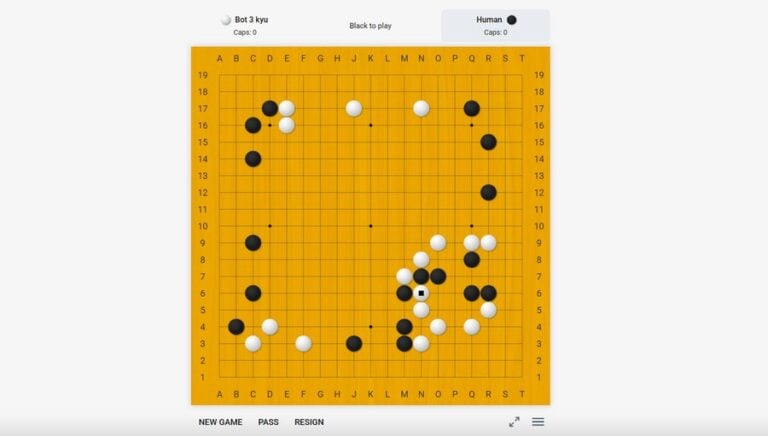
The two games share equipment and a way of thinking. Both are about influence: a stone you place never moves, and good play means putting stones where they work with the ones you already have. Gomoku asks for a single line of five; Go asks you to surround more territory than your opponent. If gomoku has you curious about the older game, learn the rules of Go and use the same board.