Reversi
Trap your opponent’s stones between two of yours to flip them to your color — whoever owns more of the board when it fills up wins.
How to Play Reversi
Reversi is played on an 8×8 board and starts with four stones in the center, two black and two white, set diagonally. Black moves first. Every move must capture: place a stone so that one or more straight lines of your opponent’s stones — horizontal, vertical or diagonal — are closed in between the new stone and another of yours, and every stone in those lines turns over to your color. If you have no move that captures, you pass and your opponent plays again. When neither side can move, usually because the board is full, the game ends and the player with more stones wins.
Here the pieces are black and white Go stones that flip when they are captured, and the legal moves can be marked on the board, so you never have to hunt for them while you learn. A marker shows the last move played, and the move list beside the board lets you step back through the game or download its record.
Play Against the Computer or a Friend
The bot comes in six levels. The first grabs as many stones as it can with every move — the classic beginner’s instinct, and a losing one — so it is a fair first opponent. The next two look a move or two ahead and still make human-looking mistakes; from level 4 up the computer plays properly, and level 6 searches until its time runs out and solves the endgame exactly whenever it can. Play as Black, as White, or let the game choose; on the first three levels you can take back up to three moves a game.
For two players, choose Two Players and take turns on one phone or computer. An unfinished game stays saved in your browser until you start a new one.
A Brief History of Reversi
Reversi was invented in England in the 1880s, and two men, Lewis Waterman and John W. Mollett, each claimed it; in early versions the players placed the first four stones themselves. In the early 1970s Goro Hasegawa in Japan fixed the start as a diagonal cross, and his version went on sale in 1973; it is the form played in world championships today, and the one here. Computers mastered it early: in 1997 the program Logistello beat the world champion Takeshi Murakami 6–0, and in 2023 a computer study reported that the 8×8 game, played perfectly by both sides, ends in a draw.
Benefits of Playing Reversi
Reversi is the best teacher there is for one counter-intuitive idea: the score in the middle of a game means almost nothing. A position with many of your stones on the board is often the weaker one, because every stone of yours is a stone your opponent can flip and a square that no longer gives you a move. Learning to judge a position by what it lets you do next, rather than by what you already have, is a habit that carries into every strategy game. And because the whole board can turn over in the last few moves, it trains counting to the end.
Tips and Principles for Winning at Reversi
Take the corners: a stone in a corner can never be flipped, and it anchors the edges next to it. For the same reason, avoid the squares diagonally next to an empty corner — players call them X-squares — and be careful with the edge squares beside it, the C-squares, because both tend to hand the corner to your opponent. In the opening and the middle game, flip few stones and keep your options open: the player with more legal moves usually ends up with the corners. And in the last moves, count — the final flips decide the game, and so does who gets to move last in each empty region.
Questions About Reversi
Which starting position does this game use?
The modern tournament one: two black and two white stones crossed diagonally in the four center squares, with Black to move.
What happens if I have no legal move?
You pass, and your opponent moves again. The game ends only when neither side can move.
Can reversi end in a draw?
Yes, when both players finish with the same number of stones — on a full board, 32 each. It is rare, but it happens.
Reversi and Go: Black and White, Played Very Differently
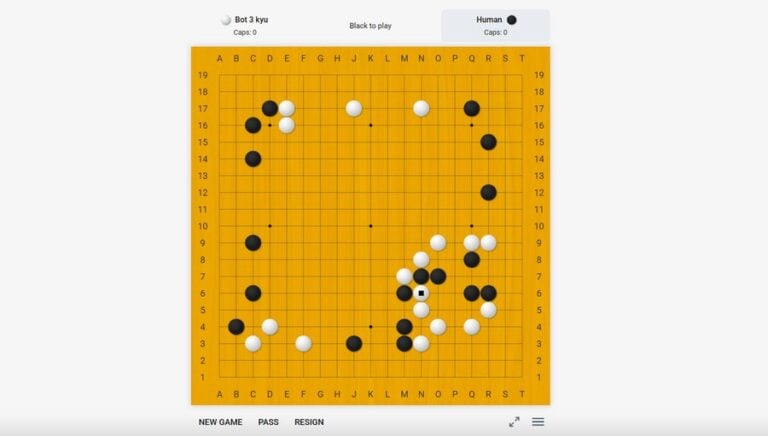
Both games use black and white stones on a grid, both are decided by counting at the end, and in both the corners and edges are worth more than they look. But they run on opposite instincts. In reversi nothing is permanent: a stone can change color again and again until the last move. In Go a stone never changes color and never moves; it stays until it is captured, and you win by the territory your stones surround, not by how many of them there are. If the moment the whole board turns over is what you enjoy, Go’s capturing races will feel familiar — a single liberty decides which group lives. Start with Atari Go, where the first capture wins and the rules take a minute, then learn the rules of Go.