GoLines
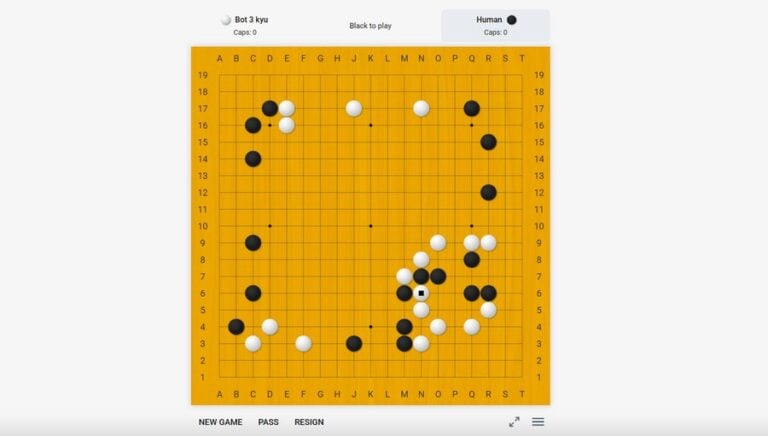
Steer falling clusters of Go stones down the goban — clear lines, capture groups or seal off territory, depending on which mode you pick.
How to Play GoLines
GoLines is a falling-block puzzle played on a Go board eleven columns wide. What falls are not the usual blocks but Go shapes — ten clusters of three to eight stones, the kind of formations you meet on a real board — and you slide and rotate them so they settle where you want. Black and white alternate strictly, so you always know which color comes next.
Three modes decide what clears the board. In Classic, a full horizontal line disappears, and a line built from a single color scores four times as much. In Liberty, the Go rule applies: surround a group of the other color on every side and it is captured and lifted off. In Territory, an empty space sealed off from the open sky scores instead. Whatever comes away, the stones above collapse into the gap — and in Territory a collapse can seal off the next pocket by itself, chain after chain. Your score is shown as a Go rank, and a good run climbs from 30 kyu toward 9 dan.
Controls
On a computer, the left and right arrows (or A and D) move a piece, the up arrow (or W) rotates it, the down arrow (or S) drops it faster and Space drops it at once; P or Esc pauses. On a phone, swipe left or right to move, tap to rotate, drag down for a soft drop and flick down for a hard drop, and tap the score panel to pause. The game also pauses by itself when you switch to another tab. On a phone the board takes the full width of the screen; on a computer the next piece and your score sit in panels beside it.
A Brief History of GoLines
GoLines crosses two traditions that never met. The falling-block puzzle is the young half: the genre was born in 1984, when Soviet researcher Alexey Pajitnov wrote the first line-clearing block game, taking his inspiration from pentomino puzzles. The goban and the stones are the old half — the same equipment used for Go, played across East Asia for more than two thousand years. GoLines takes the falling pieces from one, and the shapes, the ranks and two of its three scoring rules from the other.
Benefits of Playing GoLines
A falling-block puzzle trains thinking that happens faster than words: seeing a shape and knowing at once where it belongs, planning two pieces ahead instead of reacting to the one in front of you. Liberty and Territory add a second layer, because the questions a Go player asks — is this group surrounded, is this space really closed — have to be answered while the next piece is already on its way down.
Tips and Principles for Winning at GoLines
Keep your surface flat — one deep well and one tall tower leave you nowhere to put an awkward shape. Decide where a piece is going before it is halfway down, so you are placing it rather than rescuing it. In Classic, check the color before you commit: one stone of the wrong color turns a four-times line into an ordinary one. In Liberty, use the walls — a group pressed against the edge of the board takes far fewer stones to surround than one in the open. And in Territory, take the small enclosure you can finish now over the large one you may never close.
Questions About GoLines
Do I need to know Go to play?
No. Classic needs no Go at all. Liberty uses one Go rule — a group with no free point next to it is captured — and Territory another — empty space you close off counts for you — and each mode says in one line what it wants before you start.
Which mode should I start with?
Classic, if you have played falling-block puzzles before: the rules are the ones you know, plus the bonus for single-color lines. Then Liberty, which turns every piece into a small capturing problem, and Territory, where one collapse can set off the next.
What do the ranks mean?
They are Go ranks. A Go player starts around 30 kyu and counts down toward 1 kyu, then up through the dan grades. Here your score climbs the same ladder, from 30 kyu to 9 dan, and your best result is kept.
GoLines and Go: Shape, Space, and Efficiency
The stones are not decoration. Go is a game about space — about shapes that work efficiently and waste no moves — and GoLines asks the same question at speed: does this stone earn its place, or open a hole you pay for later? Two of the three modes are Go rules outright, capture and territory, running on a board that never stops moving. Go players call a clumsy shape heavy and a flexible one good shape, and you feel that difference here within a few rounds. If the board itself interests you, try Atari Go, the capture game you can learn in a few minutes, and then learn the rules of Go.