Tic-Tac-Toe
Three in a row wins — Xs against Os, or black against white Go stones, against a bot or a friend.
How to Play Tic-Tac-Toe
The board is a 3×3 grid. Two players take turns marking an empty square, one with X and the other with O, and the first to get three marks in a row — across, down or diagonally — wins. If all nine squares fill up with no line, the game is a draw. Those are all the rules there are, which is why tic-tac-toe is usually the first strategy game anyone learns.
Here you can play with the classic Xs and Os or switch the marks to black and white Go stones. Games run in rounds with a running score of wins and draws: the first round starts with X, and after that the player who starts alternates, so neither side keeps the advantage of the first move. Click or tap a square, or use the number keys 1 to 9, which match the squares in reading order. Undo takes a move back whenever you need it, and the current round and score stay saved until you start a new game.
Play Against the Computer or a Friend
The bot has three levels. Easy plays mostly at random — it finishes a line only some of the time and often forgets to block — so it is a gentle first opponent for a child. Medium always takes a win when it has one and always blocks yours, which is enough to beat anyone who plays carelessly. Hard plays perfectly and never loses: the best you can do against it is a draw, and holding it to one, round after round, is a real test. Play as X, as O, or let the game pick at random.
For two players, choose Two Players and take turns on one phone or computer — the paper-and-pencil game, without the paper.
A Brief History of Tic-Tac-Toe
Three-in-a-row games on a small grid are very old — Roman players are said to have known a version with three pebbles each, terni lapilli — and the pencil game was well established in Britain by the 19th century as noughts and crosses; the American name tic-tac-toe came later. It was also one of the first games a computer ever played: in 1952 A. S. Douglas wrote OXO for the EDSAC computer at Cambridge, and in 1961 Donald Michie built MENACE, a “machine” of 304 matchboxes filled with colored beads that learned the game by being rewarded with extra beads after its wins and draws.
Benefits of Playing Tic-Tac-Toe
Because the game is so small, it is the clearest place to see two ideas that run through every strategy game: blocking and forking. A child learns in a few games that you must stop the other player’s two in a row, and a little later that you can win by making two threats at once. With correct play the game is always a draw, and working out why — there are only 255,168 possible games, few enough to understand completely — is a first lesson in thinking a game through to the end.
Tips and Principles for Winning at Tic-Tac-Toe
Open in the center or a corner: the center is part of four lines, a corner of three, an edge square of only two. If your opponent opens in a corner, take the center — any other reply loses against correct play. If they open in the center, take a corner, never an edge. Always block an opponent’s two in a row before building your own, unless you can win on the spot. And aim for the fork: a move that creates two lines of two at once, so that blocking one leaves the other open — against anyone who blocks, that is the only way to win.
Questions About Tic-Tac-Toe
Can you always win at tic-tac-toe?
No. If both players play correctly, every game is a draw. What you can always do is avoid losing — and against a player who makes one mistake, a fork usually wins.
Can the Hard bot be beaten?
No, it plays perfectly. A draw is the best result against it; against Easy and Medium, wins are there for the taking.
Is there a bigger version?
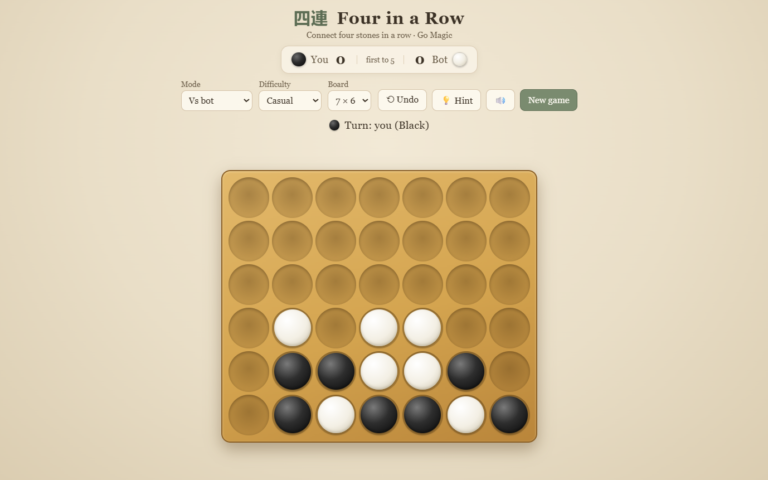
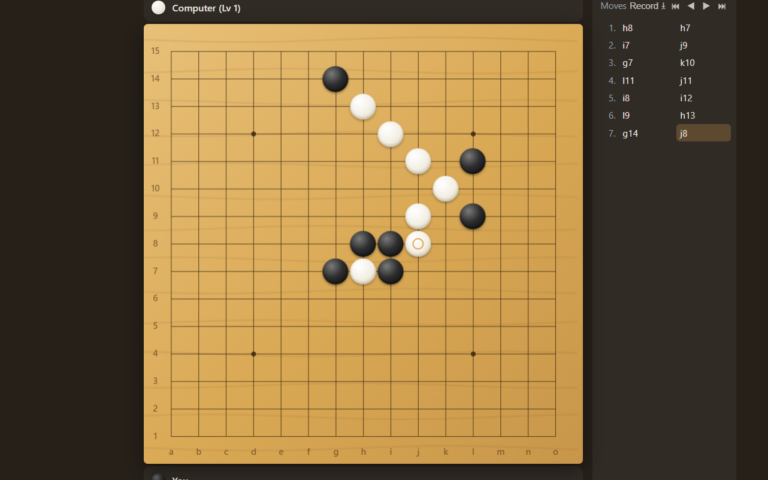
Line-up games grow up quickly. Four in a Row adds gravity and needs four, and gomoku needs five on a whole Go board — both reward planning far more than three squares can.
Tic-Tac-Toe and Go: The Same Stones, a Much Bigger Board
Switch the marks to Go stones and you are holding the equipment of the oldest board game still played in its original form. The distance between the two games shows what makes Go special: tic-tac-toe has a few hundred thousand possible games and a patient child can solve it, while the 19×19 Go board has about 2×10170 legal positions — far more than there are atoms in the observable universe — and nobody has solved it. The fork you learned here survives the trip: Go players call two threats at once miai. To feel the difference in a few minutes, play Atari Go, where the first capture wins, then read the rules of Go.