Sudoku
Fill every row, column and box with the digits 1 to 9, no repeats, using nothing but logic — on a Go board, with the digits on stones.
How to Play Sudoku
Sudoku is played on a 9×9 grid divided into nine 3×3 boxes, with some digits given at the start. Complete it so that every row, every column and every box contains each digit from 1 to 9 exactly once. That is the whole rule. Every puzzle here is generated fresh and has exactly one solution, so you never need to guess and you never run out of puzzles.
Our version is drawn on a goban, so we call it godoku: the digits you are given sit on black stones, everything you add lands on white ones, and a hint shows up in vermilion, so the puzzle you have solved is visible at a glance. Choose one of four board styles — Go Magic, Kaya, Honey or Birch, each a real wood texture — and play with a mouse, a finger or the keyboard: digits to fill a cell, arrows to move, Backspace to erase, N to switch to notes.
Six Levels, Unlimited Puzzles
Six levels run from Beginner through Easy, Medium, Hard and Expert to Demon, and they set both how much you start with and how forgiving the grid is. Mistakes are unlimited at the easiest level and capped at two on the hardest; run out and the game is over. A wrong digit is marked the moment you place it, and a mistake counter, a timer and the number of empty cells stay on screen. Pencil in candidates with notes — placing a correct digit clears it from the notes in its row, column and box — and keep three hints in reserve for when a grid stops moving. On the three easier levels a digit disappears from the number pad once all nine are placed, and when only a few cells are left, Auto-finish fills them in for you.
A Brief History of Sudoku
The mathematical ancestor of sudoku is the Latin square, which Leonhard Euler studied in the 1780s: a grid in which no symbol repeats in any row or column. The puzzle itself appeared as Number Place, designed by Howard Garns, a retired architect from Connersville, Indiana, and published by Dell Magazines in 1979. It found its audience in Japan, where Nikoli introduced it in the magazine Monthly Nikolist in April 1984 and company president Maki Kaji gave it the name sudoku, short for a phrase meaning “the digits must stay single”. Two decades later Wayne Gould brought computer-generated puzzles to The Times, which launched them on 12 November 2004 and set off the worldwide craze.
Benefits of Playing Sudoku
Sudoku is pure deduction, which makes it unusually good at building the habit of proving a move before you play it. Every digit you write should be one you can justify: it goes there because nothing else can. Following a constraint until it forces an answer is exactly what carries over into games — and on Demon, where two mistakes end the run, the habit stops being optional.
Tips and Principles for Solving Sudoku
Scan digit by digit rather than cell by cell: pick a number, look at where it already appears, and find the boxes where only one square is left for it — a hidden single. Work the most constrained units first: the row, column or box with the fewest empty cells is where the next answer usually lives. When a cell has only one candidate left, that is a naked single, and it is safe to fill. Use notes properly — two cells in a unit sharing the same pair of candidates, a naked pair, eliminate that pair everywhere else in the unit. And never guess: every puzzle here has a unique solution, so there is always a next step you can prove.
Questions About Sudoku
Does every puzzle have exactly one solution?
Yes. The generator fills a complete grid and then removes digits only as long as the solution stays unique, so every puzzle can be solved by logic alone.
What happens when I make a mistake?
The wrong digit is marked at once and counts toward the level’s limit — no limit on Beginner, two on Demon. Run out of mistakes and the game ends; start a new puzzle to try again.
How is godoku different from ordinary sudoku?
Only in the looks. The rules are the standard 9×9 sudoku; the grid is drawn as a Go board, and the digits sit on stones.
Sudoku and Go: Reading Before You Place
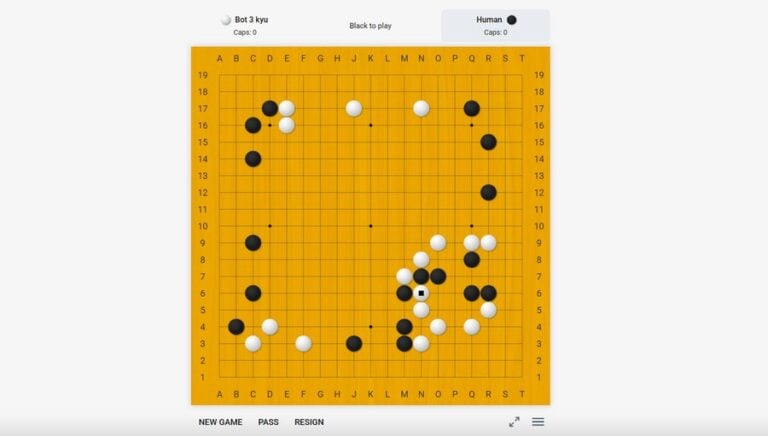
Both are played on a grid of intersecting lines and won by reading rather than reacting. In sudoku you narrow a cell down until only one digit survives; in Go you read out a sequence until only one move works, and every stone changes what is possible around it, just as every digit removes candidates from its unit. The goban you are solving on is the real thing: try Atari Go, where the first capture wins and a game takes a few minutes, or learn the rules of Go and use the board for both.